
Corinne described her first sighting as decidedly unexpected. In 1986, while on Holiday at the Kenyan coast, she and her boyfriend, Marco, had just gotten into an argument because he had almost gotten them caught for trying to buy hashish.
They had also been waiting for what felt like ages to catch the ferry. Hundreds of people, along with wares and animals, were crammed between lines of waiting vehicles to get on to the ferry.
When finally on board, it was Marco, ironically, who pointed out Corinne’s future husband. She likened it to being struck by lightning. In her book, The White Maasai, she described him as “more beautiful than anyone [she had] ever seen.”
He hardly had any clothes on, save for a loincloth and lots of jewellery. His hair was also knotted in red braids. Corinne noted that he had soft features but with significant masculinity.
They encountered each other briefly again later that day, and Corinne developed a fixation with the young Masai. When he was arrested on the beach for defending himself, she was devastated and immediately decided to find out where he was held.
She and her friend Edy went from jail to jail, sometimes offering bribes to get information on new inmates, until they finally found Lketinga. He was stripped of his jewellery and in bad shape, further distressing Corinne.
She went back to the hotel where she and Marco were staying. What followed was a tough conversation about why she was so fixated on the Masai man.
In her book, The White Maasai, she would describe her state of mind at the time, saying, “No well-meant advice has a chance against the force that’s driving me.”
Marco recognised her determination and questioned their future together. This led Corinne to admit that she had plans to move to Kenya permanently.
Planning a New Life in Kenya

Corinne returned to Switzerland and split with Marco. She found a new apartment and began planning a permanent relocation to Kenya.
Her Kenyan friend, Priscilla, also sent her a letter informing her that Lketinga had been released from jail. At this, she wrote him a letter, informing him that she would be returning to the country alone in a few months.
She arrived in Mombasa in July 1987, excited because of the potential reunion with Lketinga. She also returned with her brother, Eric, and his partner. Eric was very sceptical of the relationship upon seeing Lketinga, but Corinne was confident.
Unfortunately, it was not what she envisaged. The language barrier complicated the relationship, leading to a build-up of tension.
Emotional and Cultural Differences

During a slow dance at the disco, emotions were stirred, but the language and cultural gaps remained. Corinne narrated that she felt torn between having a deep desire for Lketinga and doubt that he felt the same way about her.
Corinne also moved in with Priscilla to be closer to Lketinga, against her brother’s concerns. She did describe a slight disconnect regarding intimacy with Lketinga.
According to a 1999 interview with Taz, she explained that her husband did not kiss. This stemmed from community practices surrounding intimacy. “You really have to adjust to that. There are also no points of physical contact. Faces or genitals are not touched.”
Priscilla, her friend, also offered insight into the differences between the cultures, especially regarding masculinity. This was essential given the reduced priority assigned to women in the Masai community.
In the Unz Review of the White Maasai, she told Corinne, “We’re not the same as white people. Go back to Marco. Come to Kenya for the holidays, not to find a partner for life.”
Despite not yet being in the actual bush, Corinne already notices the differences in fetching water and preparing food. These were issues she did not have to think about in the same manner back in Switzerland.
On a night walk with Lketinga, the heat, smells, and atmosphere are a sharp contrast to her life in Switzerland. She felt more attached to Lketinga but was still grappling with the reality of different worlds.
Her astonishment, as voiced in the Unz Review, continued, “All my romantic fantasies of cooking and eating together out in the bush . . . collapse. I can hardly hold back my tears, and Priscilla is looking at me in astonishment. Then she breaks out laughing, which makes me furious . . . .”
Corinne confirms these issues when she met with an interracial couple in Mombasa. She wanted reassurance at the time that a relationship like hers could work. The woman expressed scepticism and shared her struggles in her own marriage, highlighting the various differences in customs and educational levels.
She took it as positive criticism, but was fully committed to a life with Lketinga. There were positive encounters, though, as Corinne once took Lketinga shopping for Western clothes. They differed in taste but eventually managed to buy shoes and jeans. It led to a humorous, yet revealing interaction as they navigated societal expectations.
During her visit, Lketinga asked her if she could truly uproot her life for him. The conversation disappointed her as he emphasised the need to be practical. While this was happening, Corinne was also pursuing the possibility of obtaining a passport for Lketinga.
She returned to Switzerland soon after, hoping to finish the transition. This included finding someone to take over the shop and maximising sales to support her new life in Kenya. She also found a girlfriend to take over the shop, sold her flat, and used the proceeds to fund the trip back to Kenya.
Corinne experienced criticism, though, from friends and Lketinga even about her decision. He said that since she had a good business in Switzerland, she shouldn’t sell it.
His suggestion was that Corinne operate from Switzerland but visit Kenya often every year. According to the Unz Review, she replied, “Lketinga, when I do something, I don’t do it by halves!” On the last day, she sold her car and felt liberated as she headed to the airport.
Corinne arrived at the Africa Sea Lodge from Mombasa in July 1987. She was excited to see Priscilla, but she was also given news that Lketinga had been missing for months. As the days passed, Corinne settled in and enjoyed Priscilla’s hospitality. She also began to experience unwanted attention from other Masai men.
Soon Corinne was introduced to Jutta, a German living in a hut in the same village as Priscilla. Jutta advised Corinne on the basics of living in Mombasa and earning money as a foreigner. Then they both travelled to the Samburu district to find Lketinga.
Eventually, she joyfully reunited with Lketinga. Jutta also helped arrange a private dinner at which Corinne expressed to him her wish to stay in Kenya.
Adjusting to Life with Lketinga

In Barsaloi, Corinne felt a desire for intimacy with Lketinga but was constrained by local gender separations. She also noted unsettling things about her new love interest, such as his liking for miraa, an energy-boosting plant used recreationally by the natives.
Corinne expressed concern for his welfare as they prepared to travel to Nairobi to access her bank accounts and identity documents. They continued on to Mombasa and Priscilla’s village. Lketinga advised on safe practices when travelling through Nairobi as a foreigner. Corinne also felt safe being in his presence.
In Mombasa, Corinne began teaching Lketinga to read and write. They also engaged with tourists, selling handmade items and dancing. The local sales event increased the couple’s business success. However, Corinne was concerned that Lketinga drank beer, which was forbidden for warriors.
One night, Lketinga returned late and accused her of infidelity, according to the rumours being floated around. This devastated her and increased the tensions and misunderstandings between them.
At the time, she also had to deal with visa issues, so she went to Nairobi to file for a visa extension. When she came back, she had learned that he had left for Maralal because he felt betrayed by the Masai community in Mombasa.
She decided to go to Samburu Maralal to seek his family. She got assistance from Tom, a warrior friend of Lketinga’s, to hire a vehicle and went to Barsaloi to meet his mother. In Barsaloi, she met Lketinga, who joyfully welcomed her as his wife.
Corinne observed the cultural struggles and significantly harder living conditions. This included limited access to water for washing, compounded by language barriers. She also observed goat herding and the community’s dependence on food from nearby missions.
The Land Rover, Wedding, and Life in Barsaloi

As she continued to adjust to life in Barsaloi, she earned the respect of Lketinga’s family. Corinne also began to appreciate the complexities of her environment. A few weeks in, she realised the diet was unsustainable for her and caused weight loss.
She also felt the need for a vehicle to improve convenience. Against her mother-in-law’s and Lketinga’s wishes, she secured the funds to purchase a used Land-Rover. On the way back, she drove it through the bush and even encountered a herd of Buffalo on her way to Barsaloi.
Once back in the village, their wedding plans went ahead, though they had to go to the government office. Many locals also showed interest in the Land Rover, and she drove them to the area. They found no fuel available at the station.
Complications arose after they determined Lketinga’s identification card was missing. He also expressed the possibility of taking other wives, which greatly distressed Corinne.
Aside from the red tape, the office also frustrated their efforts with bureaucracy and questioned Corinne’s documentation. This led them to travel to Nairobi to resolve the issue.
Corinne then experienced her first bout with malaria. She felt faint and disoriented before having bouts of fever and vomiting. At one point, Corinne lost consciousness when driving back to Maralal via Isiolo.
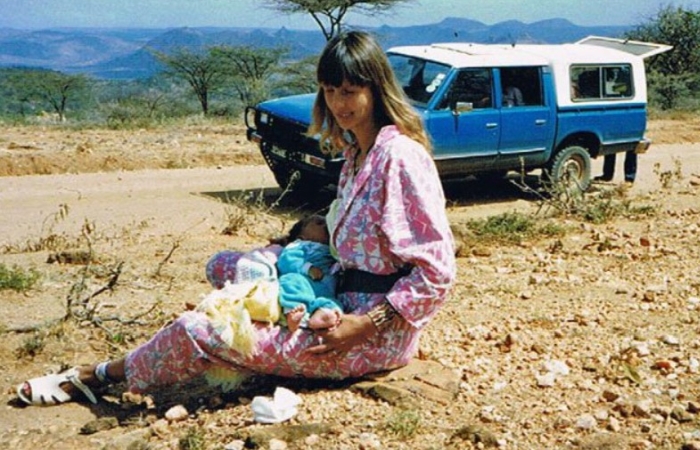
She woke up in the hospital, and the doctors informed her that she had acute malaria, but did not have the proper medication to deal with it. Lketinga tried to provide comfort, but her condition only seemed to get worse.
Jutta visited her, and they determined it would be better to leave the hospital to look for better care. It was only through her resolve that she recovered and continued on to Maralal.
Corinne soon fell pregnant but had to navigate the challenges of carrying a child in the bush. Dangers posed by harsh terrain, flooding, and recurring malaria were ever-present. She eventually gave birth to a girl in 1989 at the Bush Hospital in Wamba.
Over the following months, Corinne was frequently sick despite having to manage their shop in Maralal. She also had to travel to Nairobi to sort vehicle issues, all the while coping with growing resentment from her husband, Lketinga.
Her boldness and practical knowledge meant she had been handling most of the finances. This emasculated her husband. After being diagnosed with Hepatitis, the doctor advised her to return to Switzerland for a few months, if only to regain her strength.
Lketinga’s Accusations of Infidelity
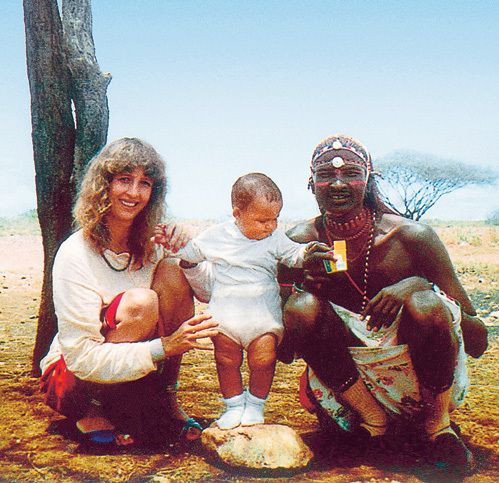
Following a trip to Switzerland with her daughter and back, Corinne was inspired to open a disco in the village to cater to the residents and construction workers building a nearby school.
At first, Lketinga offered full support but was subsequently absent, tending to ceremonies and other social obligations.
This prompted Corinne to go ahead with the plans herself. When it became a success, Lketinga was furious, accusing her of infidelity. He even questioned Napirai’s paternity.
Corinne became deeply frustrated with Lketinga’s drinking and negligence, which jeopardised the business. His jealous behaviour also precluded her from having any time alone. This drove her to start considering leaving him, but with her daughter.
She also feared for her daughter, considering Lketinga was already fielding marriage proposals and discussing plans to circumcise Napirai. Her decision to leave the country saved Corinne immense heartache.
That is not to mention the potential hazards of relying on traditional devices and the dangers of potentially dangerous social interactions. There have been several cases of foreigners going missing in similar austere environments, including Sophia Koetsier, who disappeared while on Holiday in Uganda.
They moved to Mombasa in 1990 in hopes of a fresh start and new business. Unfortunately, the accusations of infidelity only increased. Lketinga did not provide much help setting up the new shop, which only further frustrated Corinne. Eventually, she had had enough and decided to leave for Switzerland.
On the day, she packed essentials for her daughter and handed over the bank cards to Lketinga, promising to return. He was initially sceptical but, in turn, signed the letter granting them permission to leave for Switzerland.
As she got into her vehicle, Corinne penned in her novel, “I climb behind the steering wheel… I drive off immediately without once looking back; it’s a long journey, but it leads to freedom.”
She penned a letter to Lketinga expressing her decision not to return. Corinne reminisced about their love and agreed that their differences were too significant. She also suggested that he marry a traditional Samburu woman rather than a white woman. She offered him her business, shop, and vehicle, then encouraged him to build a future without her.
Lketinga Now and Corinne’s Return Visit to Barsaloi

Corinne opted to visit Barsaloi in 2004, fourteen years after fleeing with her daughter. She was filled with anxiety and unsure about the reaction from the locals, and especially her husband.
The locals who remembered her welcomed her without reservation, a contrast to the strained manner in which she left in 1990. Lketinga himself still regarded her as his ‘number one wife’, despite the years of absence. His demeanour was also much calmer.

She was also well received by Lketinga’s other, who had cared for Corinne and her child during the difficult times. Equally excited to her was James, who had now become a schoolteacher.
Lketinga currently lives in Lulu village. According to the Samburu Light page post, he is a superstar, and everyone knows him as the White Masai. He clarified that the events described in Corinne’s book are true. “She told me about her plans to write down our story. I agreed because I hadn’t done anything wrong.”
For more stories about interesting lives, explore our articles on Tonda Dickerson and Anatoli Bugorski.