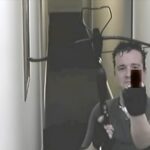


By 1978, 36-year-old Anatoli Bugorski had a solid reputation as a particle physicist at the Institute for High Energy Physics in Protvino, a science town in the former Soviet Union.
His work was focused on the U-70 synchrotron, the largest particle accelerator in the USSR. Bugorski was responsible for operating and maintaining the accelerator, ensuring that all experiments ran smoothly.
Inside the synchrotron’s ring-shaped tunnels, protons are accelerated to almost the speed of light before being directed into experimental targets.
However, equipment malfunctions were common at the time. In such a complex facility, something always needed to be calibrated.
On the morning of July 13, 1978, Bugorski notified the control room to power down the beam so he could fix a malfunction in the machine. He then waited for the automated safety interlocks to engage.
Unbeknownst to Bugorski and his team, the safety interlocks had been bypassed or had failed during a previous test. No one noticed.
There was also a visual warning light that came on, showing that the high-energy beam was firing. On that day, the red warning bulb had burned out.
So, when Bugorski was authorised to move to the channel, he expected the beam to be deactivated. He also noted that since the bulb was off, there was no danger.
To inspect the malfunctioning equipment, he needed to bend forward into the open space between the accelerator vacuum tubes.
He was checking a specific channel on the machine, where the experimental instruments and safety equipment had been housed. Bugorski’s head became lodged in the path of the synchrotron’s proton beam.
Before he could do anything else, Bugorski took a particle beam blast to the head. These were concentrated protons travelling 99% the speed of light with an energy of 76 billion electronvolts.
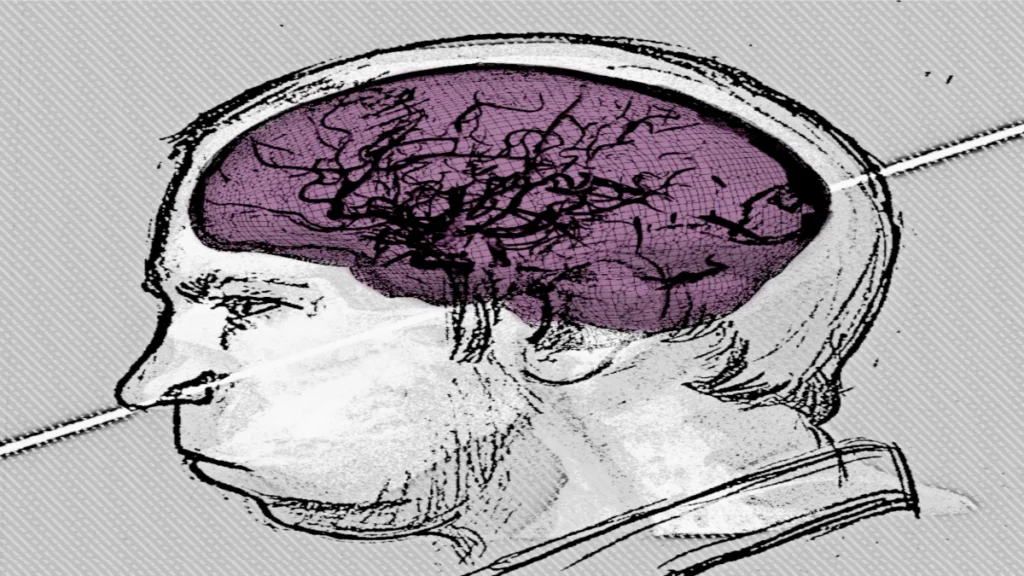
According to his account, he saw a flash brighter than a thousand suns, but there was no pain. The beam went through the back of his skull, the occipital and temporal lobes of his brain, and out via the left side of his nose.
He was effectively hit with 3,000 Gys of radiation. This is equivalent to more than 340,000 roentgen. To place these figures into perspective, the exposed reactor at Chornobyl emitted 15,000 roentgen in its immediate vicinity after the initial explosion.
The dose at Chornobyl was enough to ensure death after a few minutes of exposure. The difference was that it happened in the blink of an eye, and the hit was so localised, it was narrower than a pencil in width.
This was as opposed to other radiation accidents, where the exposure was constant over minutes, hours, days, and years.
Bugorski had absorbed more than 20 times the fatal dose in less time than it took to blink. Then, he finished his work and went home as if nothing had happened.
No one else at the facility noticed what happened. Bugorski stood back up and checked the equipment that he had gone to inspect. He filled out the operations logbook, where he recorded his work on the synchrotron.
As a particle physicist, Bugorski knew what the bright flash of light meant. His head had essentially been bisected by the beam, but he was unsure as to the scale of the damage.
Whether it was shock or typical soviet stoicism, no one knows why he remained silent that day.
Immediate Effects on the Body
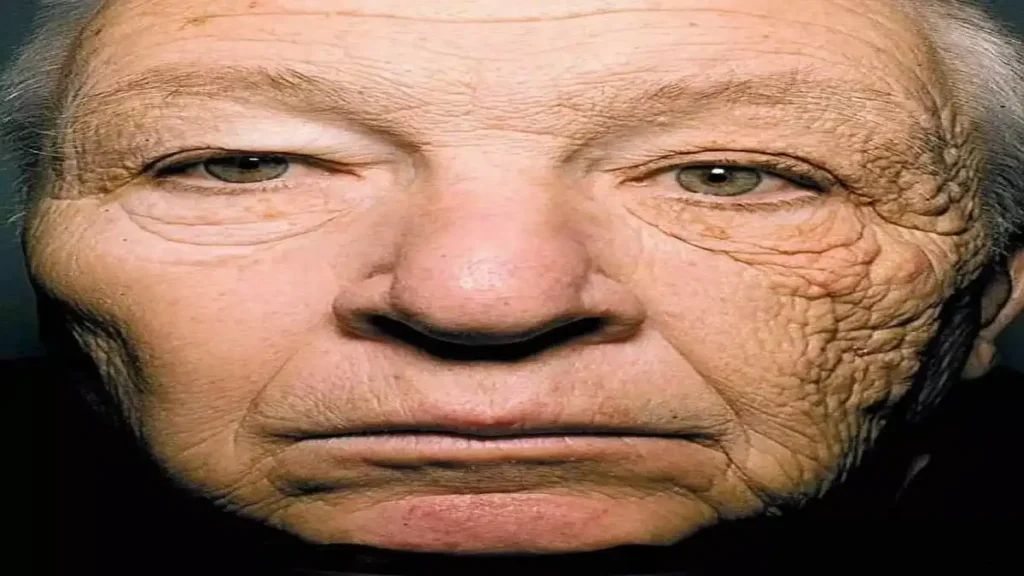
Overnight, it became impossible for Bugorski to ignore what had happened to his body. The left half of his face swelled up beyond recognition. The skin began to peel, showing the path the proton beam took through his face, skull, and brain.
This wound was not a radiation burn, as would be expected. It was a tunnel of destruction that was burned through by something moving so fast that the body was just now realising the damage.
Seeing the swelling and thinking that acute radiation damage had set in at a cellular level, Bugorski sought the help of the facility’s medical team. They rushed him to Hospital Number 6, which is where they handled radiation patients.
Doctors and scientists considered him a dead man walking. Having calculated that the exposure level was actually hundreds of times the fatal threshold, doctors believed Bugorski would eventually experience total nervous system collapse.
However, they had no protocols for dealing with high-energy particle-beam strikes. The facility was tailored to cater to victims of radiation exposure, where the entire body was affected. No one knew what to expect with such a localised hit.
Doctors placed Bugorski in a sterile setting to observe and document what would happen to him before he died. His medical team was led by Dr Angeline Guskova, a pioneer in radiation medicine.
The burns and peeling created a surgical line across Bugorski’s face and neck. For the first time, the doctors could visually see the tunnel the beam had cauterised through his brain and facial tissue.
It appeared that the occipital lobe, which processes vision, and the temporal lobe, which governs sensory input, language, and memory, were directly hit. These sit at the centre of a person’s consciousness. Yet death did not come.
Days went by, then weeks, and the swelling began to subside. Amazingly, the skin healed over the beam’s track through his head. Bugorski, who should have been dead or at least in a vegetative state, was still active, asking questions. He was mostly still himself.
The remaining damage was still very localised. The hearing in his left ear, though, was replaced by ringing.
The left side of Bugorski’s face became paralysed due to the destruction of nerves. Interestingly, as the right side of his face aged over the years, his left remained frozen in time for 36 years.
How Bugorski Survived the Unfathomable
The question that fascinated doctors and scientists alike was how Bugorski stayed alive and why the damage remained contained.
Typical acute radiation, which was seen at Hiroshima, Nagasaki, and Chornobyl, washed the bones, organs and tissue with electron-sized bullets, disrupting function at a cellular level.
The damage is experienced throughout the body simultaneously. This overwhelming attack is what kills the systems.
In Chornobyl, the victims’ full bodies were exposed to high-energy gamma rays. Though in Bugorski’s case, only his head was exposed, and it was in one path through it. So it kept the damage to one single line.
The proton beam was also precise. It passed through Bugorski like a surgical instrument, destroying the tissue along its narrow path. But it left everything on either side intact.
The intensity of the beam that hit him is probably part of the reason he survived in the first place. Luckily for Bugorski, the areas of his brain that the proton beam passed through missed the essential parts.
If it were millimetres in any other direction, the story would have ended differently. For example, if it had gone through the brain stem, he would have died instantly.
Bugorski received a clean bill and was eventually discharged from Hospital No. 6, after the skin healed. He was classified as a medical anomaly.
He was required to return to the hospital at least twice a year, for the rest of his life, for data collection and check-ups.
There was no damage to his intellectual capacity, but Bugorski did develop fatigue in doing mental work. He would eventually suffer occasional seizures in the years that followed. But the ability to reason, engage, or analyse aspects of his field remained the same.
The Government’s Treatment of the Case
In any other country, what happened to the Soviet physicist would have been national news, and the government would have reached out to other scientific authorities for consultation.
The scientific and medical implications of this incident would have led to hundreds of papers and policy amendments in particle research.
However, for more than 10 years, almost no one outside of a few individuals in the soviet government was aware of the full details of Bugorski’s case.
Due to the Soviet Union’s policy pertaining to maintaining secrecy, especially on nuclear energy-related issues, Burgoski was not permitted to speak openly about what happened for ten years.
Soviet Institutional secrecy aimed to quell talk of any incidents, if possible, as such accidents were embarrassing for the government. It also undermined confidence in the state’s competence, a matter of national security.
So the most remarkable medical survival story of the atomic age was locked behind a file number because the state could not afford to look weak.
Finally, in the late 1980s, as general secretary Mikhail Gorbachev loosened some of the information controls, Burgoski began to disclose what happened to him.
During that time, he was still not allowed to travel, and there was no press conference or international announcement. The physicist quietly told the world what had happened.
Life After the Accident
One of the most remarkable themes in Burgoski’s story is not the accident but his experience afterwards. Despite the injuries he got and the potential health issues, Burgoski continued to work as a particle physicist at the institute where he got the accident.
He even took on the role of experiment coordinator for projects involving the same accelerator that almost killed him. It was a refusal to let the worst moment of his life become the defining factor of his existence.
He also continued going to Moscow Hospital No. 6 twice a year for examinations and met with other nuclear accident victims. Bugorski became the silent poster boy for Soviet radiation medicine.
That said, most of the details of his story were paradoxically kept sealed away from the public’s eyes.
The bureaucratic indignity that came with life in post Soviet Russia dealt him another blow. Following the collapse of the soviet union, Bugorski was financially ruined, and he was still not allowed to travel.
He continued to work at the Institute for High Energy Physics, but the facility entered a survival mode. To survive the post soviet economic issues, it was absorbed into the Kurchatov Institute National Research Centre. There was also a shift from discovery-based high-energy physics to applied research.
In 1996, Bugorski unsuccessfully applied for disability status to get free epilepsy medication. This was despite the decades of contributions to Soviet physics and the accidental radiation exposure.
Eventually, Bugorski expressed interest in participating in research by Western scientists, but he was unable to leave Protvino.
This was ironic, considering he was practically one of the most valuable commodities in the scientific community at the time, yet he was unable to reach them because he had no money.
Bugorski did give an interview to Wired in 1997, in which he broke years of silence about the accelerator incident. He also shared about post-Soviet life and a failed attempt to get state disability support.
After working well past the standard retirement age to achieve some stability, Bugorski finally retired as a physics experiment coordinator at 77. He currently lives in Protvino with his wife, aged 83.
Bugorski remains clinically healthy outside of the documented localised facial paralysis, outliving all expectations of his lifespan by four decades.
If you are interested in reading about other tragic radiation accidents or absurd Cold War projects, check out our articles on Hisachi Ouchi and Project West Ford.