

She tied you to a kitchen chair
She broke your throne and cut your hair
And from your lips, she drew the Hallelujah
Fleet Street’s Fever Dream
British tabloids would find the perfect headline in Joyce McKinney in August 1977. To call it absurd would be an understatement; if there was a secret checklist for boosting tabloid sales, McKinney seemed to have ticked every box.
Religion, sex scandals, beauty queens, handcuffs, courtroom drama, escapades in disguises, you name it, and her story had it. Fleet Street could hardly have invented a better story even if it had tried.
To quote Mr. Twain, “Truth is stranger than Fiction, but it is because Fiction is obliged to stick to possibilities; Truth isn’t.”
Joyce McKinney was neither the one-dimensional femme-fatale of the tabloids nor the hopeless romantic she claimed herself to be.
Yet to understand the woman behind the myth, one must leave the now-infamous English cottage and return to North Carolina in 1949, where Joyce McKinney’s story begins.
The Making of Joyce McKinney
Joyce Bernann McKinney was born on August 6, 1949, in the small town of Avery County, North Carolina, to Davis McKinney, principal of the nearby Newland Elementary School, and Maxine McKinney, an English teacher at the same school.
Born when conventional ideas of femininity and orthodox Christianity often went hand in hand, McKinney was drawn to beauty pageants.
Blessed with an unmistakable charisma and striking looks, McKinney would go on to become quite a name in the world of beauty pageants, even winning Miss Wyoming World in 1973, something that the tabloids would later make no effort to hammer upon.
Like any other woman her age, McKinney was searching for purpose in her life, and that search, more than the tabloids cared to admit, led her to the faith and the man who changed her life forever.
“You met me at a very strange time in my life”
By the 1970s, McKinney had ‘reinvented’ herself a hundred times over. After winning Miss Wyoming once, she decided it was time to take her life in a different direction and join the Church of Jesus Christ of Latter-day Saints (i.e., the Mormons).
Having failed to kick off a relationship with Wayne Osmond, her eyes fell upon 20-year-old Kirk Anderson, at a time when apparently she’d been looking for a “clean-cut, all-American boy.”
“I was the ideal modern girl at BYU. I wanted a temple marriage… a marriage for eternity,” she’d mention in the Sarasota Herald-Tribune in 1977.
What followed next seems to have wildly different versions. McKinney stated that she and Kirk had fallen “madly in love” and even went so far as to mention that they’d apparently been engaged to be married.
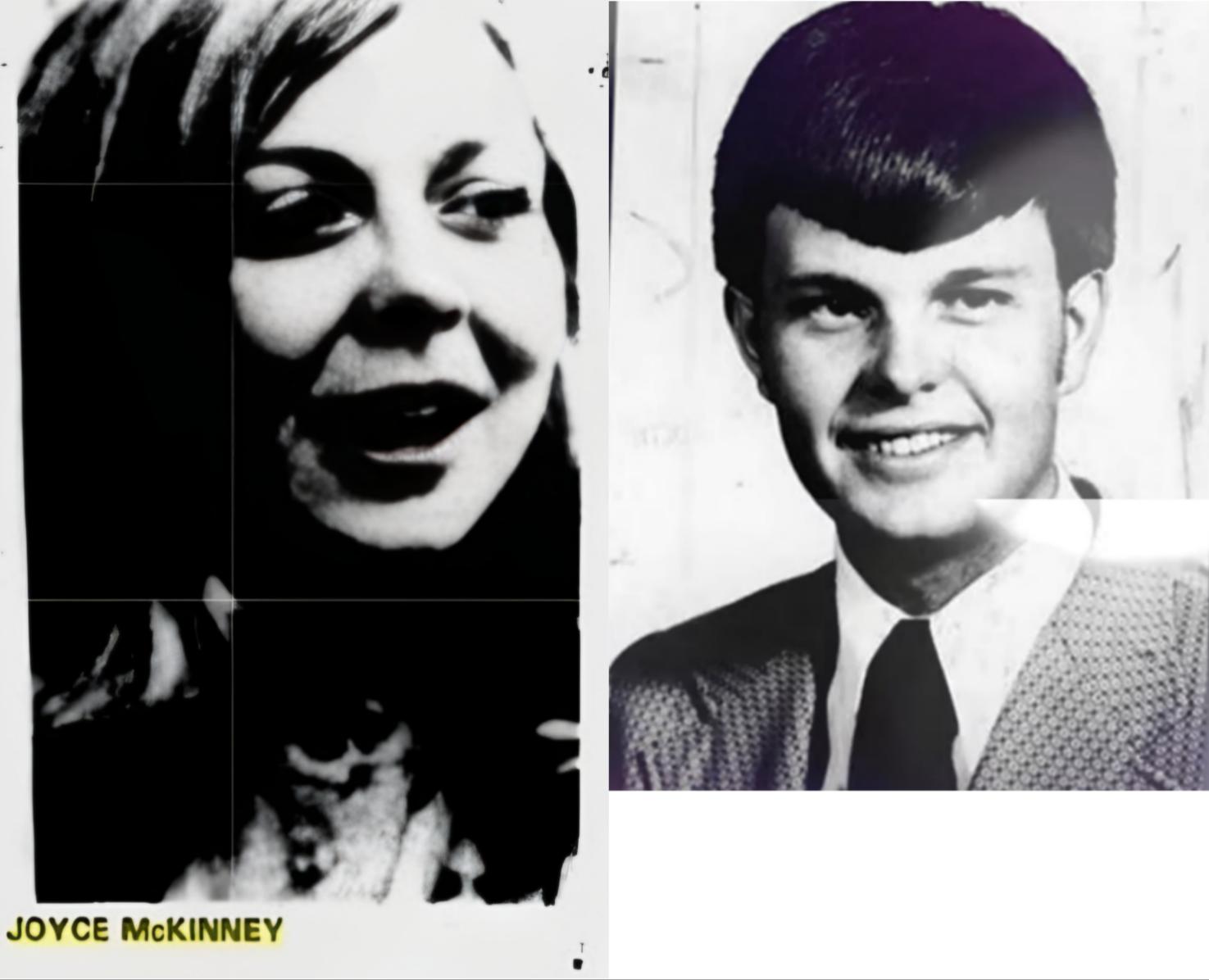
Anderson, however, disputes virtually every aspect of this account, claiming their relationship was far less serious than McKinney portrayed.
Finally deciding he had enough, Kirk requested a posting overseas, in England, as part of his religious mission.
Enraged, she now denounced the Church, declaring it to be “cultish”, and blamed it for having “brainwashed” her “true love”, though she’d once been a convert herself.
A Journey Across the Atlantic
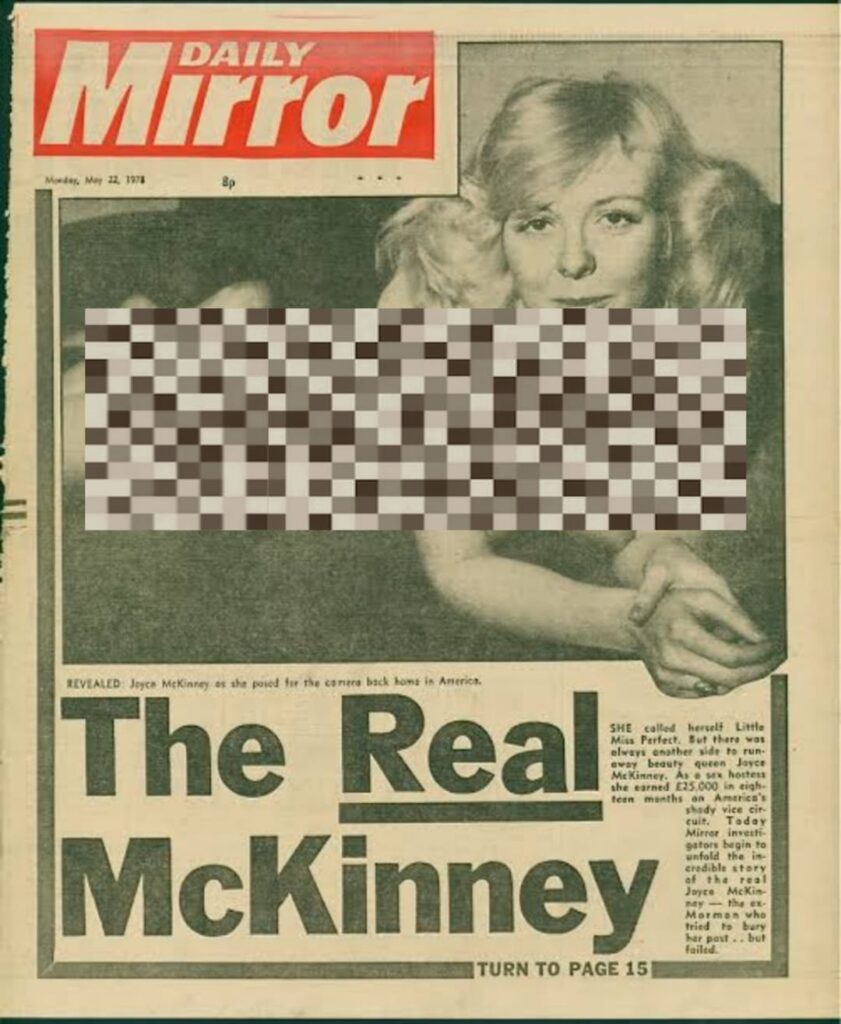
Never one to abandon a cause, McKinney started working as a call girl in California to fund her trip to England (a claim she has consistently denied, though years later the Daily Mirror published photographs of her in compromising positions as apparent evidence).
Whatever the truth, by the summer of 1977 Joyce McKinney had raised the money and hired a private pilot (Jackson Shaw) and a bodyguard (Gil Parker).
Much like Corinne Hofmann, who left a settled life in Switzerland to shift all the way to Kenya and marry her true love, Joyce McKinney and her friend Keith “K.J.” May set out on an ambitious journey to the other side of the pond, with their band of merry men.
“Abandon Ship!”
In England, McKinney would reveal her arsenal (quite a literal one) of handcuffs, chloroform and a fake handgun, which obviously put off both Shaw and Parker, promptly causing them to return to the US, suspecting that they could have been accessories to a possible crime.
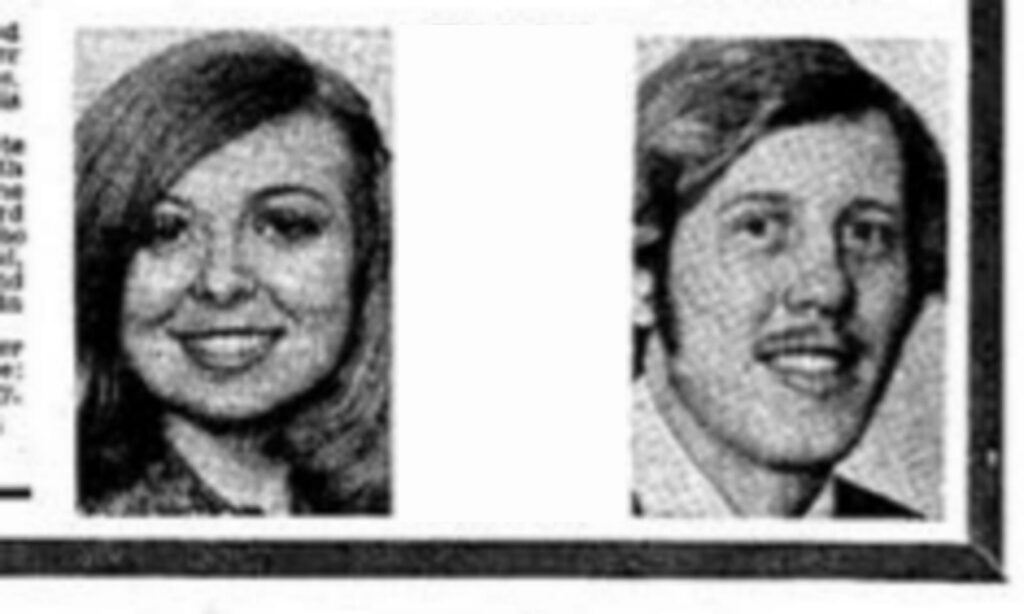
Having already hired a private detective in the US to track Kirk down, McKinney had no trouble contacting him and somehow persuading him to come meet her.
At this point, however, both their accounts seem to diverge, with Kirk claiming that he’s been forced to board a car by being held at gunpoint, while McKinney staunchly maintains that Kirk accompanied her voluntarily.
Whatever the truth may have been, the surprise in the English countryside cottage was not at all pleasant for Kirk.
“Forever’s Gonna Start Tonight”
Apparently, Kirk was chained to the bed by May and McKinney, after which McKinney continued to rape Kirk, reportedly insisting that she’d do so until she became pregnant with his child.
Interestingly, she apparently did not really realize where the problem in her actions lay. Speaking to several newspapers, she revealed that she’d actually chanced upon this particular idea from a sex therapy book.
“I thought, ‘Wham’, that book was right after all,” she told in a BBC interview. Further revealing that she never intended to hurt Kirk, she mentioned that she’d specifically used fur-lined handcuffs to tie him to the bed.
“… but the specialist shop I went to did not have any [mink-lined handcuffs], so I bought a pair just lined in fur. You see, I didn’t really want to hurt him,” she said.
When Yes Means No
After three days of this arduous torture, Kirk Anderson finally agreed to marry his torturer, not finding any alternatives. Thus, Kirk, May and McKinney finally returned to London on the 17th September, 1977. On the 14th, Kirk had already been reported missing.
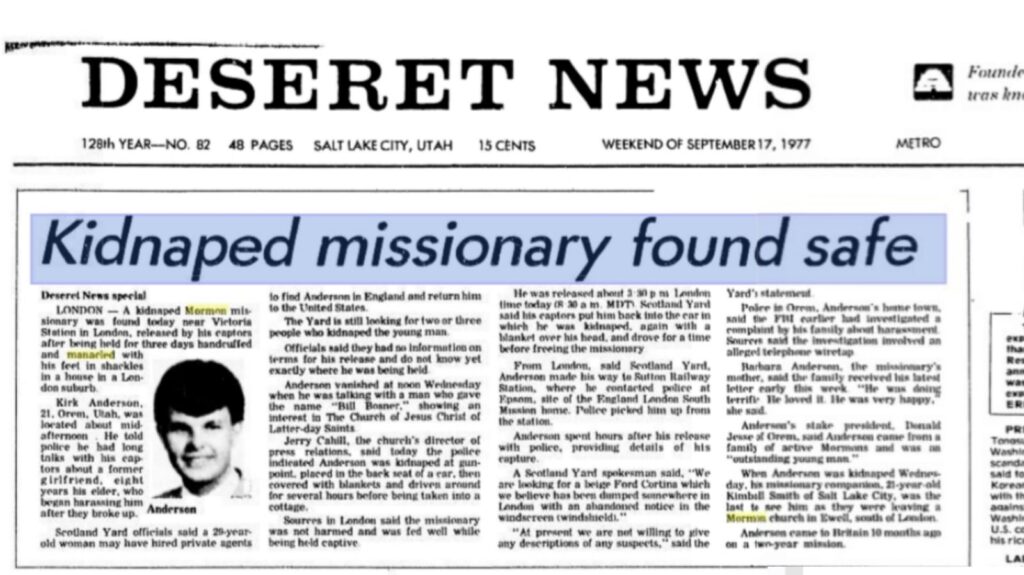
After somehow coaxing McKinney into letting him go to the police station and report that he was ‘safe’, Kirk fled from May and McKinney. Official police records note that Kirk had gone directly to the police and reported his abduction and assault.
However, McKinney maintains that this too was an ‘evil’ ploy of the Mormon church, which had apparently threatened Kirk with excommunication if he did not comply.
“Anything I did was with his (Anderson’s) consent. Kirk is so afraid that the church of his is going to excommunicate him; he just made all that up”, she declared, pasting this handwritten message onto a glass window, while being transported in a police van.
The Making of a Sensation
McKinney and May would be arrested just two days later, in a police sting operation when they’d agreed to meet Kirk at a mutually agreed spot. Though there were no laws for sexual crimes committed by women against men at the time, both were charged with sexual indecency, possession of a replica firearm, and abduction.
Kirk’s chains had been removed, but the media circus had just begun.
Far from shying away from the press, McKinney actually embraced her publicity, arriving at the court impeccably dressed day after day, smiling for photographers, giving impromptu interviews, and even offering her own dramatic retelling of the events. To the tabloids, she was simply irresistible.
At a pre-trial hearing, McKinney would deliver quite a colorful statement professing her love for Anderson and detailing their sexual escapades, insisting he had come with her willingly and their intercourse had, in fact, been consensual, and that the charges against her were the product of a vast Mormon conspiracy determined to silence their relationship.
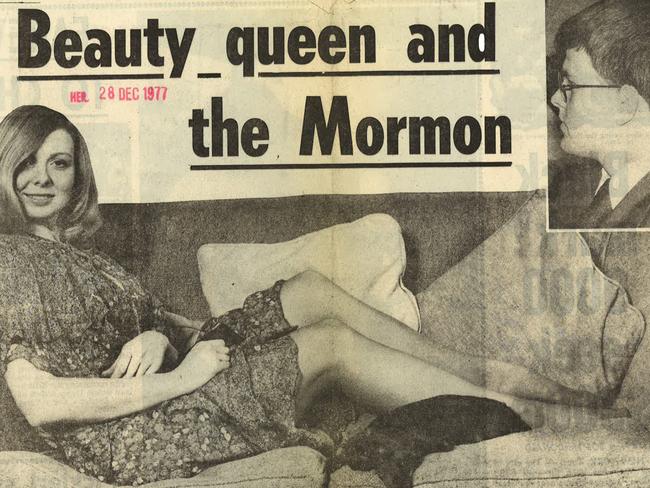
Not one to shy away from hyperbole either, she’d go on to mention that she once loved Anderson so much she “would have skied down Mount Everest in the nude with a carnation up my nose” if he had asked her to.
Surprisingly, though, the legal battle between the two narratives would soon become secondary to the battle of narratives that would make rounds across the front pages of every major newspaper in the country.
Across the Pond, Again
Yet, for all the column inches that the case generated, Britain was deprived of the grand courtroom finale it had anticipated.
McKinney had been jailed in Holloway Prison for three months, and when she was released on bail, the media made no effort to cozy up to her. She’d go on to attend the premieres of Saturday Night Fever and The Stud.
However, a few weeks before their kidnapping trial was scheduled to begin, May and McKinney would make their way across the pond to Canada on 12 April 1978 using various ‘outlandish’ disguises and fake identities, posing as deaf and mute.
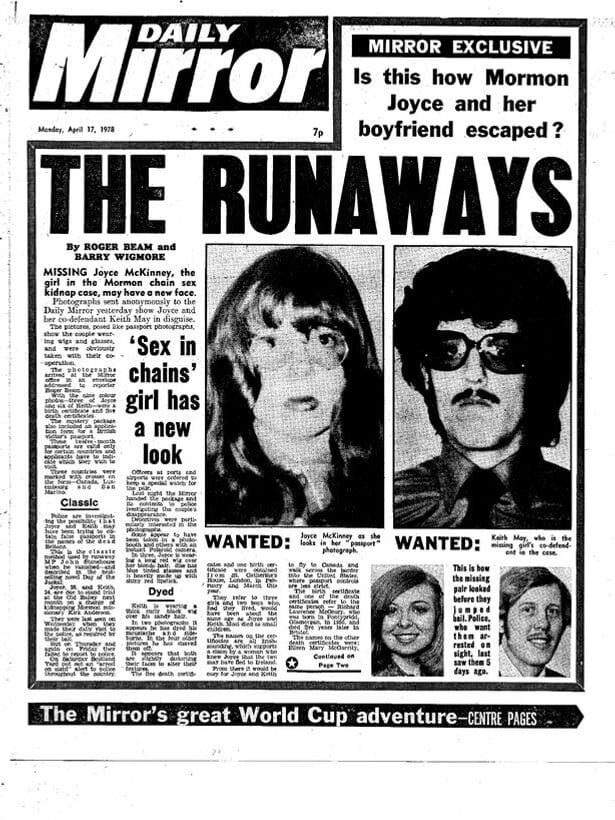
“Joyce’s main piece of bulging luggage, which contained a Chinese laundry of wigs, dresses, saris, suits, nuns’ habits, books. And theatrical makeup was the biggest and heaviest I have ever seen,” an acquaintance would note.
However, the British authorities made no attempt to extradite her, though London’s Central Criminal Court sentenced McKinney and May in absentia to a year in prison for skipping bail (if their bail money, £1,000 each, was not paid to the court as a forfeiture).
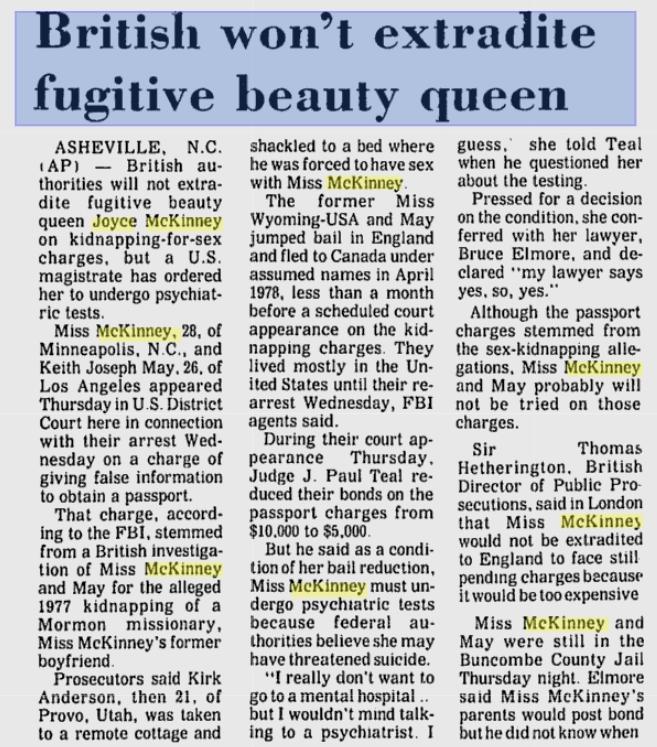
The question remained, however, as to who would bell the metaphorical cat. With McKinney safely back on American soil, the sentence was little more than ink on paper, meant for defendants already an Ocean away.
Back in the Land of the Free
A Greyhound bus driver would testify that he saw May and McKinney on his bus as they entered the United States in Buffalo, New York, presumably from Toronto, on an Air Canada flight from Ireland via Montreal.
“They sat quietly throughout the journey, but looked very happy once we were in the United States,” the driver would note.
More than a year after this escapade, May and McKinney would be arrested by the FBI on 18th July, 1979, near Asheville, on charges of obtaining a passport under false pretenses.
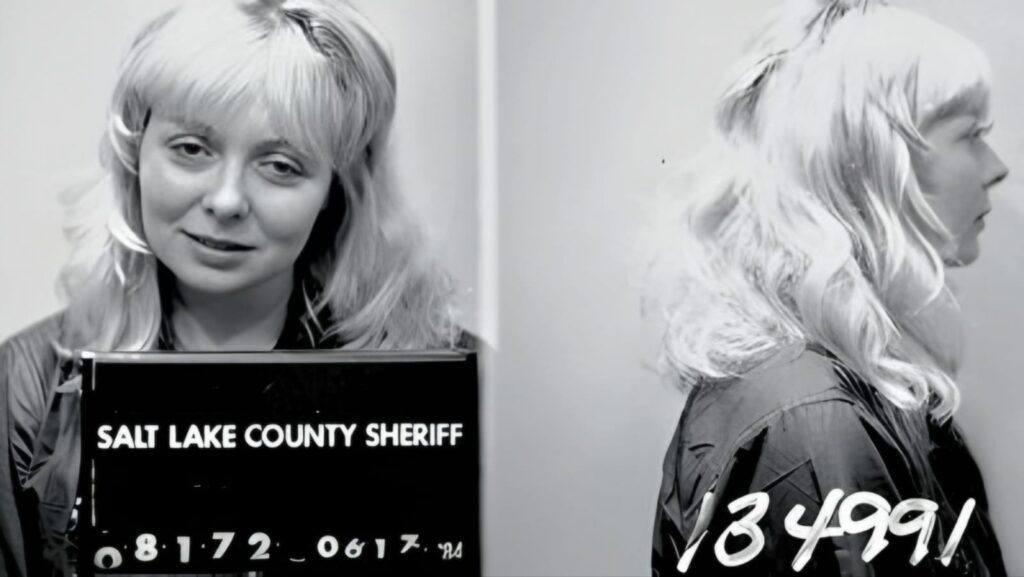
Their attorney then told the media they would plead guilty as charged, with McKinney having applied under the name ‘Cathy Vaughn’.
Loose Ends
The outcome was rather anticlimactic again. Both received one year of unsupervised probation and were fined $500 each, with the judge ordering them to surrender their fraudulently obtained passports.
No prison sentence was imposed, and contemporary reports noted the judge treated the matter as a passport-fraud case rather than examining the underlying British allegations.
Interestingly, in 1984, McKinney was arrested again after Kirk Anderson spotted her hanging around his workplace near Salt Lake City.
Upon searching the boot of her car, police found a length of rope, a pair of handcuffs, and a notebook detailing the now-married Anderson’s movements.
McKinney failed to appear for a subsequent court hearing in Utah, and the case was dropped. Since then, Kirk Anderson has kept a low profile, but reportedly went on to work as a real estate agent.
Not Quite the End
Had this been fiction, I’d have happily shaken your hand right here and called it a day. The villain had escaped, the lovers had parted, and the tabloids had squeezed every last drop of ink from this ugly affair.
In fact, it would’ve been a perfectly respectable ending given the light of things. Unfortunately (perhaps fortunately for those of us with a taste for the absurd), this is Joyce McKinney we’re talking about.
In 2008, four years after Keith May died, almost 30 years after that infamous menaced Mormon fiasco, Joyce McKinney once again made the front pages around the world.
This time, too, it would be for matters of love, but not towards Kirk Anderson.
Just when I thought I was out, they pull me back in!
On the receiving end this time was McKinney’s 5-year-old pit bull, Booger, who had died in 2006 after an arduous battle with cancer. What would likely be a moment of profound grief for most pet owners marked the start of yet another crusade for McKinney.
Refusing to accept Booger’s death as the final word, McKinney traveled to South Korea and paid more than $150,000 to have him cloned by the laboratory of the controversial scientist Hwang Woo-suk.
The procedure ultimately produced five genetically identical puppies, whom McKinney regarded simply as continuations of Booger.
Naturally, the world media descended on this feat with unmistakable frenzy.
The coverage of this fiasco, too, was predictably split. To some, this felt like the eccentricity of a woman who seemed constitutionally incapable of avoiding the bizarre, while others empathized with her grief and praised her determination to reunite with a beloved companion.
Commenting upon the dissent, McKinney would say, “I thought people would be honest enough to see me as a person who was trying to do something good and not as a celebrity,” clearly still not out of the trance she’d once claimed to be in.
More, or Mere Madness?
If you were to actually zoom out the lens from this woman for the moment, a curious pattern seems to emerge.
Throughout her life, Joyce McKinney displayed an extraordinary inability, or perhaps an extraordinary refusal, to accept loss in any form whatsoever. Be it an estranged lover or a dead pet, she had somehow gotten her way.
It is tempting to dismiss her as merely evil, delusional, or manipulative, or even to don rose-tinted glasses and call her a ‘hopeless romantic’ (I wonder if I could’ve written this if the roles were reversed).
But if one were to think for a while, they’d understand that McKinney was neither actually. Every attempt to define her was eventually contradicted by the next improbable turn in her life, and perhaps that is why one can still write about her today.
Making Sense of Joyce
In 2010, filmmaker Errol Morris tried to answer that very question with the documentary Tabloid, and although it has its moments, the broader picture it paints is hardly rose-tinted.
McKinney, then 61, seemed to possess that same characteristic overenthusiasm that had made her a media spectacle so many years back.

Even after three decades, she remained as captivating and as contradictory as she was in 1977.
Kirk Anderson, in contrast, wanted none of it.
After years of insisting that he had been abducted and assaulted, he gradually withdrew from the public eye altogether, obviously burdened by the weight of his words being weighed against a former Miss Wyoming, a woman who had not left any attempt to remind the world of her antics.
The Cost of a Headline
I started this article with Mr. Twain, and I can’t think of a better place to leave you than with him.
Truth is stranger than fiction, and if I had written this, I’d have given Kirk his ordinary life back on page one. Instead, the most traumatic phase of his life would be nothing more than juicy gossip in the tabloids.
In an era where sexual violence against men was almost unheard of, Kirk found himself not only defending his account of the events but his very victimhood.
But strangely, if you’ve remembered Joyce McKinney more vividly than Kirk Anderson by the time you’ve reached this line (which you perhaps have), then perhaps the tabloids won after all.
The evil that men do lives after them; The good is oft interred with their bones.” William Shakespeare, Julius Caesar
If you enjoy reading about intriguing people across the world, our articles on Leonard Dirickson and Kim Ung-Yong will definitely intrigue you.