
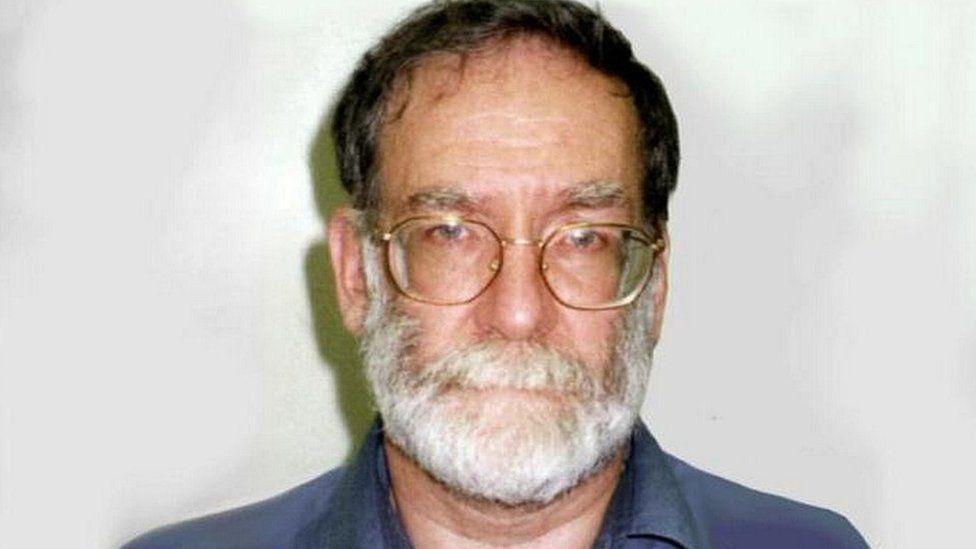
The will left Kathleen Grundy’s entire estate to the doctor who had signed her death certificate. Her daughter, Angela Woodruff, was a solicitor who handled her mother’s affairs. Now another firm was telling her that Grundy had supposedly left her estate to Harold Shipman. He stood to inherit about £386,000.
Woodruff could not reconcile the document with the woman who supposedly signed it. Even its appearance was wrong.
“It was badly typed, and my mother was meticulously tidy,” she later told the court.
Grundy lived alone in Hyde, near Manchester, but kept busy with friends, gardening and charity work. She was devoted to her family. At 81, she still volunteered at a day center for older people, and when she failed to arrive there on June 24, 1998, two colleagues went to her house. They found her fully dressed on the sofa, dead.
Shipman had visited that morning, supposedly to take a blood sample for research into aging. When called back, he pronounced her dead and subsequently certified the cause as old age. The new will claimed that her family did not need the money and that she wanted to reward her doctor for his care.
Woodruff went to the police. She was asking them to consider that the man entrusted with her mother’s health had forged her signature and might have killed her. Her profession helped make the allegation credible. “Once they knew that I was a lawyer, it became much easier,” she told the BBC in 2000.
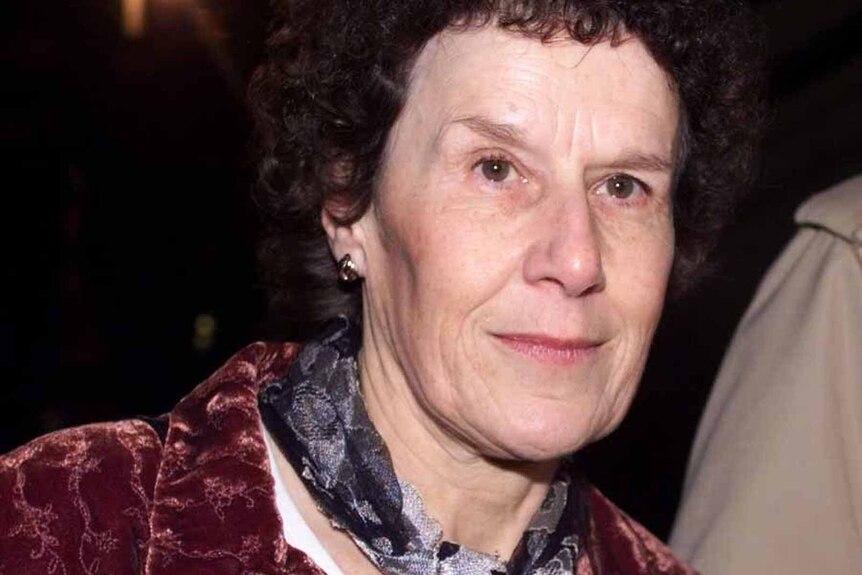
For more than twenty years, Shipman had built a reputation as a dependable family doctor. Patients appreciated his readiness to visit them at home and the attention he gave them. With older patients, he could be warm and gently teasing, making them feel that they were seeing a friend as well as a physician. Grundy had trusted him too.
His arrival in Hyde in 1977 followed a serious breach of trust elsewhere. At his first general practice in Todmorden, West Yorkshire, he became addicted to pethidine, an opioid painkiller, and obtained it dishonestly. He underwent treatment and was convicted of drug offenses in 1976. During that period, he gave a written undertaking that he did not intend to return to general practice.
The General Medical Council did not prevent his return. A psychiatrist had advised that excluding him from practice would be “catastrophic.” By 1977, he was seeing patients again. Fifteen years later, he left his Hyde group practice and opened his own practice.
Working alone gave him greater freedom, though his killings began long before that move. A familiar visit could end with a lethal injection of diamorphine, a powerful opioid used in medical care. Sometimes he said a patient died while he was there. Sometimes he left, and someone else discovered the body. He supplied an explanation, signed the death certificate and, when necessary, invented an illness to make the death seem unsurprising.

He acquired the drugs through fraudulent prescriptions and by taking unused supplies from patients or their families. There was no effective system for following what happened to those drugs after they were dispensed. He kept no controlled-drugs register and claimed that he did not carry opioids.
The paperwork could look reassuring precisely because he had written it. A second doctor was required to check a proposed cremation, but the inquiry later found that these checks were often cursory. An independent safeguard had become something colleagues did largely on one another’s word.
By early 1998, however, a funeral director was having trouble accepting the pattern. Deborah Bambroffe, who worked in her family’s undertaking business, saw how patients were found as well as what appeared on their certificates. Shipman’s patients were often fully dressed, sitting in chairs, without the equipment or surroundings associated with prolonged illness.
In February, when Dr Susan Booth came to complete cremation paperwork, Bambroffe told her what she had noticed. Booth discussed it with colleagues at her practice. One of them, Dr Linda Reynolds, contacted the coroner on March 24. Their concern reached the police.
These women were in a position to see deaths collectively. A daughter might lose one mother and accept the doctor’s explanation. A funeral director or neighbouring practice encountered the next death, and the next. Yet making that pattern convincing to investigators proved much harder than noticing it.
The detective who spoke to Bambroffe spent only about ten or fifteen minutes with her. He did not properly explore the details she could provide or examine the firm’s records. Two bodies were still available for post-mortem examination during the investigation, but neither was examined before cremation.
Police closed the investigation on April 17. Shipman went on to kill Winifred Mellor, Joan Melia and Kathleen Grundy.
Years later, Dame Janet Smith, the judge leading the public inquiry into Shipman, found the investigation seriously deficient and its senior officers unsuited to the task. A competent investigation could have saved those last three victims.
Woodruff’s complaint reopened a question the authorities had already put aside. This time, the suspect had left evidence outside the medical records he controlled. The will made a specific, testable claim about what Grundy wanted, and her daughter believed it was wrong.
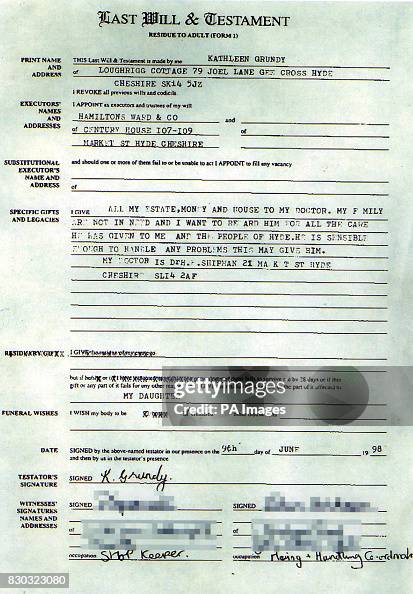
Police traced the typing to a machine from Shipman’s surgery. His fingerprint was on the document. The supposed generosity of an elderly patient became a forgery inquiry with a dead woman at its centre.
The inquiry later reconstructed how he obtained the signatures he copied. On June 9, he persuaded Grundy to sign what she understood to be paperwork for university research into ageing. He brought two patients from his waiting room to witness her signature. Their names then appeared as witnesses on the will. The same supposed research gave him a reason to arrange an early-morning blood sample at Grundy’s home. What she understood as helping a medical study had supplied him with both signatures and access.
Grundy had been buried. On August 1, 1998, investigators exhumed her body. Toxicological testing found morphine at a level consistent with a fatal dose. The doctor’s diagnosis of old age could no longer account for what they had found.
Investigators went on to examine other deaths. Nine bodies in the eventual prosecution were exhumed; six other women whose deaths became murder charges had been cremated. Police had to reconstruct their last hours through relatives, witnesses and medical records, including records that Shipman had altered.
His computer preserved an audit trail of changes. An entry could be made to look as though it described an earlier consultation, but the system recorded when it was actually entered. The distinction exposed histories of illness created after patients died.
One set of changes concerned Bianka Pomfret, who was 49. After visiting her on December 10, 1997, Shipman made three backdated entries about chest pains. He was called back that evening, when she was dead. Her records appeared to supply a history explaining her death, but those entries had been made on the day it happened.
At his trial in Preston, Shipman acknowledged backdating some records but presented it as ordinary clinical housekeeping. He said doctors needed complete histories for referrals and to review treatments. He also said he knew the computer had an audit trail. Asked about Pomfret, he described her as a difficult patient and said he had been upset that she did not trust him enough to tell him about her chest pains.
When questioned about Grundy, he offered a different account of the woman her family knew. He suggested that she had been abusing drugs. His suspicions, he said, appeared in the computer only after her death because the pressures of running a small practice delayed his record-keeping.
He also explained what happened to the blood he supposedly took that morning. He told the court that the samples became covered by letters and magazines in his consulting room, were overlooked and eventually thrown away. Earlier, he told police he sent them to a laboratory.
As for the death certificate, he said, “I thought old age might cover it.”
Grundy, he claimed, had borrowed his typewriter. In the witness box, he folded a sheet of paper into three and pushed it across the ledge to demonstrate how his fingerprints might have reached the will.
The active widow who worked for other pensioners was being presented as a woman concealing a drug problem. Her medical notes appeared to support that version, until their dates were checked.
Shipman repeatedly denied injecting his patients. The fifteen women in the prosecution ranged in age from 49 to 81. The prosecution accused him of enjoying control over life and death, but he offered no admission and no account that would explain why he had done it.
“I was not aware I had got away with anything,” he told the court.
In January 2000, the jury convicted him of murdering fifteen women and forging Grundy’s will. He received life sentences. The criminal trial established those murders, but it could not answer the question facing the many other families whose relatives had died in his care.
The public inquiry went back through his career, including his years as a junior hospital doctor. Its work required separating murder from natural death in cases where records were incomplete and the doctor’s own account was often the very thing under suspicion.
By its final report in 2005, Smith had positively identified 218 victims and estimated that the total was about 250, across the years 1971 to 1998. In other cases, the surviving evidence would not allow her to reach a definite conclusion.
The will explained how Shipman was caught, but it did not explain the decades of killing that preceded it. Financial gain could not account for the wider pattern. Nor had he confined himself to patients already dying. The inquiry considered whether killing had become compulsive and whether he sought the power it gave him, but his motives remained unresolved.
He refused to cooperate with the inquiry and died by suicide in prison in January 2004.
For Woodruff, exposing the murderer also meant defending the record of her mother’s life. After the conviction, she contacted the coroner to ask whether the official register could be corrected. It still mattered what anyone looking up Kathleen Grundy would be told about her death.
She discovered that the entry had already been changed, without her knowledge, in January 1999. The coroner had followed the usual procedure and passed on the pathologist’s finding. In place of “old age,” the register now said “overdose of morphine.”
Nothing indicated that somebody else had administered it. Woodruff worried that future generations of her family would read the entry and wonder whether their ancestor had been a heroin addict.
For more unsettling mysteries, read about the woman who returned alive 11 years after disappearing and being declared dead, or the teenager whose body was discovered inside a chimney after a seven-year search in Colorado.