


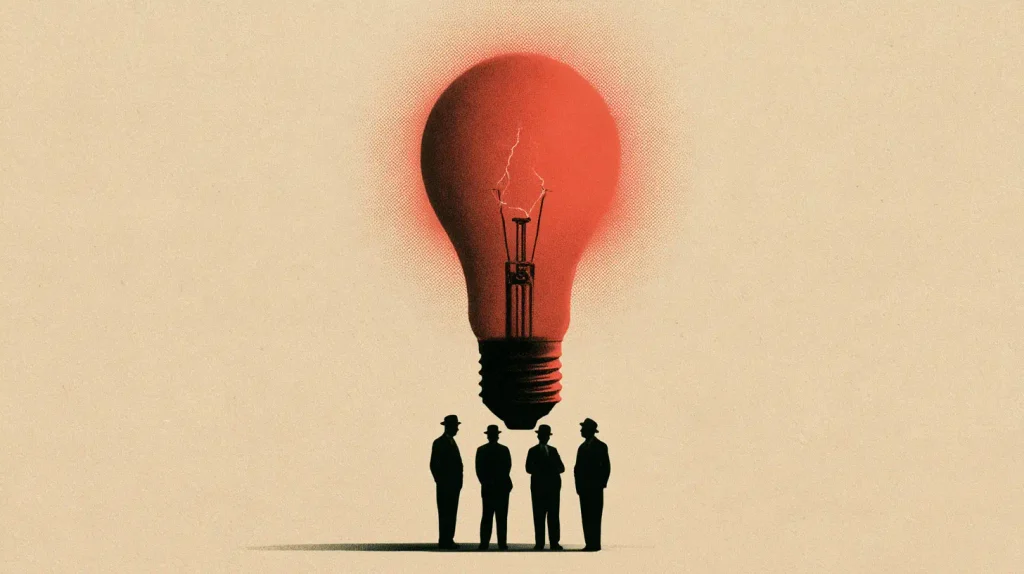
People of the same trade seldom meet together, even for merriment and diversion, but the conversation ends in a conspiracy against the public, or in some contrivance to raise prices.
– Adam Smith, The Wealth of Nations, Book I, Chapter X.
“We don’t build things today to last,” retired fire deputy chief Tom Bramell said in a New Yorker interview, speaking in a way for almost all of us. Put plainly, this is because “owning things longer hurts the economy” and, in many cases, the company’s coffers.
These ‘things’ or commodities seem to encapsulate almost all aspects of our everyday life. For instance, consider the humble light bulb; one might begin to question its longevity. New Yorker’s ‘The LED Quandary’ article notes that a ‘typical drugstore incandescent bulb’ lasts only for approximately 1000 hours.
Historically, though, many lightbulbs have glowed for unnaturally long durations, with the longest being the Centennial Lightbulb in California. So why exactly do modern lightbulbs face this ‘quandary’ of depleting in an almost clockwork manner when a fixed time span ends?
There is a Light that Never Goes Out
When Thomas Edison first demonstrated his commercially viable incandescent light bulb in 1879, he could scarcely have imagined the strange problem its manufacturers would face.
As filament materials and bulb design improved, the bulb’s longevity increased manifold. But a bulb that lasted longer required fewer replacements and generated less profit for its manufacturers.
Being a light bulb manufacturer in the 1920s wasn’t easy, even with the rapid electrification of roads, houses, vehicles, and other appliances. Demand for light bulbs was growing. But no company could occupy a sizable portion of the market, mainly because competition grew over time.
According to the Rexburg Standard Journal, researcher Markus Krajewski noted that German manufacturer Osram saw a sharp drop in sales, from 63 million lightbulbs in the 1922 fiscal year to 28 million the following year.
Whether this tension alone explains what happened next is also contested. Still, in 1924, some of the world’s largest lighting manufacturers gathered in Geneva to establish what would become known as the ‘Phoebus cartel’. The cartel named its Swiss-incorporated entity Phœbus S.A. Compagnie Industrielle pour le Développement de l’Éclairage, ironically after Apollo, the Greek god of radiance and light.
Incidentally, this cartel shouldn’t exactly be new to many of you either. Those of you who have read Thomas Pynchon’s 1973 cult classic novel, Gravity’s Rainbow, might remember the immortal light bulb named ‘Byron’ who becomes the unlikely target of this Phoebus cartel.
Having outlived his prescribed lifespan, Byron finds himself pursued by the cartel’s agents, who are determined to end his inconvenient longevity.
But these devious members of the ‘Committee on Incandescent Anomalies’ weren’t totally a work of fiction, with many parts of Pynchon’s tale indeed based on fact.
The Phoebus Cartel
IEEE Spectrum reported that, seemingly, the ‘innocuous’ agreement between the major light bulb manufacturers across the world was titled ‘Convention for the Development and Progress of the International Incandescent Electric Lamp Industry’.
According to that document, the organization’s chief goals were “securing the cooperation of all parties to the agreement, ensuring the advantageous exploitation of their manufacturing capabilities in the production of lamps, ensuring and maintaining a uniformly high quality, increasing the effectiveness of electric lighting and increasing light use to the advantage of the consumer.”
Members included Germany’s Osram, Hungary’s Tungsram, the United Kingdom’s Associated Electrical Industries, Italy’s Società Edison Clerici, France’s Compagnie des Lampes, and Japan’s Tokyo Electric.
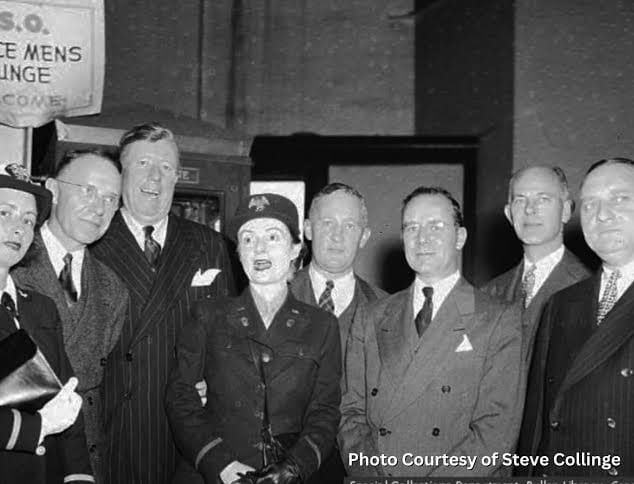
The US company General Electric was represented by its British subsidiary, International General Electric, and by the Overseas Group, which included its subsidiaries in Brazil, China, and Mexico.
How the 1000-Hour Lightbulb Worked
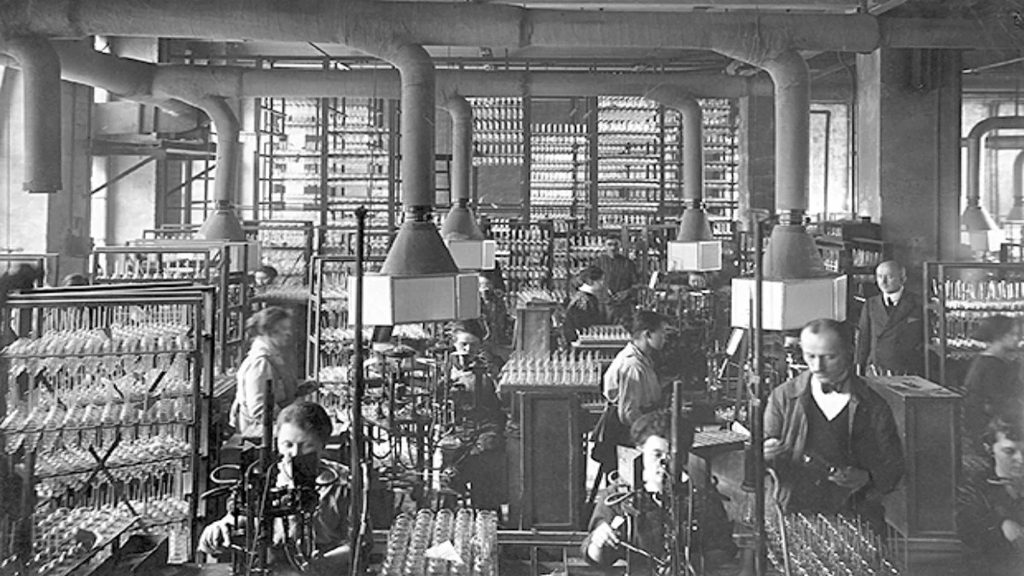
By the 1920s, the bulbs’ lifespans had reached a point where they were causing what one senior member of the group described as a ‘mire‘ in sales turnover.
So, one of its priorities was to reduce lamp life to a thousand-hour standard. Today the effort is considered one of the earliest examples of planned obsolescence at an industrial scale.
Open Jurist reported a letter about the negotiations in which J. M. Woodward, representing International General Electric, stated that he was “satisfied that there [was] nothing improper in it.“
When the new bulbs started coming out, Phoebus members explained the shorter design life as an effort to establish a quality standard for brighter, more energy-efficient bulbs.
During an interview with The New Yorker, though, Krajewski disagreed, saying the only significant technical innovation in the new bulbs was the significant drop in operating life. “It was the explicit aim of the cartel to reduce the life span of the lamps to increase sales,” he said. “Economics, not physics.“
Physics Boosts Economics
To boost company economics, physics still played a major part. The hotter the tungsten filament in a bulb burns, the brighter the light it produces, but the hotter it burns, the faster the tungsten evaporates.
This gradually thins the wire until it develops a weak spot and eventually snaps.
A brighter bulb is not necessarily a longer-lasting one, but quite often, it is precisely the opposite.
This was the predicament that the cartel cashed in on.
IEEE Spectrum indicated, “Each national and regional zone assigned its own manufacturers and production quotas.”
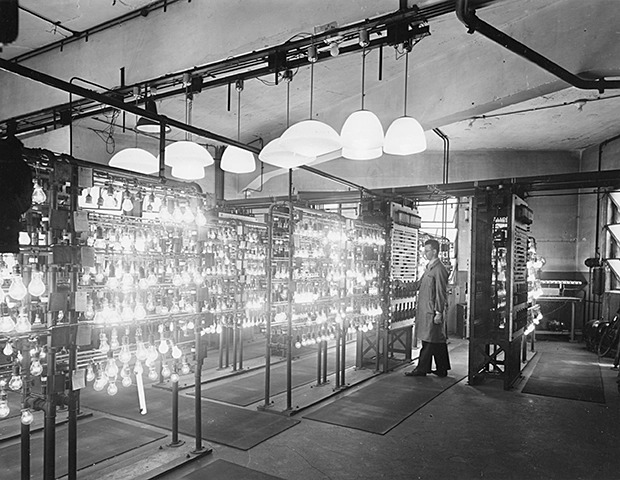
According to Taz Blogs, Phoebus Cartel mandates indicated, “The average life of lamps for General Lighting Service must not be guaranteed, published or offered for another value than 1000 hours to burn out on normal laboratory test conditions at rated voltage.”
To make matters worse, Krajewski notes that “If any factory submitted bulbs lasting longer or shorter than the regulated life span for its type, the factory was obliged to pay a fine.”
Concerns from Manufacturers
Pierre Moyse’s paper on ‘The Uneasy Case of Programmed Obsolescence’ claimed the 1924 Convention provided a ‘formulae for arriving at the economic life of lamps.’
Accordingly, all members had to send samples to a testing laboratory in Switzerland where the life of the light bulbs was meticulously recorded. Members who deviated from the cartel’s optimal range were fined.
Tokyo Electric explained that, after shortening the lifespans of its vacuum- and gas-filled bulbs, its sales had increased fivefold. Yet the sales increase apparently meant exceeding its allocated sales quota and incurring a penalty.
The cartel’s negative feedback prompted a memo reported on Spectrum IEEE saying, “if the increase in our business resulting from such endeavors directly mean[s] a heavy penalty, it must be a thing out of reason and shall quite discourage us.”
All Was Not Good in the Cartel
“This, you will agree with me, is a very dangerous practice and is having a most detrimental influence on the total turnover of the Phoebus Parties.”
Philips chief Anton Philips wrote this after discovering that some cartel members were effectively circumventing the lifespan restrictions by operating bulbs at higher voltages.
He continued, saying, “After the very strenuous efforts we made to emerge from a period of long life lamps, it is of the greatest importance that we do not sink back into the same mire.”
Consumers, meanwhile, had already begun to notice the difference in correspondence dated May 19, 1933. General Electric officials R. G. Morison and A. L. Powell observed that competing manufacturers were selling bulbs that, although somewhat less efficient, lasted considerably longer.
They lamented that consumers tended to judge a bulb by how long it lasted rather than how efficiently it used electricity. The cartel had no way of knowing its troubles would come from the government, not falling sales.
Legal Wars Bring an End to Phoebus
In 1938, President Franklin D. Roosevelt appointed Thurman Arnold to head the Department of Justice Antitrust Division.
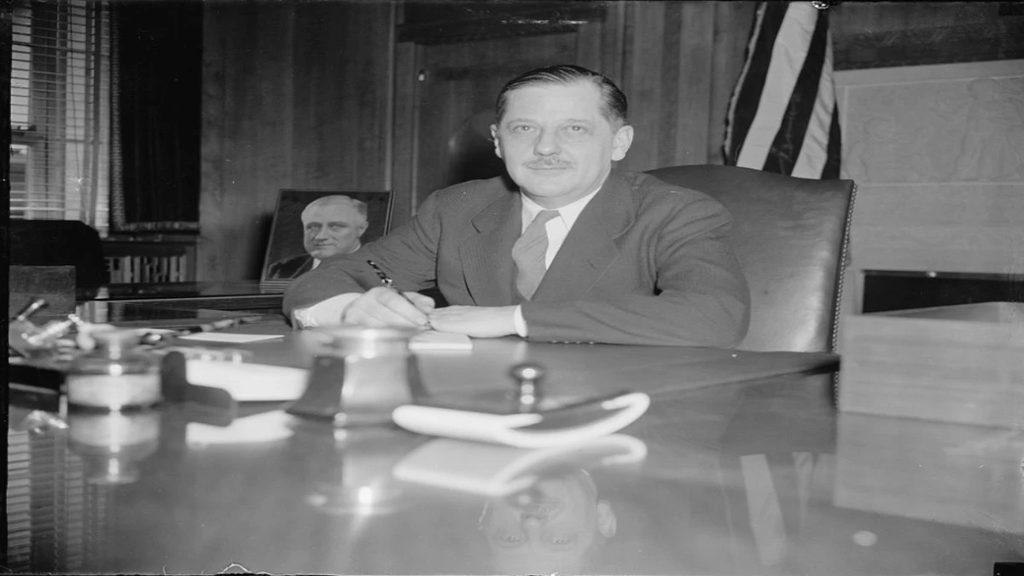
An aggressive antitrust enforcer who believed corporate monopolies choked the economy, Arnold suspected General Electric was using international agreements to bypass domestic law.
Armed with expanded grand jury subpoena powers, his federal investigators spent two years looking into corporate files. Because Swiss secrecy laws shielded Phoebus’s archives, investigators targeted the available files on International General Electric.
There, they uncovered a primary paper trail of thousands of internal letters, cross-licensing agreements, and telegrams linking American executives to the secret conspiracy to shorten light bulb lifespans and limit market supply.
The companies began to feel the legal consequences of the antitrust case in 1953 at the US Post Office and Courthouse.
Presiding judge Phillip Forman issued a final judgment stripping General Electric of their exclusive lighting monopolies and ordered the company to dedicate all its primary incandescent lamp patents to the public domain.
It was also required to share its proprietary manuals with any domestic competitor that requested them. The Department of Justice wanted to go a step further to push GE to divest 50 percent of its physical manufacturing plants, but this attempt was unsuccessful.
By 1955, the formal administrative framework of Phoebus SA was completely dead. However, the conspiracy left behind a permanent footprint, and three decades of operations had completely changed the standard for light bulbs.
Hundreds of global plants continued to manufacture household bulbs to the same 1,000-hour specification as part of routine operations. The cartel was largely gone, but the culture was firmly embedded in the global assembly lines.
The Patent Shelving Era
During the 1970s and 80s, the economic strategy pioneered by the Phoebus Cartel became standard operating procedure for consumer electronics. The global economy was also shifting toward mass-consumption models where product durability was seen as a threat to continuous sales.
So independent investors who tried breaking the 1,000-hour standard ran into a wall of corporate suppression.
In the late 1970s, an independent West German inventor named Dieter Binninger developed an incandescent bulb which was designed to burn continuously for 15,000 hours.

He did this by utilizing a special carbon filament and altering the internal operating temperatures. The lighting industry rejected his invention, citing doubts about cost-effectiveness.
Major lighting manufacturers also pivoted to corporate patent acquisition rather than internal fine schedules.
When an independent engineer designed a durable product that threatened high-turnover replacement, large firms bought the rights to the technology and shelved the blueprints to prevent commercial distribution.
The Archival Unearthing
For decades, the inner workings of the Phoebus Cartel remained rumor until they became documented fact in the 1990s, after Germany’s reunification and the reorganization of corporate records.
Markus Krajewski and journalist Helmut Herger gained access to Osram’s central corporate archives in Berlin. Herger knew the workers’ council had saved documents when the plant was closed.
He then found a cache of internal records showing the cartel’s inner workings. Herger told the BBC, “I knew the people from the works council of the light bulb factory, and I knew that when they closed it, they had saved the archive.”
The documents included the 1924 agreement, the 1,000-hour standard, and the correspondence between member companies.

The cache even included the official 1929 sliding-scale penalty charts detailing the exact financial fines imposed on factories that built superior bulbs, and internal lettering mapping the deliberate degradation of product lifespans to optimize global sales volume.
It provided documented proof that prominent manufacturers reduced light bulb quality worldwide as a business transaction.
The discovery in the Berlin archives brought the historical trajectory of the Phoebus Cartel full circle, grounding decades of consumer suspicion in documented administrative fact.
The files proved the rollback of light bulb lifespans was never a limitation of industrial engineering but a calculated financial strategy executed by the world’s manufacturers.
The Case for 1,000 Hours
Defenders of the 1,000-hour standard for bulbs begin with the physics argument. A filament that runs hotter will give more light but burn out sooner. So the trade-off is efficiency against life.
More light is needed today for everyday activities, so it would make sense to sacrifice longevity if it means more light from the bulb. The United Kingdom’s Monopolies and Restrictive Practices Commission indicated that standards bodies considered 1,000 hours as the best compromise.
The second argument is cost to the consumer. Bulbs may have been cheap, but electricity was not. Phillip’s historian I.J. Blanket reiterated that the cheap Japanese lamps flooding the market drew more current.
This made them many times more expensive to run than branded bulbs, despite the lower sticker price. That means a brighter but quickly replaced bulb interestingly saved more on the power bill than it cost to replace.
The Modern Blueprint
Today, the technical strategy codified around the Geneva conference table in 1924 is seen as part of the standard culture governing the construction of modern consumer electronics.
This same design philosophy governs smart devices through deliberately non-removable batteries and proprietary hardware fasteners that restrict independent repair.
In 2010, Cosima Dannoritzer directed a 75-minute documentary titled The Light Bulb Conspiracy. Dannoritzer spent years tracking down original archival records and internal corporate letters across Europe and the United States.
Rather than treating the cartel as an isolated 1920s scandal, the documentary claimed it was the ‘birth’ of planned obsolescence. It directly linked the cartel’s business model to current consumer frustrations like iPods with non-replaceable batteries or other consumer electronics designed to break down after limited use.

The physical proof that long-lasting technical capability existed before the 1924 corporate conspiracy continues to burn at Fire Station No. 6 in Livermore, California. The Centennial Light, a hand-blown, carbon-filament bulb manufactured by the Shelby Electric Company in the late 1890s, has remained illuminated since 1901.
When it finally blows out, as one day it will, company officials claim it shall be “put to rest” after more than a hundred years of dedicated service.
For more forgotten stories from history, read about the giant concrete arrows that once guided airmail pilots across America and Project West Ford, the Cold War plan to surround Earth with hundreds of millions of tiny copper needles.