
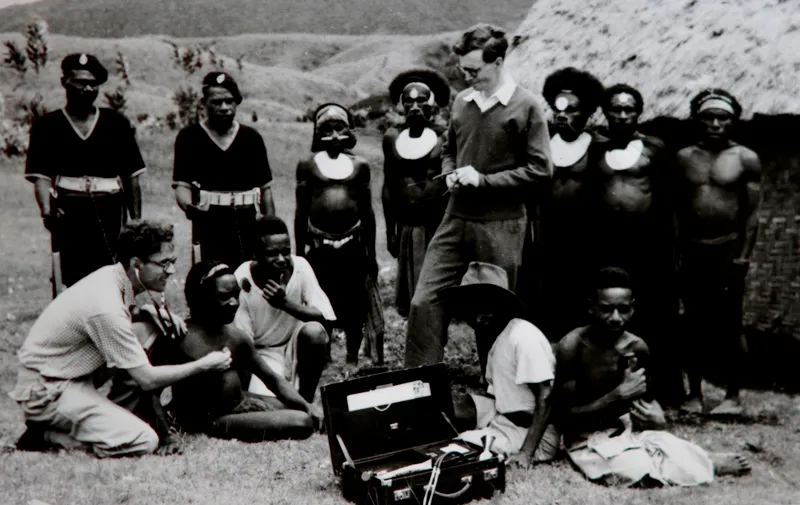
In 1962, Kainamba Mabage helped clear land for a doctor’s house in Waisa, a Fore village in the Eastern Highlands of what is now Papua New Guinea. She was young and unmarried. The doctor, an Australian named Michael Alpers, came to investigate kuru, a fatal illness spreading through families in the surrounding communities.
Mabage, the young man she later married, joined Alpers’s field team. He accompanied the doctor on visits and sometimes went alone to check patients, reporting changes in their symptoms. When the researchers ran short of provisions, villagers supplied vegetables. The same workers who collected medical samples also helped families with funerals. Kainamba remembered villages “so often mourning the dead.”
The illness began by making ordinary movements unreliable. People stumbled, trembled, and struggled to coordinate their limbs. As it advanced, they needed support to walk, then could no longer stand. Speech and swallowing became difficult. Once recognizable symptoms developed, no one recovered; death usually followed within about a year. The Fore name, kuru, meant “trembling.”
Adult women and children of both sexes accounted for most early cases; adult men were comparatively spared. In the first five years of systematic investigation, from 1957 through 1961, roughly a thousand people died. The epidemic affected the Fore and neighboring communities linked to them through marriage.
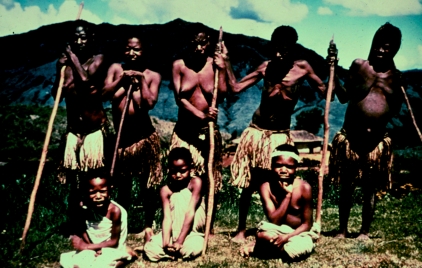
These losses changed how households stayed alive. As women fell ill, husbands took over planting, weeding, and harvesting, and daughters spent more time in the gardens. Men fed children and managed homes in their wives’ absence. Families took in children whose mothers were gone.
Atenamu Bavasa, another Fore man who assisted the researchers, carried equipment and food on patrols that lasted weeks. He also explained to villagers why outsiders wanted to examine the sick. Then his adopted daughter died, followed by his second wife.
“I gave up my job to take care of the children left behind,” he recalled.
These repeated family losses led medical investigators to think kuru might be inherited. Carleton Gajdusek, an American physician, and Vincent Zigas, a government medical officer, began systematic studies in 1957. They established that kuru involved severe neurological damage, but its cause remained uncertain. By the early 1960s, many investigators favored a genetic explanation.
That possibility brought anthropologists Shirley Lindenbaum and Robert Glasse to the South Fore in 1961. Their assignment included collecting family histories that a geneticist expected would support his theory. Living among the people whose relationships they charted, they found that expectation flawed.
People described as brothers or sisters were not necessarily close biological relatives. Kinship could grow through adoption, shared food, obligations, and sustained loyalty. A chart that treated every family relationship as evidence of shared ancestry could make kuru appear more hereditary than it was.
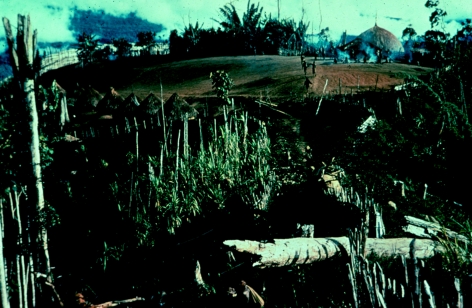
The Fore also remembered a time before the disease. Villagers named early victims and described its arrival from communities farther north. Lindenbaum and Glasse walked between settlements, collecting accounts that traced its southward movement in the early twentieth century. Their accounts described a relatively new disease moving between communities within living memory.
Families sought healers far beyond their own villages. Many Fore attributed kuru to sorcery, and accusations strained neighborly relations. That belief also shaped how they treated the dead: a person killed by sorcery was not necessarily considered dangerous to eat.
Among the Fore, consuming deceased relatives was a way of mourning them. Unlike historical accounts of enslaved children being killed and consumed in the Congo, these were funeral rites involving people who had already died. The practice belonged to a complex set of obligations linking the living, the dead, and the ancestors. Families could understand burial as surrendering a loved one to worms, whereas consuming the body kept it among people who cared for the person. People believed the rites helped the dead reach the ancestral world.

Researchers described this as mortuary cannibalism, or transumption. Customs varied between communities, and the dying could express wishes about the treatment of their bodies. To understand its relationship to kuru, researchers needed to know who participated and which parts they consumed.
Women and young children were the main participants, including in consuming brain tissue. Most adult men participated little or not at all, particularly in the South Fore. Boys’ exposure generally ended as they left their mothers’ households and moved into men’s houses. The pattern closely matched the disease’s unequal toll.
Lindenbaum remembered a 1963 conversation with neurologist Richard Hornabrook. He asked, “What do adult women and children of both sexes do that adult men don’t do?”
“They ate the dead,” the anthropologists answered.
This explained the family clusters. Relatives shared funeral obligations and homes. If something in a deceased person’s tissues caused kuru, mourning one victim could expose the next. Women carrying out an obligation to their dead, and children eating what their mothers gave them, faced the greatest danger.
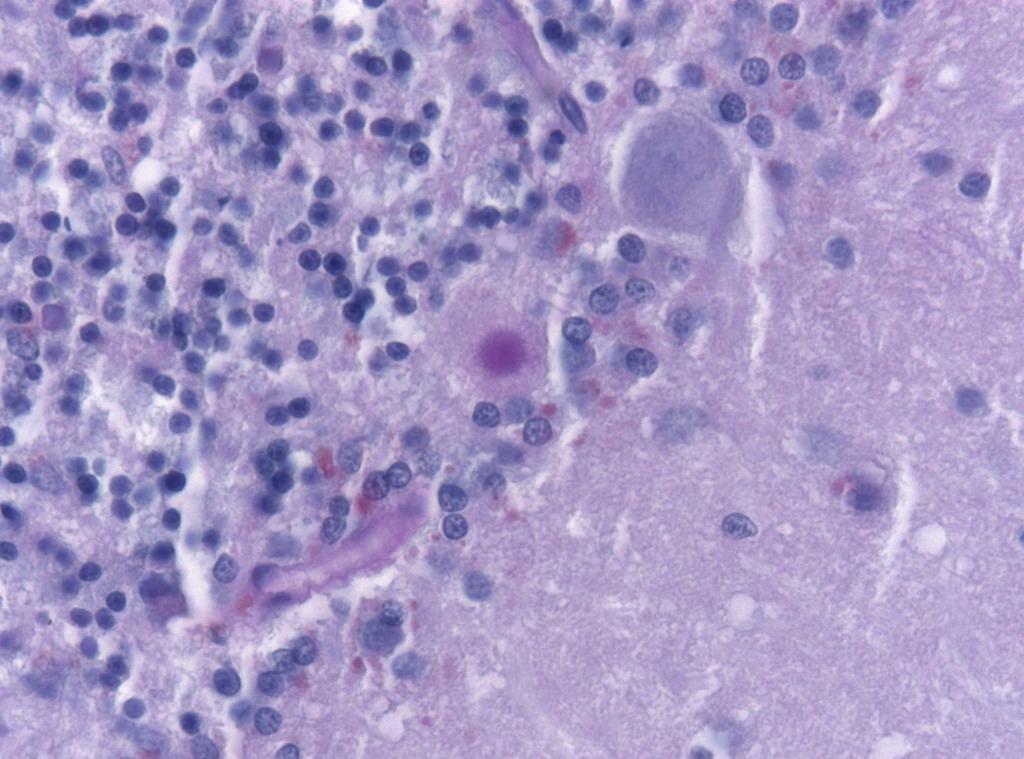
The hypothesis still required a biological explanation. A separate line of investigation began earlier at a London exhibition. In 1959, veterinary pathologist William Hadlow visited a display about kuru at the Wellcome Medical Museum. Photographs of damaged brain cells reminded him of scrapie, a fatal disease he studied in sheep and goats.
Scrapie could be transmitted experimentally, but illness took a long time to appear. Hadlow suggested that kuru might behave similarly. An experiment abandoned too soon could miss the result.
Testing that possibility depended on families willing to permit examinations after death. In Waisa, Alpers cared for an eleven-year-old girl named Kigea, whose mother died of kuru before her. During the final six weeks of her illness, Kigea survived on sips of sugar water and lay almost motionless. The day before she died, Alpers asked her to put out her tongue. “She understood me talking to her,” he recalled.
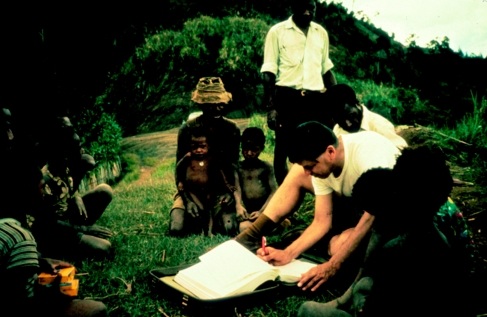
Earlier autopsies caused distress when bodies were taken away to a hospital and not promptly returned. Alpers arranged limited examinations in patients’ home villages, with family permission and help from relatives and Fore fieldworkers. After a patient died, he checked with the family again before proceeding.
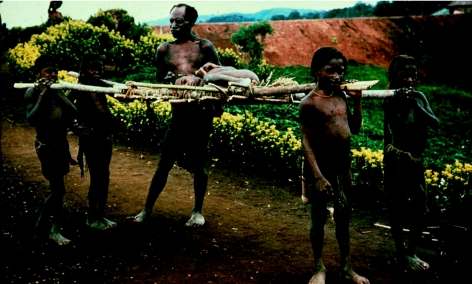
After Kigea died, tissue from her brain went to the United States. There, researchers injected brain material from kuru patients into chimpanzees’ brains. The animals were watched for years. In 1965, two developed the characteristic loss of coordination. Examination of a chimpanzee’s brain confirmed changes resembling those in human kuru.
Gajdusek, Joseph Gibbs and Alpers published the results in Nature in 1966. The experiment demonstrated that kuru could be transmitted. It did not yet identify the infectious agent, but it gave the funeral hypothesis the medical support it lacked. The paper listed the patients’ names alongside the animals’.
Evidence for how the disease spread was already accumulating in the villages. During the 1950s, Australian administrators and missionaries pressured communities to stop consuming their dead. Their objections were legal and religious; they did not know they were interrupting kuru transmission. By around 1960, the practice had effectively ceased.
The decline that followed was uneven. Adults continued to fall ill, but kuru progressively disappeared from younger age groups. No recorded patient was born after 1959. Children grew up free of the disease even when their mothers subsequently died from it, evidence against transmission during pregnancy or ordinary mother-and-child contact.
Together, the laboratory results and the changing village patterns showed that eating infected tissue was the main route of transmission. The brain contained particularly high concentrations of the agent. Stopping the funeral practice protected a new generation, but people already exposed could remain apparently healthy for decades before falling ill.
Kainamba and Mabage lived through that long decline. After his research employment ended, the couple remained in Waisa. “We lived a happy life in Waisa until he died of kuru in 1980,” she recalled.
The infection that killed Mabage belonged to a category scientists were still struggling to understand. Many described the agent as a slow virus, but scientists still couldn’t identify it. In 1982, Stanley Prusiner, working on scrapie, proposed the term prion for an infectious particle whose essential component was protein.
Further research showed that a normal protein made by the body could adopt an abnormal shape. In that form, it could induce other copies to change shape too, spreading the process and damaging the brain. Unlike a virus, the infectious agent did not need its own DNA or RNA genome. Kuru became part of a family of prion diseases that included scrapie and Creutzfeldt–Jakob disease.
This offered a plausible explanation for how the epidemic began. Researchers proposed that someone in the region developed a spontaneous case of Creutzfeldt–Jakob disease, a rare illness found in populations worldwide. If relatives consumed that person’s infectious tissues, they could become infected; their own funerals could extend the chain. Later laboratory comparisons supported the connection. The first patient and exact event remain unproven.
The possibility of decades of silent infection acquired new urgency in 1996, when a new form of Creutzfeldt–Jakob disease appeared in Britain, linked to bovine spongiform encephalopathy, or mad cow disease. Investigators faced another foodborne illness. The Fore families’ experience offered evidence about how long such infections could take to reveal themselves.
In Papua New Guinea, fieldworkers kept returning to villages, checking suspected cases and distinguishing kuru from other causes of trembling and disability. Among eleven patients studied between 1996 and 2004, the youngest was 46 when symptoms began; the oldest was 63. Some estimated incubation periods exceeded fifty years. Those decades without symptoms preceded the same progressive loss of movement that families knew from the epidemic’s early years.
The boys who once joined their mothers at funerals could therefore become ill as older men. The changing ages of the patients preserved a record of when exposure ended. Researchers were watching childhood infections emerge near the other end of a lifetime. Inherited differences in the prion protein gene influenced susceptibility and incubation, helping explain why people exposed to the epidemic could remain well for very different lengths of time.
By then, the work itself passed between generations. Andemba Anua accompanied her husband on journeys to report on patients in distant villages. She later helped researchers gather local histories. Their sons, Sena and Tuli, also joined the Kuru Project. In her account of the work, she expressed pride that her children were employed as their father was.
Kainamba traveled to London for a 2007 Royal Society meeting that brought researchers and Fore participants together to consider the epidemic’s approaching end. People who helped build houses, carry provisions, explain family histories, and care for patients sat alongside the laboratory scientists. Some of their accounts appeared in the meeting’s published proceedings, including her brief recollection of Mabage.
The epidemic was not quite finished. Its last known death occurred in 2009. Routine field surveillance ended in 2012, more than half a century after systematic investigation began.
Even as cases became rare, people who remembered the epidemic feared its return. In a 2008 account, Tiu Pekiyeva, a Fore research worker who began helping as a boy, described that fear. He also recorded something the families could see for themselves.
“The children of those who died of kuru are today still alive in the villages.”