
In May 1888, near the village of Rikakiba on the Congo River, James Sligo Jameson sat with Zanzibari slave trader Tippu Tip. Tippu’s men were guiding the European column through the territory during the heavy rain season.
28-year-old James was the grandson of John Jameson, the founder of Jameson Irish Whiskey and a naturalist on Henry Morton Stanley’s Emin Pasha relief expedition.
Their connection to Tippu Tip, though, would hurt the expedition, as villagers along the route refused to trade with them, having been personally affected by Tippu’s slave raids. So Jameson and his party had sometimes resorted to kidnapping women and holding them hostage until the communities gave them food.
According to All That’s Interesting, Jameson had written in his diary, “We finished our last plantain to-day, and have only two more fowls left, a kid and a goat; I see no chance in getting any more, for the natives do not trade, or offer to, in the least. As a last resort, we must catch some more of their women.”
On this day Jameson had been invited to the house of the local chief, named Longa Longa, where a group of villagers was performing. As they watched the dance unfold, Tippu casually mentioned that in this region, these specific celebratory dances usually concluded with a banquet of human flesh.
Jameson depicted his reactions in his diary, saying, “I told [Tippu Tip] that people at home generally believed that these were only ‘travelers’ tales,’ as they are called in our country, or, in other words, lies.” He then said something to an Arab called Ali, seated next to him, who turned round to me and said, “Give me a bit of cloth, and see.”
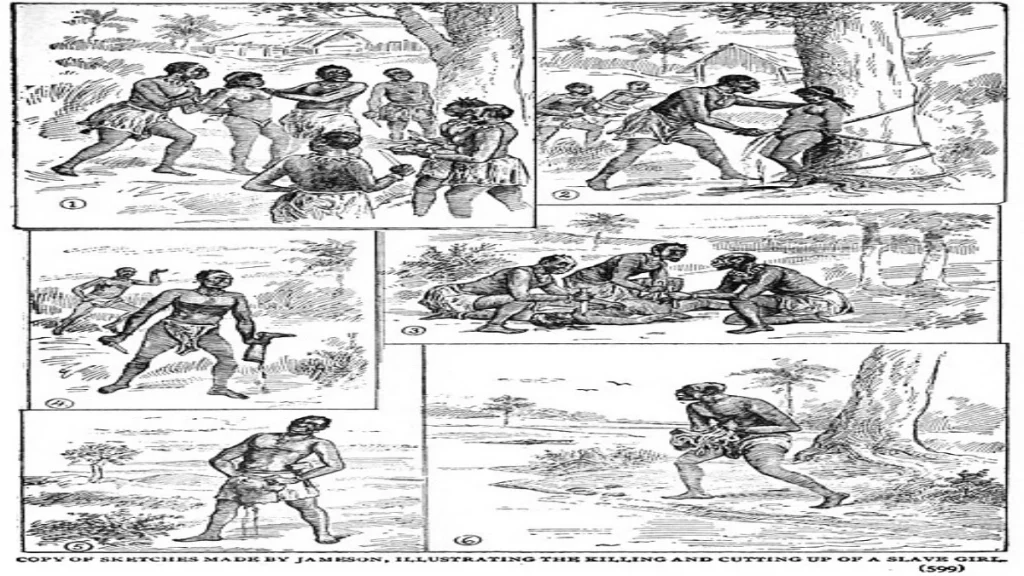
Believing the exchange was a joke, Jameson sent a boy to fetch six cloth handkerchiefs, which he handed over to Tippu’s men. After a few minutes, a man came, leading a 10-year-old girl by the hand who had been captured during a recent slave raid.
Without any warning, this man took a knife and stabbed the slave girl twice in the breast. Jameson wrote that the girl didn’t scream or fight. She just turned to the side as she fell lifeless to the ground.
Three men ran forward and began butchering the body with brutal efficiency. Her head was severed, and her body parts were taken down to the river to be washed for eating.
Later that day, Jameson returned to his quarters and sketched the entire macabre event and the cannibalization scene in watercolors from memory.
Assad Farrad, a translator from the expedition, later reported this event to the British authorities and leaked it to the New York Times. In his account, Jameson wanted to see it happen so he could later draw it.
The expedition leader, Henry Morton Stanley, also discovered Jameson’s sketches and diaries. Furious at the disgrace that it brought the mission, he publicly condemned Jameson, validating the claims that the whisky heir had purchased a child’s execution for the sake of a drawing.
One of Stanley’s men said that Jameson seemed initially unfazed by the incident, only realizing its seriousness later. According to Futility Closet, he wrote, “Life is very cheap in Central Africa. Mr. Jameson forgot how differently this terrible thing would be regarded at home.”
Jameson eventually died from tropical fever in August 1888, but the fallout from the recorded incident would later shake the Western world.
Origins of Child Cannibalism in the Congo
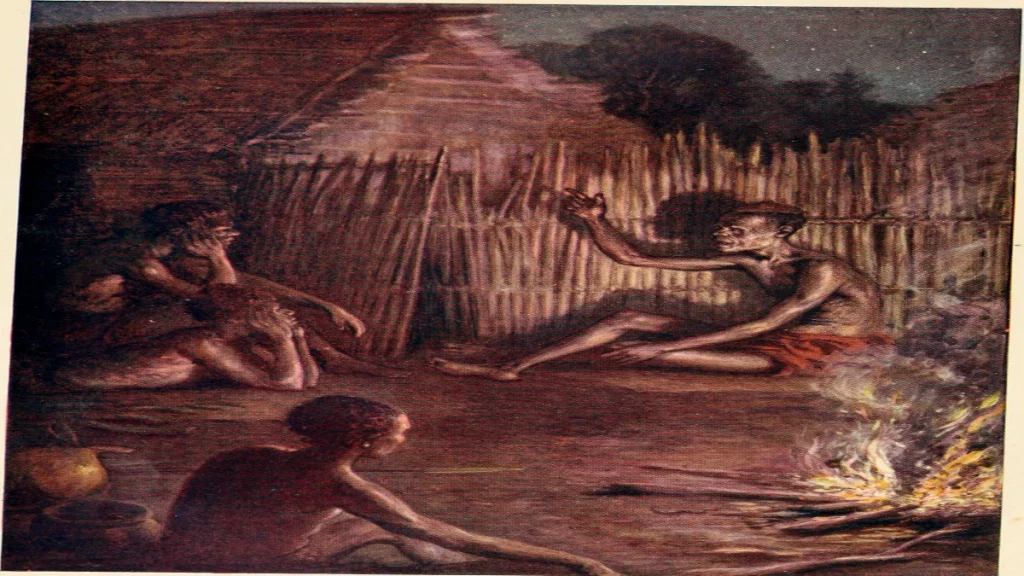
The account of Jameson highlights how the convergence of pre-existing tribal customs, the slave trade, and European economic exploitation caused child cannibalism to escalate throughout the 19th and 20th centuries.
This practice did not originate from a single source but existed across diverse ethnic landscapes before the 19th century. In particular regions like the upper reaches of the Congo and Lualaba rivers, anthropologists documented that certain tribes occasionally practiced cannibalism out of pure gastronomic desire for human flesh.
Unlike the Wendigo lore, where cannibalism was borne from severe famine and hunger, this phenomenon seemed to come purely from preference and economic motivation.
It was not considered taboo there. Rather, human flesh was highly prized and treated as a superior culinary delicacy. For the other groups, consuming parts of an enemy like the heart or their blood allowed them to absorb the victim’s life force or to celebrate a battle victory.
As the slave routes expanded along the Congo and Ubangi rivers, it escalated, and human beings became a form of currency. Captives from the interior tribes were bought at mass markets and then transported by canoe to trading hubs.
In this market, adult slaves were valued because of the potential heavy labor they could provide. Children could not perform at the same level, but still consumed food rations.
This made them economic liabilities to the traders, and they subsequently became cheap to purchase. They also became primary targets of the gastronomic market, as buyers sometimes bought young slave children to fatten them up for upcoming village feasts.
The Nsala Photograph: Wala, May 1904
Sixteen years later and four hundred miles downriver, a similar transaction happened without any curiosity attached. The Anglo-Belgian India Rubber Company, known as ABIR, held a concession covering the village of Wala on the Maringa River.
Like any ABIR post, it used quota systems in which each village was assigned a rubber tonnage based on the number of adult men, and armed company guards enforced delivery.
By 1904, the vines within reach of most of the posts were stripped bare from years of overharvesting. Export volumes even fell by half that year, but the demands on quotas did not.
In May, ABIR guards arrived in Wala ahead of the delivery date, and the village hadn’t yet met the full rubber quota. The guards opened fire.
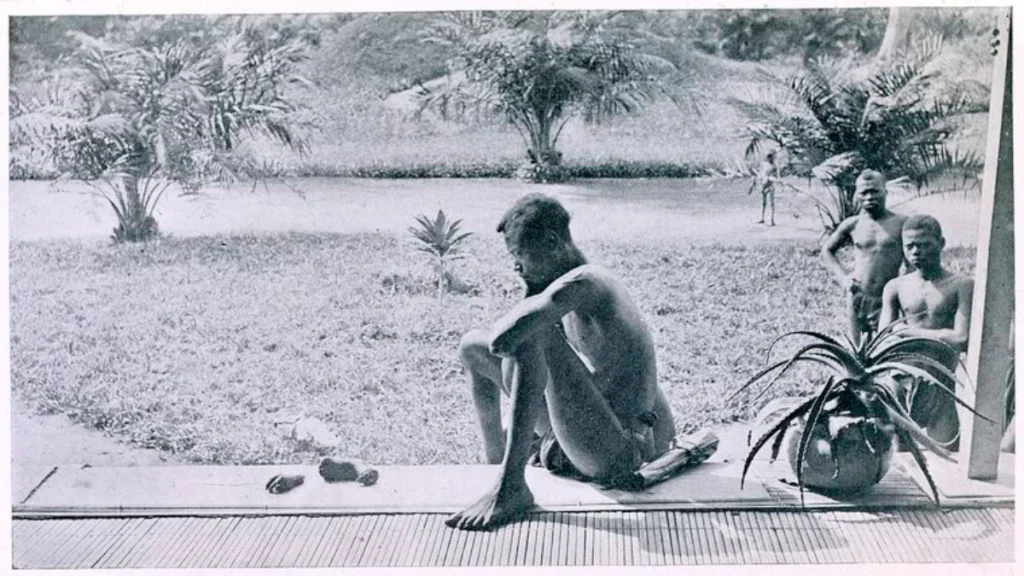
Among those killed were a five-year-old girl named Boali and her mother, Bonginganoa. They were the daughter and wife of a villager named Nsala. ABIR company guards killed more than eighty people in Wala that month.
British missionary Alice Seeley Harris gave an account that the guards did more than just kill. They cannibalized both Boali and her mother, leaving Nsala with his daughter’s severed hand and foot.
Nsala wrapped the hand and foot, then took them to the neighboring mission station at Baringa, where Harris and her husband lived. The following day, Harris asked him to sit on the veranda, and she photographed him staring at the only physical trace left of his child.
Rare Historical photos recorded her account, which read, “He hadn’t made his rubber quota for the day, so the Belgian-appointed overseers had cut off his daughter’s hand and foot. Her name was Boali. She was five years old. Then they killed her. But they weren’t finished. Then they killed his wife too.“
“And because that didn’t seem quite cruel enough, quite strong enough to make their case, they cannibalized both Boali and her mother.”
The Casement Report and a Pattern of Violence
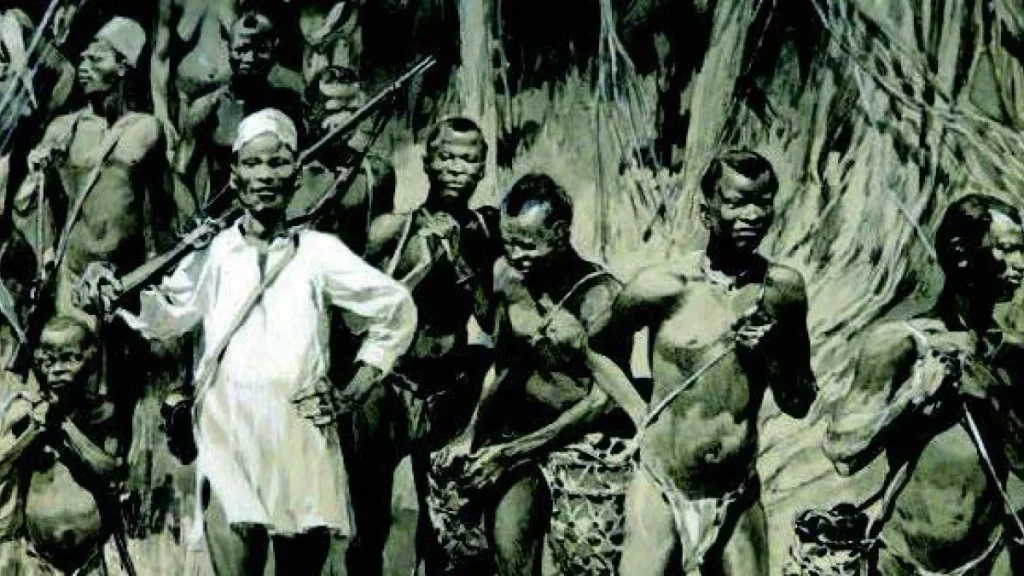
In 1904, British Consul Roger Casement traveled through the rubber-producing regions to verify the rumors that had reached Europe and America. His report that was submitted in December that year, documented a systematic pattern of violence where children were not collateral damage but intended targets.
At Lake Mantumba, Casement was brought six natives who had been mutilated at the hands of the rubber regime. In the Project Gutenberg eBook of the Casement report, he wrote, “Of six natives (one a girl, three little boys, one youth, and one old woman) who had been mutilated in this way during the rubber régime, all except one were dead at the date of my visit.“
Professor Campbell records another excerpt from the Casement report, in which he penned the testimony of a refugee. “As we fled, the soldiers killed ten children in the water. They killed a lot of adults, cut off their hands, put them in baskets, and took them to the white man, who counted 200 hands…. One day, soldiers struck a child with a gun-butt, cut off its head, and killed my sister and cut off her head, hands, and feet because she had on rings.”
The violence was not random. Testimony was recorded relating to Casement’s investigation and described a system where ammunition was accounted for through severed hands.
In Mark Twain’s text on King Leopold’s Soliloquy, he wrote, “Each time the corporal goes out to get rubber, cartridges are given him. He must bring back all not used, and for every one used he must bring back a right hand.“
When Roger Casement’s report was submitted to the British government and published in 1904, it sparked massive international public outrage. King Leopold II initially dismissed the findings, saying they had been fabricated by Britain as a way to steal his territory.
As diplomatic pressure intensified, Leopold was forced to appoint an independent international commission to investigate Casement’s claims. He assumed the appointed officials in the commission would clear his name.
Instead, after traveling the Congo River and hearing the same testimonies from Congolese victims, the King’s own commission confirmed Casement’s report.
The corroboration of the report made it impossible for the state to ignore the atrocities. A subsequent investigation led to the arrest, trial, and punishment of several white corporate agents and African sentries who had orchestrated the rubber raids.
Abstract: Atrocity Statistics and a Single Grieving Father
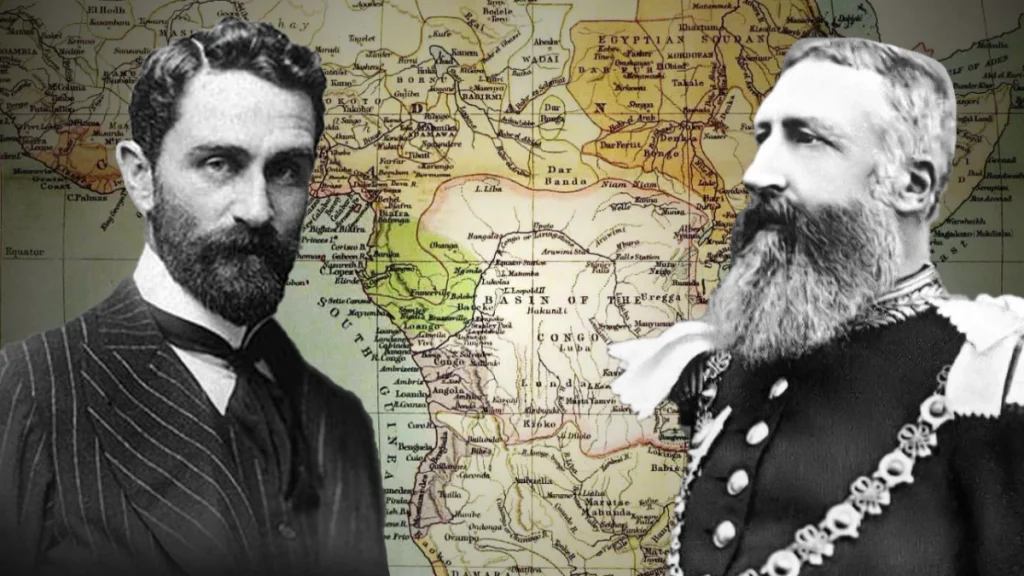
Though the Casement report was a scathing consular document detailing mass killings and mutilations in the Congo, it was especially difficult for everyday citizens in London and New York to conceptualize violence at that scale. Harris’s photograph humanized the tragedy.
It stripped away the political jargon and presented a devastating image of a father immobilized by grief, staring at pieces of his daughter. By showing a single victim rather than overwhelming statistics, the image evoked immediate empathy across cultural divides.
E.D Morel, an investigative journalist who co-founded the Congo Reform Association (CRA), recognized the power of visual evidence.
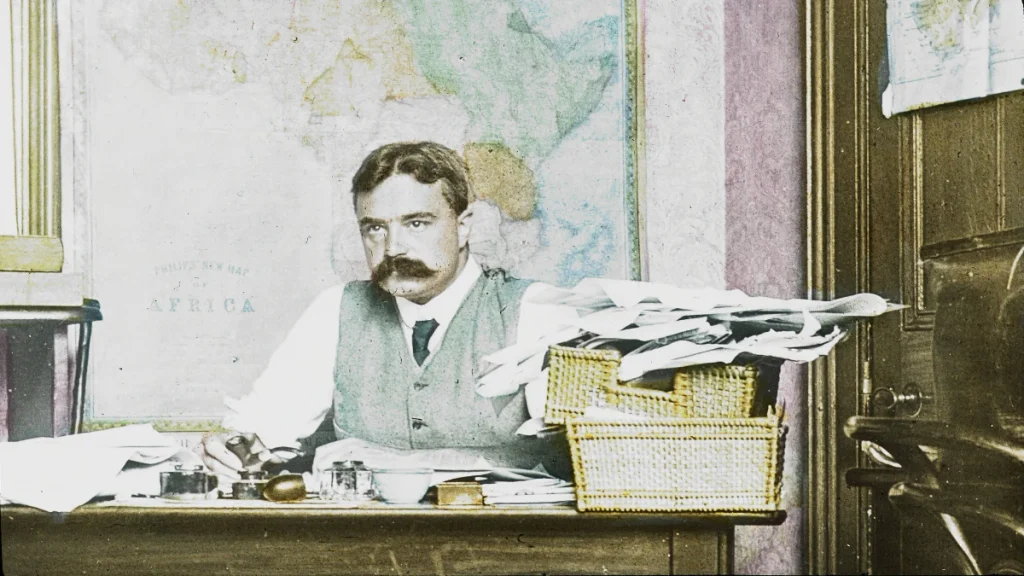
He published the photograph in his book, King Leopold’s Rule in Africa, providing undeniable proof about the atrocities of the Belgian regime. Long before the days of modern cinema, the CRA weaponized early slide projectors.
Missionaries traveled to church halls, town halls, and lecture rooms in the West, projecting images of Nsala and other victims. Audiences sitting in the dark were confronted with high-contrast images that served as proof of the corporate atrocities.
This prompted public outrage, which captured the attention of influential artists like Mark Twain, who was so moved by the evidence that he wrote a biting political satire about King Leopold.
In it, Twain described the king as a dictator raging against the invention of the camera. Whereas Leopold had previously been able to bribe journalists and manipulate witness testimony, he was powerless against the evidence provided by the first cameras.
Historiography and Evidence
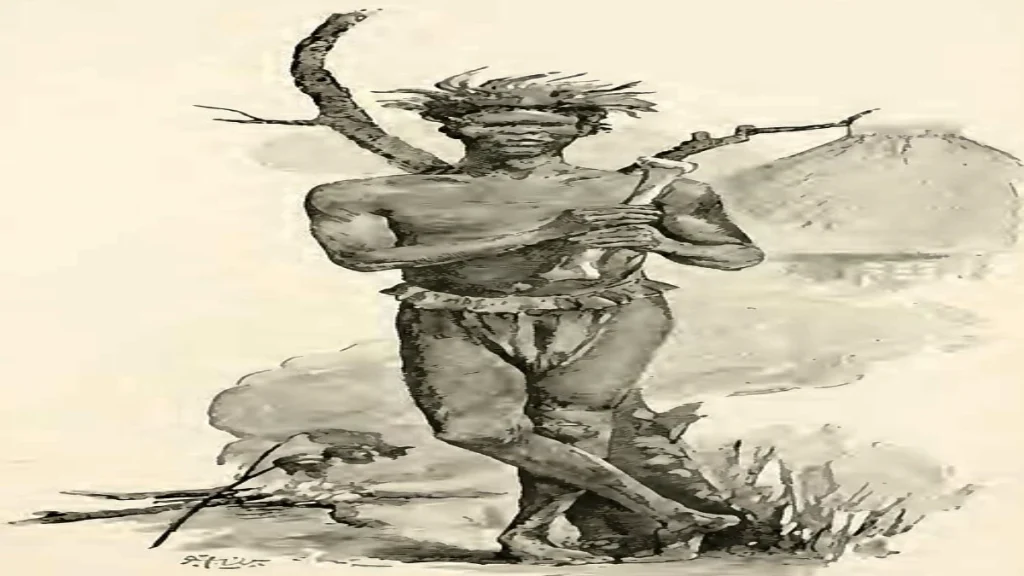
The documented cases of child cannibalism within the Congo in the 19th and 20th centuries were comprehensive but marred in some instances. Even while confirming the atrocities, some European observers used cannibalism as a trope to mark African savagery even as they staged or paid for the acts they claimed to document.
The Jameson affair is a good example, as he paid for the girl with cloth, then claimed surprise when she was killed and eaten in front of him. One historian, Christian Siefkes, noted that Jameson was well informed about cannibal customs before the incident, casting doubt on his surprise.
Similarly, the Nsala photograph was also taken by a missionary who was in the Congo to evangelize. Harris’ testimony and the physical evidence all confirm that Bonginganoa, Boali, and Esanga were killed and eaten by ABIR guards.
However, the evidence was already framed by colonial and missionary agendas, shifting the topic from the plight of the children to the need for colonization. At the heart of the tragedy sat the most vulnerable demographic in the society.
They were already devalued by the economics of the slave trade as manual liabilities. Young souls like Boali and others were transformed into disposable commodities. They were bought for the price of handkerchiefs, fattened like livestock, and ultimately consumed.
While ritualistic child cannibalism was intense and horrific, anthropological records show that it was the economic and gastronomic market that caused the practice to escalate.
Most child cannibalism cases that were documented by the early explorers and missionaries were not sudden battlefield frenzies. They were calculated transactions.
When European corporate militias like the ABIR took over, they weaponized these tribal practices, hiring warrior groups known for these acts. They also armed them with modern weapons and unleashed them on the agricultural villages.
It was only after the abolition of the slave routes and an official ban on cannibalism that the practice largely ended. However, during subsequent conflicts in the 1960s and the Second Congo War, there were documented instances of ritualistic cannibalism in the eastern DRC jungles.
In these modern scenarios, the motive was no longer a commercial food market but a strategy of psychological torture.
For other stories on forgotten history, see the Great Stink of London and the World War II Ghost Army.