
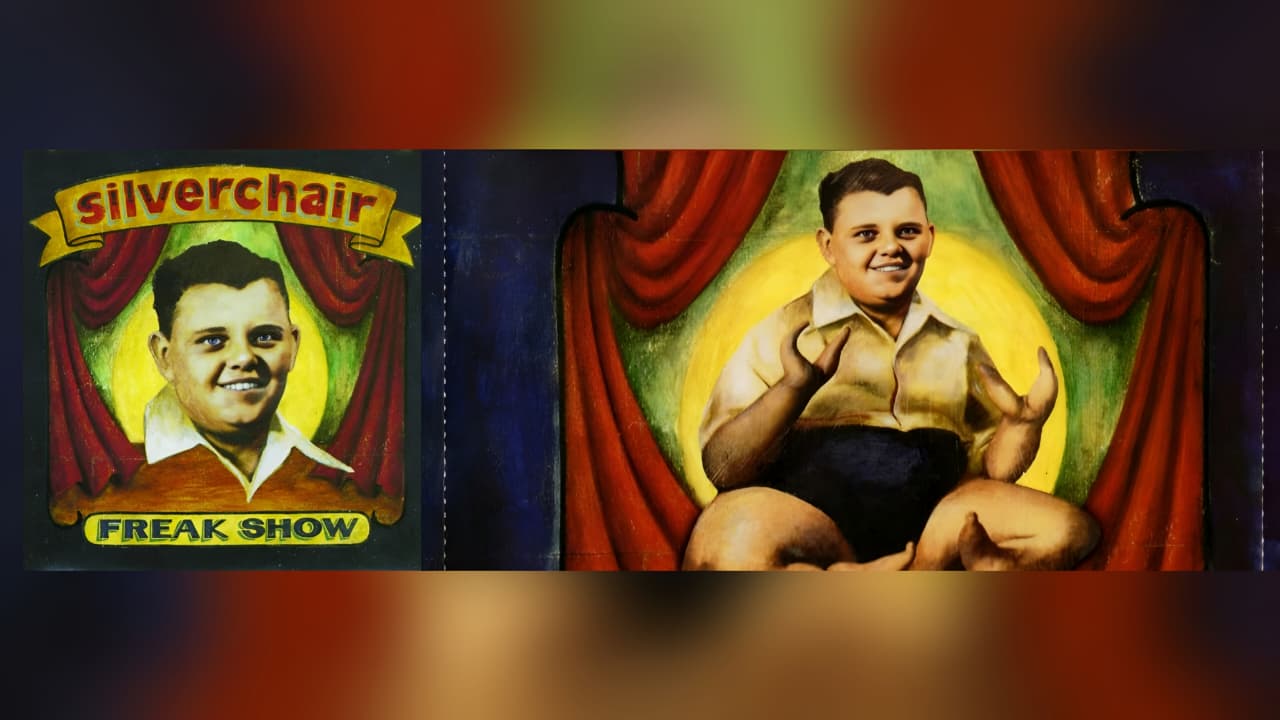
For those of you familiar with Silverchair’s album Freak Show, you might remember a rather unsettling image on its cover: a boy with claw-like hands, sitting on the stage, and staring directly at the camera.
What you might not know is that the image is of Grady Stiles Jr., better known as the “Lobster Boy.”
Growing Up in the Stiles Family
Grady Franklin Stiles Jr. was born on 26 June 1937 in Pittsburgh, Pennsylvania, to Grady Stiles Sr. and his wife, Edna.
For Stiles, his body was both his inheritance and his livelihood. Born with ectrodactyly, a condition that fuses the fingers and toes, leaving the hands claw-like and the legs short below the knees, he was exhibited to curious crowds as the ‘Lobster Boy’.
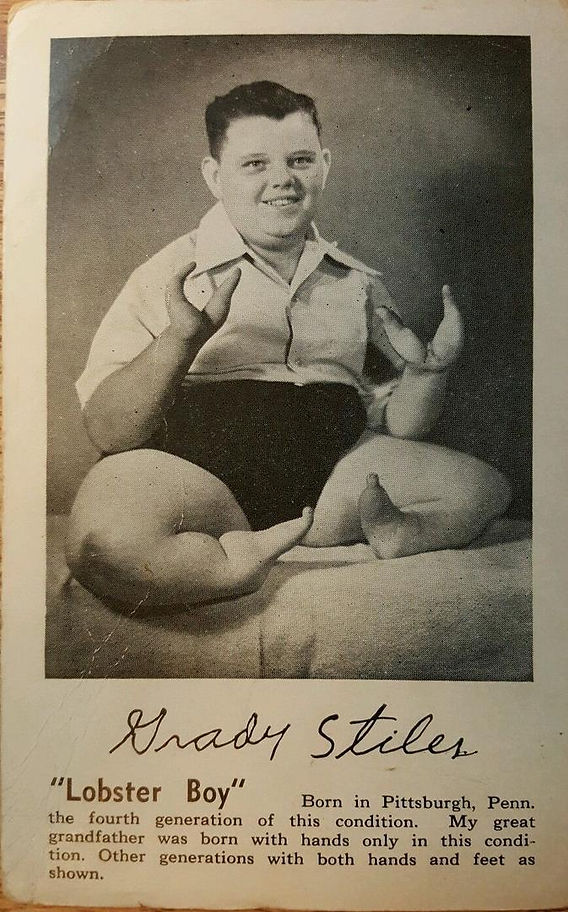
Grady was not the first member of the Stiles family to be born with the condition. For generations, the family had lived with ectrodactyly, with the origins leading back to William Stiles in 1805, about 4 generations before. Some members had even exhibited their deformities in traveling carnival sideshows.
His father, Grady Stiles Sr., made a living as a sideshow performer, exhibiting the same condition that later made his son famous.
Life as a Sideshow
Stiles was only seven when he began appearing in shows alongside his father, thrust into a life where his deformity became a source of his family’s livelihood.
Stiles’ childhood was anything but normal. In 1944, for instance, his uncle, John Murphy, was arrested after allegedly breaking the young Grady’s already crippled leg when the latter had requested a dime.
According to reports of that time, Murphy had been drinking when he attacked the boy, even burning his injured leg with a cigarette before breaking it with his hands.
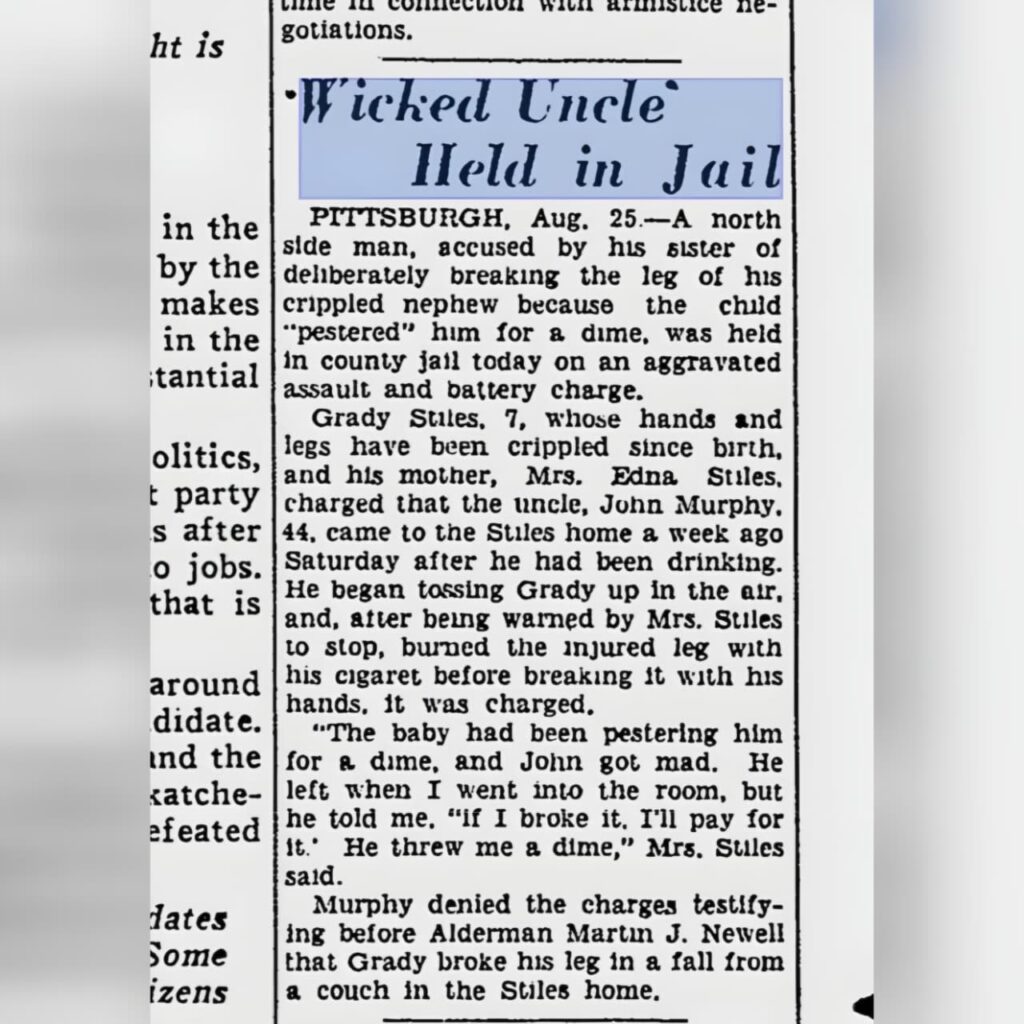
The incident was an early indication of the violence that punctuated Stiles’ life almost throughout, much of which he then projected further onto those surrounding him.
An Unlikely Marriage
In 1958, Stiles married Maria Teresa Herzog, a 19-year-old who had (ironically) run away from an abusive home to join the carnival.
The couple had two daughters, Donna and Cathy. Donna was born without ectrodactyly, while Cathy inherited the condition, becoming the fifth generation of the Stiles family to be born with it.
The two girls went on to become a part of their father’s carnival act, performing alongside him as the “Lobster Family.”
The carnival also became the setting for another troubled family story that began decades later. Korrina Malinoski met her future husband while he was working at a carnival, before their marriage was eventually scarred by violence.
But unlike the Stiles children, Korrina’s daughter Annette later became part of a far more mysterious story of her own.

Stiles’ appearance might have fetched the sympathy of many, but by almost all accounts, Grady Stiles was every bit of the monster he appeared to be.
Stiles had grown incredibly fond of the bottle, and in his drunken fits, was known to beat his wife and daughters.
By 1978, Stiles had divorced Mary Teresa and married Barbara Lucille. The couple lived with some of Stiles’ children from his first marriage, along with Grady Stiles III, his son from Barbara Lucille.
In the meantime, Mary Teresa married Harry Glenn Newman, another carnival performer who was billed as the “Smallest Man in the World.”
Donna Stiles, Grady Stiles’ daughter, had a tough time living with her father. Between his violent fits of rage and his incessant drinking, it was not a particularly peaceful household for the young girl.
A Human Among the Lobsters
Donna was described by many as ‘pretty and petite’, and had not been born with her father’s affliction. While living with her stepmother and Grady on Foreland Street, she fell in love with Jack Layne, an 18-year-old who lived in the neighborhood.
“She felt trapped in her home, and she wanted out, and this boy was the way out”, an attorney later described.

However, Grady did not take the relationship well, for Layne had made it clear that he would not let Grady dictate his daughter’s choices. Further, the complaint was that “The kid [Layne] made fun of [Stiles].”
Layne had made his intention to marry Donna explicit, and things took a much darker turn as their wedding date approached.
Stiles began to threaten Layne’s life and took Donna to an East Ohio Street pawn shop and bought a .32-caliber revolver, remarking jokingly that he would “use it on Jack.”
As tensions further escalated, Stiles was forced to supposedly ‘give in’ to the marriage, and the date was fixed on September 28th.
The Murder of Jack Layne
A day before the wedding, Stiles called Layne to his house for ‘a private talk’.
A friend of Layne’s later mentioned that he saw Stiles pull a gun from the left side of his wheelchair, point it at Layne, and say, “I will kill you before you marry my daughter,” according to news accounts.
Donna and her stepmother had stepped out of the house to buy Donna’s wedding dress. By the time they had returned, tensions had further escalated, and Stiles shot Layne in the chest, and as the teen turned to flee, shot him in the back.
Layne walked outside, mumbled, “He shot me,” and collapsed on the sidewalk in front of Donna. “He died in her arms,” contemporary reports said.
To make matters even more ghastly, Grady then apparently smiled at her from the window and said, “I told you I would kill him.”
Layne was pronounced dead about 30 minutes later at Allegheny General Hospital.
The Trial of the Lobster Boy
Stiles was quick to confess to the police. “He was cooperative,” recalled one of the homicide detectives, Frank Amity. “We didn’t have any trouble with him at all.”
When Stiles was brought to trial, his defense chose to highlight his disability, stating that Layne had apparently approached Stiles aggressively, and given his disadvantageous position, Stiles had acted in self-defense.
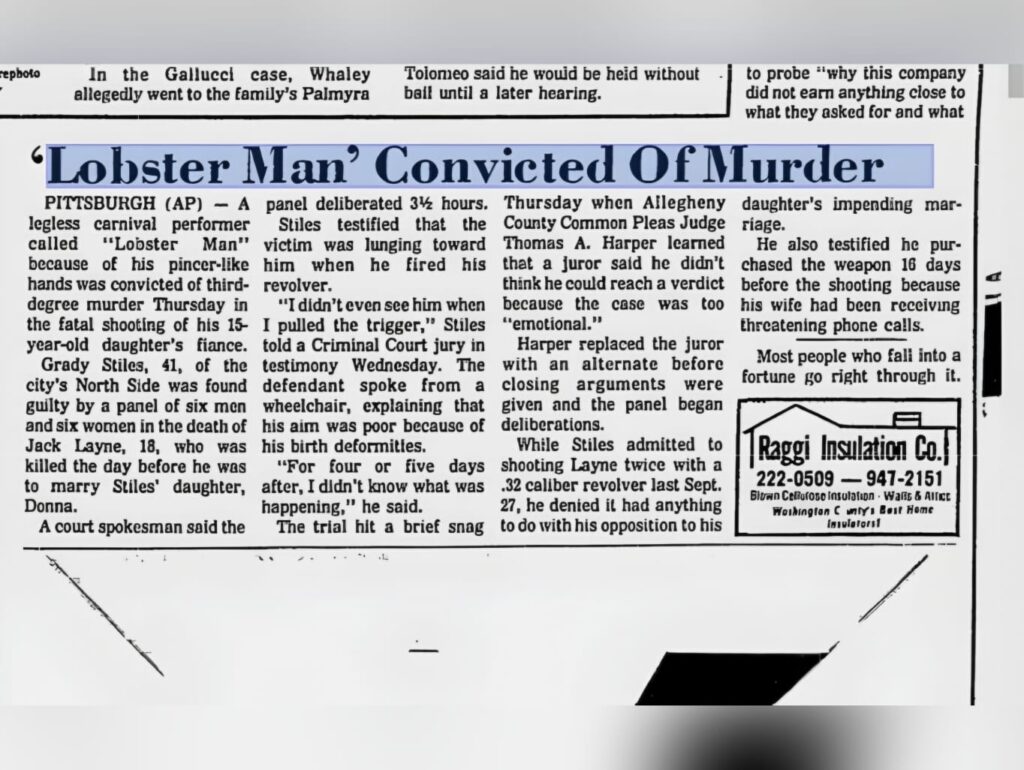
“I didn’t even see him when I pulled the trigger,” he told the Criminal Court jury in testimony, explaining that his aim was poor because of his birth deformities.
The trial lasted just a few days and included character witnesses such as a circus “fat lady,” a carnival dwarf and a bearded woman.
“That was one of the weirdest trials I ever covered,” reporter Gabriel Ireton later stated.
Despite his disabilities, however, the jury was not swayed, and on 22nd February 1979, he was convicted of third-degree murder.
A Toothless Punishment
The most important question, however, arrived after the trial.
“Let me ask you something, Your Honor: How are you going to punish this guy?” Gabriel Ireton asked Common Pleas Judge Thomas A. Harper.
“I hadn’t thought of that,” came the flat reply.
As it turned out, state prison officials concluded that their facilities were not adequate to accommodate Stiles’ special needs.
In what is now deemed to be one of the most unjustified rulings against a victim of domestic violence, Harper sentenced a ‘sympathy verdict’, limiting Stiles to 15 years’ probation and house arrest, remarking that besides his ectrodactyly, Stiles also had emphysema, kidney disease and cirrhosis of the liver.
Back to the Carnival
After his conviction, Stiles moved to Florida, where his ex-wife lived in Gibsonton, a carnival wintering town near Tampa. The two eventually reconnected and remarried in 1989 after he divorced his second wife and assured her his drinking days were over.
Stiles ran his own carnival shows and was known as a shrewd businessman. At this point, apparently, Stiles had given up drinking and was trying to ‘renounce’ his ways.
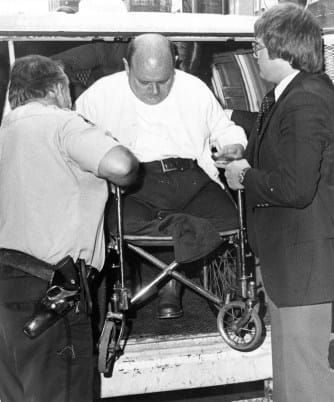
Mary believed that the man she had once loved had finally left his drinking behind.
After a brief stint as a teetotaller, he inevitably started drinking and beating his wife again. “Two weeks later,” she said, “he was back to the same old Grady.”
She described him as a “powerful, drunken brute,” claiming that he used to beat her with his pincer-like hands, headbutt her, and sexually abuse her.
His behavior in the carnival further deteriorated at this point, with family members testifying that Stiles would even be drunk on stage and lunge at the audience to scare them.
Grady Behind Closed Doors
His children were obviously not spared his wrath either.
I’m not a fan of my dad as a person,” Grady Stiles III commented at a later interview with the Huffington Post. “My father was racist [and] abusive. When I cried, [he was like] ‘I’ll give you a reason to cry.”
“I think alcohol brought out the worst in him,” he would further say.
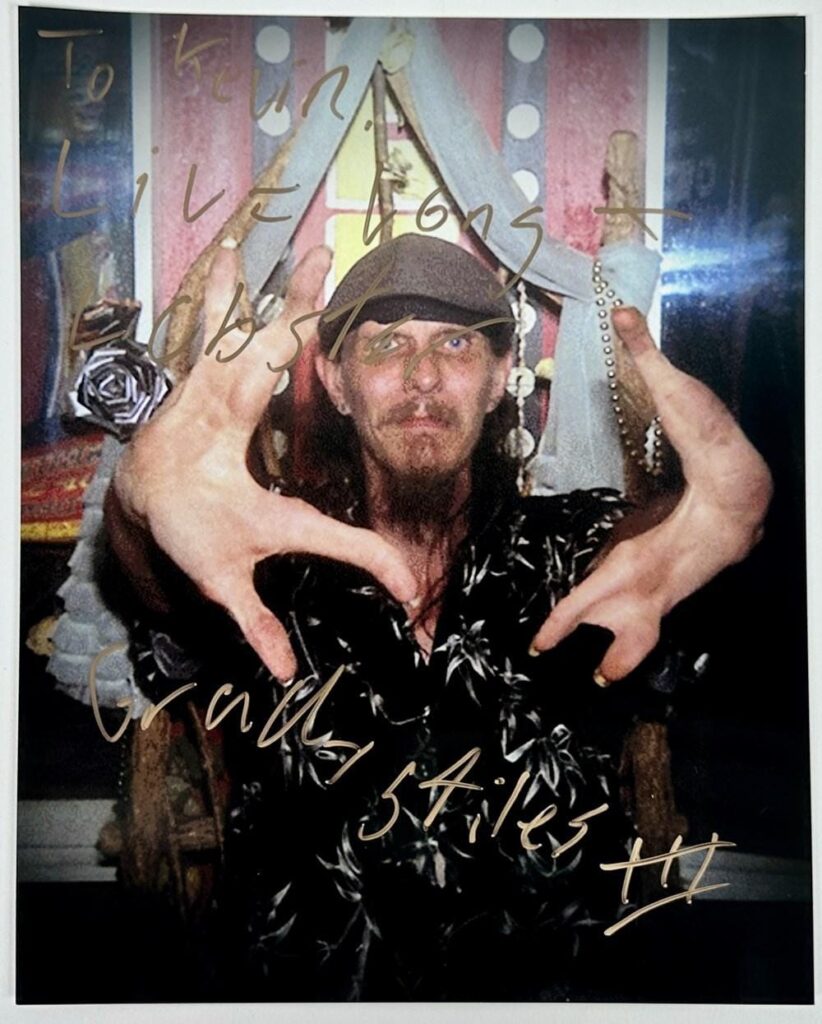
Despite his stunted limbs, Grady was in no way physically weak.
“He [Grady] had no legs. He had stumps. But in spite of these deformities, he was a powerful, powerful person. He would pop off the wheelchair, onto his fingers, scoot across an area, and in a drunken state, beat someone, usually his wife or children,” an attorney later mentioned in court.
Cathy Stiles described her father as “Satan himself” to the Los Angeles Times, elaborating that he refused to allow them to venture out on the carnival midways unless they wore large leather gloves so that carnival-goers, the “marks,” wouldn’t get a free peek at their condition.
“Something had to be Done”
Grady’s abuse peaked in 1992, when he left absolutely no effort undone in unleashing terror upon his wife.
Mary Stiles recalled that he sexually abused her, tried to smother her with a pillow, and one morning awoke her with whiskey on his breath and a butcher knife to her throat.
“One of these days I’m going to kill you and your family,” she quoted him as saying.
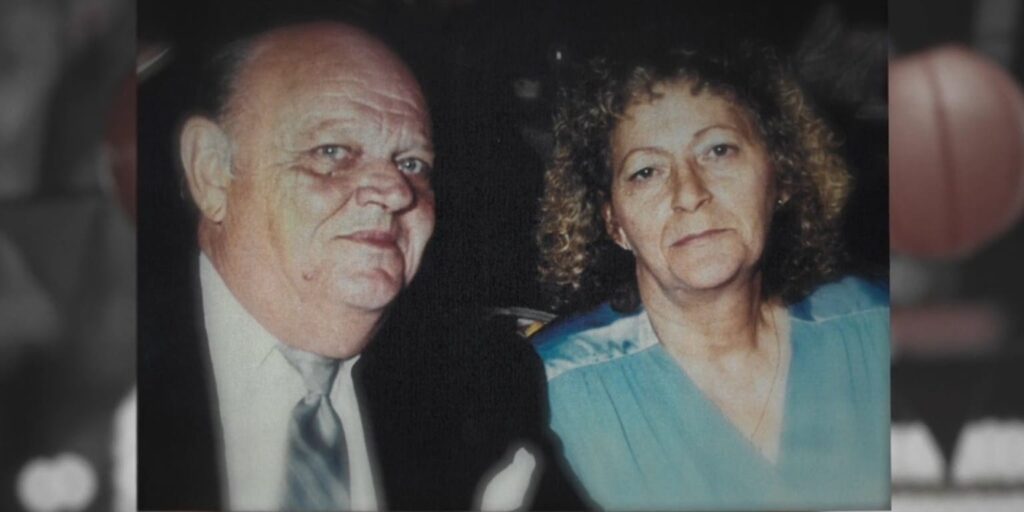
Mary turned to her eldest son, Harry Glenn Newman Jr., and apparently told him that “something had to be done.”
Newman, who performed as the “Human Blockhead” in the family sideshow, turned to a 17-year-old classmate and fellow sideshow performer, Christopher Wyant, whom the pair paid 1500 dollars to kill Stiles.
On 29th November, 1992, as Stiles smoked a cigarette on the sofa while watching a video, Wyant entered his home with a semi-automatic pistol and shot him twice in the back of the head, killing him at the age of 55.
So hated was Stiles in his community that reportedly only ten people came to attend his funeral. Further, there were no pallbearers to be found for his coffin.
Investigators soon traced the killing back to Mary and Newman, discovering the $1,500 payment made to Wyant. Needless to say, all three found themselves in court very soon.
Murder for Hire
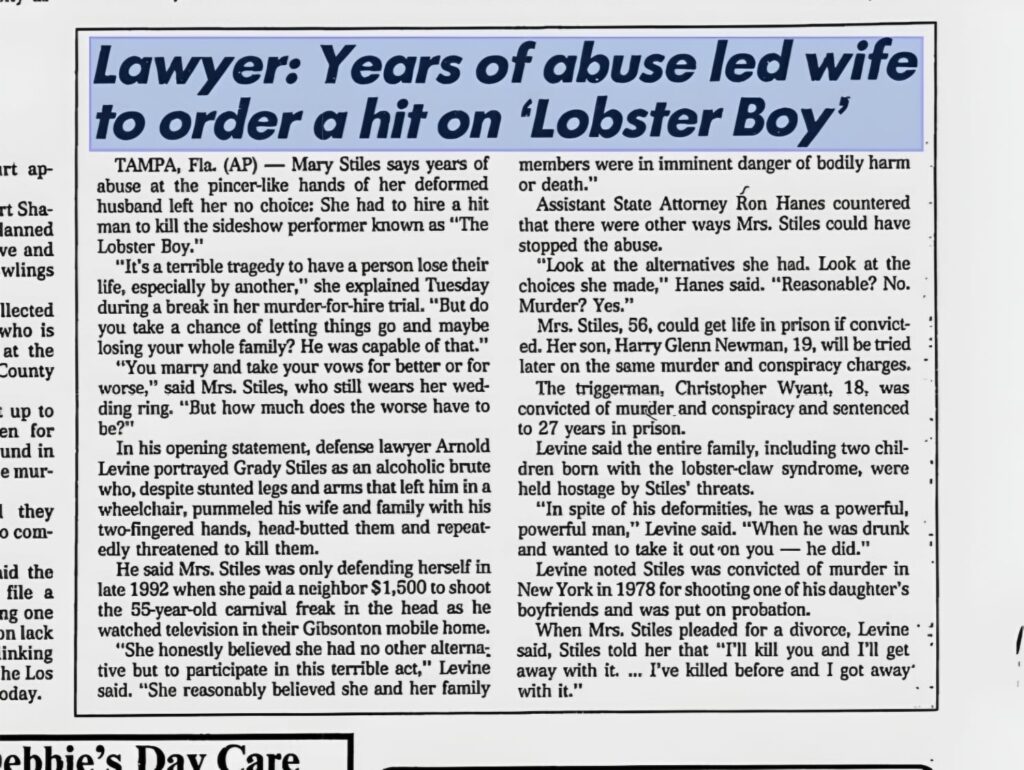
“Because of the cumulative years of abuse,” Mary Teresa’s Defense Attorney Arnold Levine said in his opening statement, “Mary Stiles believed she was in imminent fear of harm or death. She had no alternative but to participate in this unthinkable act.”
Mary’s defense portrayed her as a battered wife who genuinely believed that Stiles was going to kill her and her family, pleading for leniency from the jury.
The prosecution, however, had quite a different perspective, arguing that Mary had planned the killing weeks in advance and intended to take over Stiles’ carnival businesses, including the Human Pincushion, the Blockhead and the Gorilla Lady Illusion, calling it a “killing of convenience.”
Harry Glenn Newman Jr., Mary’s son, who had been the link between his mother and the teenager who carried out the murder, was not spared either.
Like much of the Stiles family, Newman was involved in the carnival business, performing as the “Human Blockhead.” Prosecutors argued that he had helped turn his mother’s desire to escape Stiles into a concrete plan to kill him by hiring Wyant.
At just 19 years old, Wyant was the youngest of the three and the person who ultimately pulled the trigger. He later testified against the others, describing how he had been recruited into the plot and how the murder was carried out.
Three Defendants
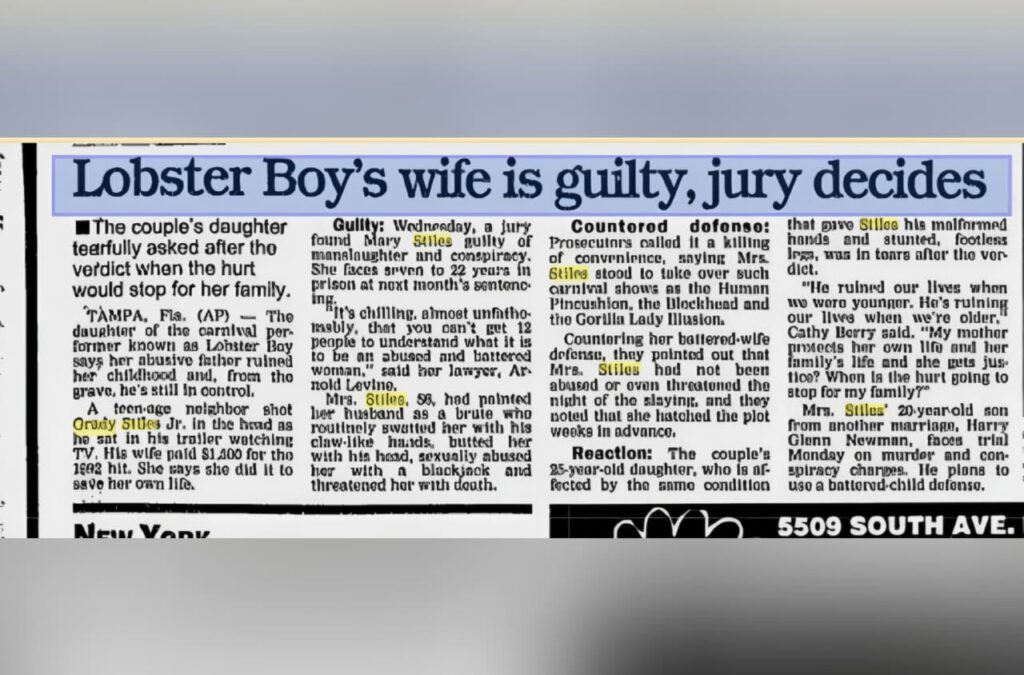
Mary Teresa Stiles, who had been charged with first-degree murder, was convicted in July 1994 of the lesser charge of manslaughter with a firearm and conspiracy to commit first-degree murder.
The jury had deliberated for roughly ten hours over two days before reaching its verdict.
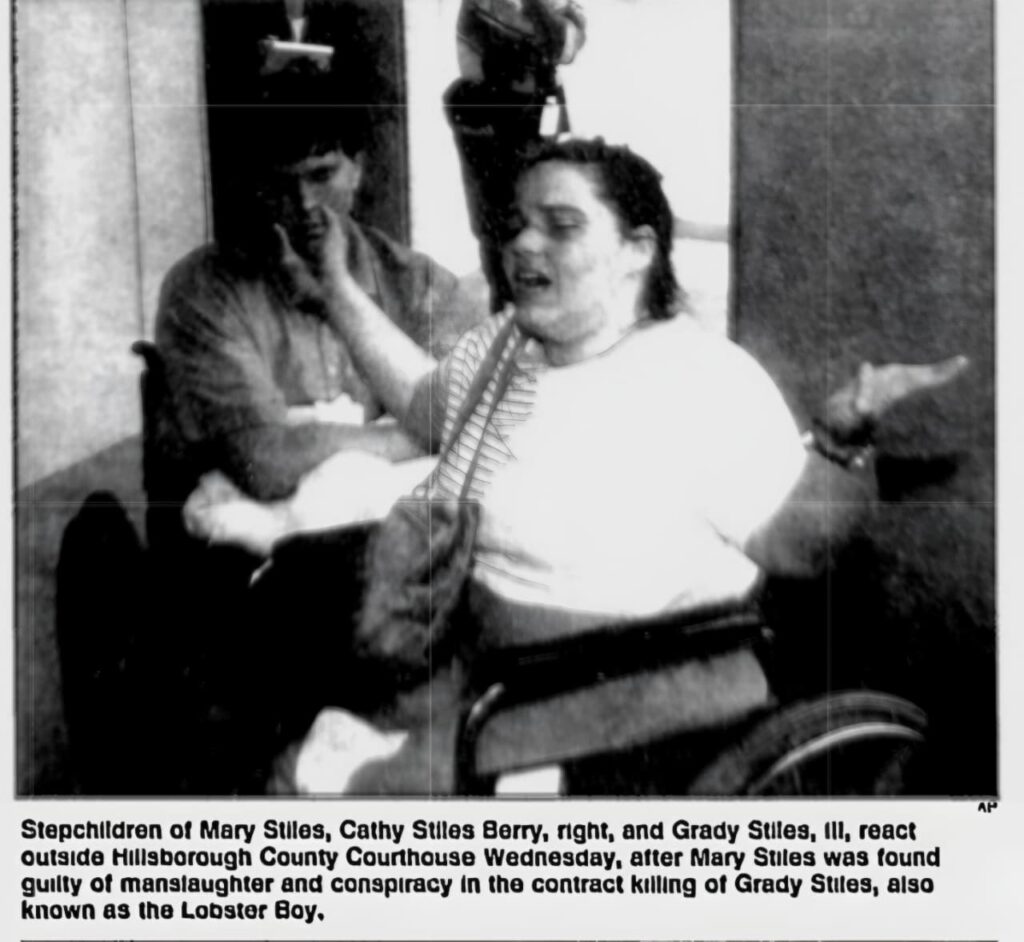
A few weeks later, Harry Glenn Newman Jr. faced the jury, where his defense argued that he had become involved in the plot only because he wanted to protect his mother from Stiles’ abuse.
The jury, however, remained unconvinced, and Newman was convicted of first-degree murder and murder conspiracy, his sentence being a mandatory life sentence without the possibility of parole for 25 years.
Christopher Wyant, meanwhile, had already been convicted of second-degree murder for ultimately pulling the trigger. Despite being only 19 at the time of his conviction, he was sentenced to 27 years in prison.

On August 29, 1994, acting Circuit Judge William Fuente sentenced Mary Teresa Stiles to 12 years in prison for manslaughter and conspiracy, with the sentences running concurrently.
Fuente said he was “genuinely sympathetic” to Mary and acknowledged that he had no doubt she had been a battered spouse; hence, she received the lightest sentence.
Mary was initially allowed to remain out on bond while appealing, but in 1997 her conviction was affirmed, and she was taken to prison to begin the 12-year sentence.
The Legacy of Lobster Boy
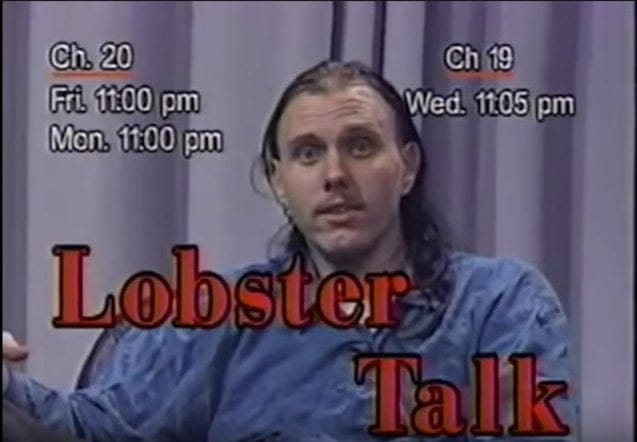
Like his father before him, Grady III continued performing in sideshows. By 2000, the Los Angeles Times reported that he had moved into a more modern version of the family business, hosting a public-access television program called Lobster Talk.
“I want people to see the show and see me,” he said in a newspaper interview. “I don’t want to be recognized for him. I’m me, and he’s him. I’m nothing like him, except my hands.”
Speaking about the murder years later, he disputed the straightforward version of events presented at his father’s trial. According to Grady III, Mary and Grady had been arguing when Mary said that “something needs to be done.”
“My brother had overheard that and went to the neighbor kid and told him that something had to be done. He [Harry] thought that meant scaring him or beating [my dad] up or something to make him realize that he was going to lose his family. A little while later, my dad was shot.”
Asked what he would say to Grady if he had the chance, Grady III’s answer was strikingly complicated.
“Thank you for showing me who not to be, and maybe you can appreciate who I became because of that,” he said to The Huffington Post. “You were a drunken bastard, but you were my dad.”
If you enjoy reading about human prodigies or other such interesting 20th-century mysteries, please consider checking out our articles on the child prodigy Kim Ung-Yong or the ingenious Ghost Army, which successfully hoodwinked the Nazis during World War II.