
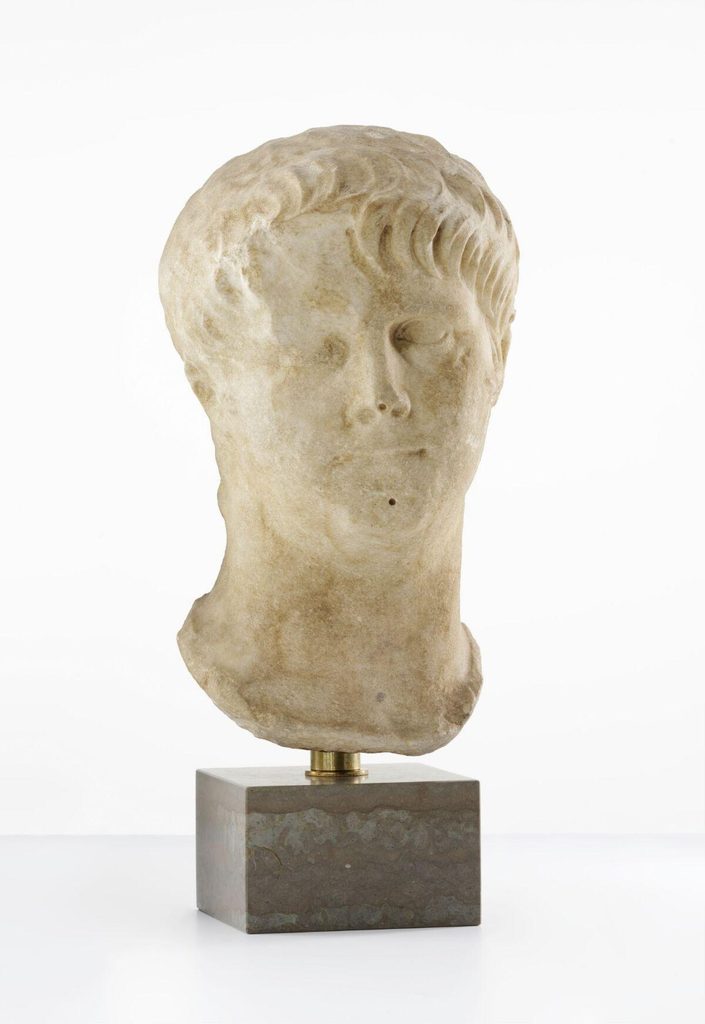
At Nero’s wedding in Greece, the well-wishers hoped the couple would have legitimate children. The bride was Sporus, a young man the emperor had ordered castrated. He wore a bridal veil and received a dowry, while Tigellinus, one of the commanders of the imperial guard, gave him away. According to the historian Cassius Dio, the Greeks observed the usual wedding customs, right down to those wishes for a family.
Nero called his bride Sabina. The name belonged to his second wife, Poppaea Sabina, who died in AD 65. Sporus resembled her, Dio wrote, and the emperor wanted him in her place. During Nero’s tour of Greece in 66–67, that resemblance became the basis for a public marriage.
Almost nothing survives of Sporus’s life before Nero noticed him. Ancient writers described him as a boy or young freedman, someone formerly enslaved, but supplied no dependable age or account of his upbringing. Suetonius wrote decades after Nero’s death, and Cassius Dio more than a century later. Both were interested in what Sporus’s treatment revealed about the emperor. They recorded his clothes, his attendants, and the names powerful men called him, while leaving no account in his own words.
Poppaea came from a world of wealth and influential connections. Before marrying Nero, she was the wife of Marcus Salvius Otho, one of his closest companions. Otho apparently talked so enthusiastically about her beauty that he helped bring her to the emperor’s attention. Tacitus, who told this story, could not decide whether Otho spoke carelessly out of affection or calculated that sharing her with Nero might strengthen his position.
Whatever he intended, Otho lost both his wife and his place at court. Nero sent him to govern Lusitania, in the western Iberian Peninsula, where he remained for roughly a decade. In 62, the emperor married Poppaea after divorcing his first wife, Octavia, whom he subsequently had killed.
The following year, Poppaea gave birth to a daughter, Claudia, and received the title Augusta. The child died in infancy, but her mother’s position was celebrated well beyond the palace. Poppaea appeared on coins, and in Pompeii someone scratched a verse into a kitchen wall thanking the imperial couple for gifts of jewels and gold to Venus. By the summer of 65, she was pregnant again.
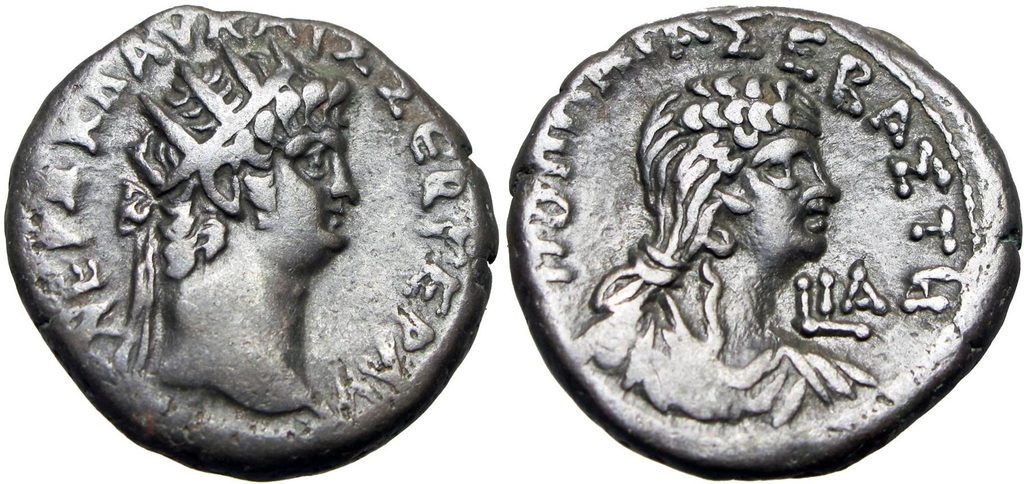
Tacitus attributed her death to a kick from Nero during an angry outburst. Suetonius also accused the emperor, although the circumstances cannot now be established with confidence. Some modern historians suspect a pregnancy complication and regard the murderous kick as part of the hostile storytelling around Nero. His public response, however, was elaborate mourning. He had Poppaea’s body embalmed rather than cremated and placed in the imperial mausoleum. At her funeral, he praised her beauty and recalled their dead daughter.
The Senate declared her a goddess. In the imperial household, Nero began seeking someone who looked like her. Dio described an initial attempt involving a woman, whom Nero summoned and kept with him, before turning to Sporus. The historian explained the castration and marriage as stemming from the emperor’s longing for Poppaea. How much that explanation reveals about Nero, and how much it reflects later efforts to make sense of his behavior, remains uncertain.
By the time he married Sporus, Nero also had another wife, the aristocratic Statilia Messalina. Her presence did nothing to prevent him from publicly treating Sporus as an empress. Calvia Crispinilla, a high-ranking court woman, supervised his care and wardrobe. He traveled in a litter wearing imperial finery, and people addressed him as “lady” and “queen.”
Dio Chrysostom, a Greek speaker who lived through Nero’s reign, described Sporus with his hair parted, dressed in women’s clothing and accompanied by female attendants when he went walking. He “was forced to do everything else a woman does in the same way,” Chrysostom wrote. The elaborate wedding belonged to an arrangement that extended into his clothes, his company, and his movements outside the palace.
In Greece, Sporus accompanied an emperor determined to display his own talents. Nero competed as a musician, actor, and charioteer, and the festivals adjusted their schedules to accommodate him. At Olympia, he entered a race with a ten-horse team, fell from his chariot, and failed to finish. He nevertheless received the victor’s crown. The judges later received Roman citizenship and money.
The performances also brought Poppaea’s likeness before an audience. When Nero played women in tragedies, Dio wrote, his masks reproduced her features. His repertoire included a woman in labor. In the historian’s account, the masks let the dead empress keep taking part in the spectacle.
For an audience, watching Nero perform came with responsibilities. Tacitus described soldiers stationed among spectators at performances in Rome, correcting people who applauded too slowly or disrupted the organized clapping. Informers watched faces and noted who looked pleased, who looked unhappy, and who stayed away. People visiting from provincial towns, unfamiliar with the routine, struggled to keep up. An emperor who appeared before a crowd and submitted to its judgment still had ways of making sure it delivered the right response.
Back in Rome, Nero took Sporus through public places and kissed him openly. Those who watched saw the emperor behaving as a husband toward someone dressed as an imperial wife. In Chrysostom’s description of the court, “no one contradicted him in anything.”
The ancient authors who preserved these scenes were often more interested in condemning Nero than understanding Sporus. For them, the emperor’s sexual conduct, theatrical ambitions and treatment of a young freedman all supplied evidence of a ruler who disregarded the restraints expected of him. Suetonius followed his description of the wedding with a joke that the world would have been better off if Nero’s father had married that sort of wife.
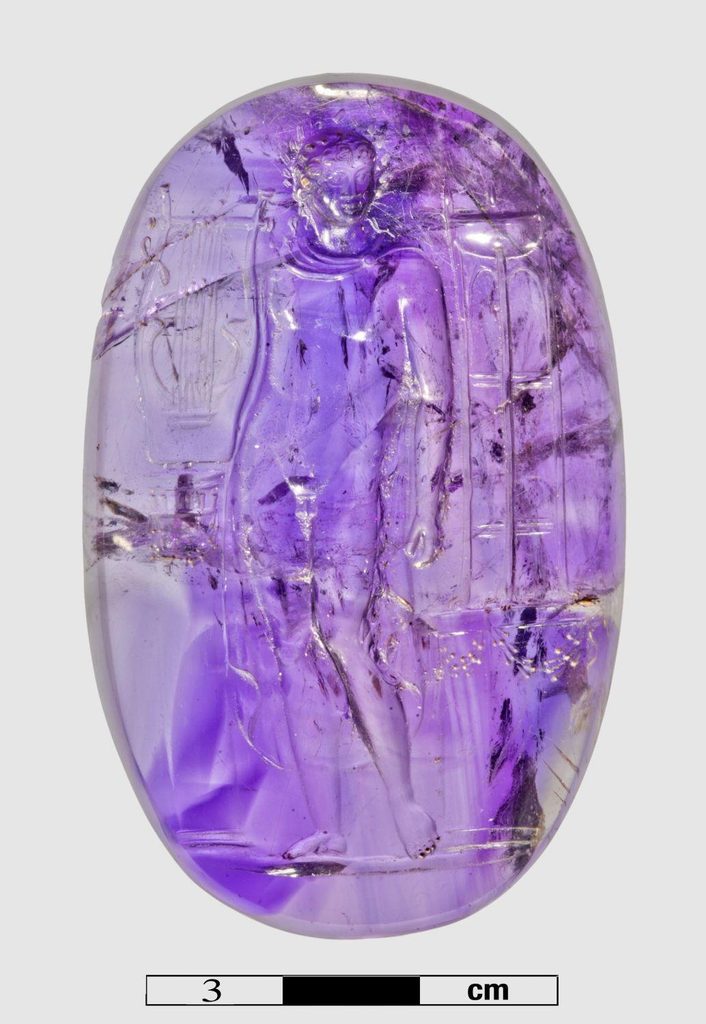
Among the few recorded actions of Sporus himself was an unusual gift. While Nero was taking the auspices, seeking signs of the gods’ intentions, Sporus gave him a ring. Its engraved gem depicted the abduction of Proserpina, whom the ruler of the underworld carried away to become his wife. Suetonius placed the gift among the omens preceding Nero’s fall. The historian David Woods has suggested that Sporus deliberately chose an unsettling image, but the surviving evidence does not establish his intent.
By the spring of 68, Nero faced opposition that could not be managed through applause or ceremony. Revolt broke out in Gaul, and Galba, a governor in Spain, emerged as a rival for the throne. In Rome, Nymphidius Sabinus, another commander of the Praetorian Guard, persuaded the soldiers to support Galba with promises of an enormous payment.
Chrysostom gave Sporus a part in this collapse. He claimed that the young man, angry at his treatment, disclosed Nero’s plans to members of his retinue, causing them to desert him. He did not explain which plans, and the other surviving narratives do not establish that Sporus caused the defections. Yet the claim complicates the familiar picture of a companion who stayed loyal until the end.
In the accounts of Nero’s final flight, Sporus was among the few people who went with him. In June, the emperor left Rome at night with four attendants and headed for a country property belonging to his freedman Phaon. Nero wore a faded cloak and covered his head, with a handkerchief held over his face. Near the villa, the party made its way through reeds and brambles. He crawled inside through a narrow opening.
Suetonius described the emperor lying on a mattress under an old cloak, unable to bring himself to die. He tested the points of daggers, put them away, and asked someone else to kill himself first as an example. He also turned to Sporus and asked him to begin lamenting. When horsemen approached, Nero killed himself with help from his secretary, Epaphroditus.
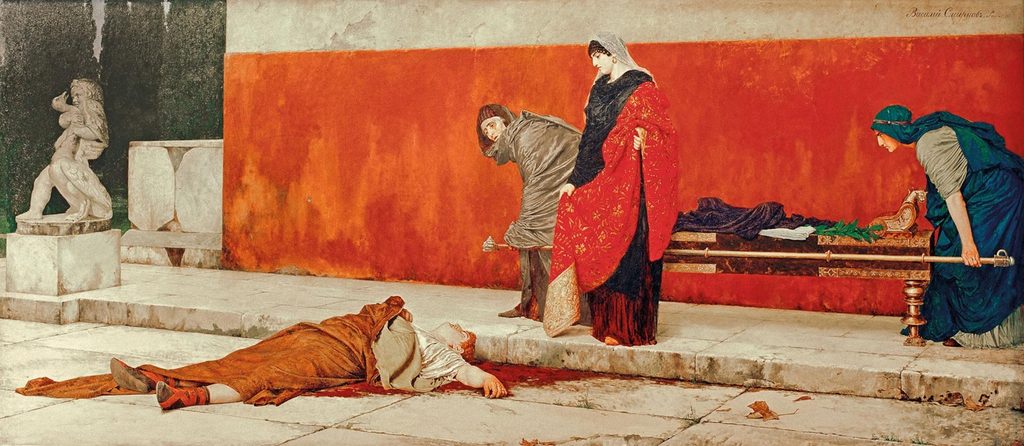
Sporus’s presence has sometimes been treated as proof that he loved Nero, although it cannot tell us what choices he believed were open to him. Surviving the emperor did not free him from men who wanted to occupy Nero’s place.
While Nero’s body was still burning on its funeral pyre, Nymphidius sent for Sporus. Plutarch described the guard commander taking him as his consort and calling him Poppaea.
Nymphidius had helped make Galba emperor but now wanted the throne himself. He approached the guards’ camp at night, carrying a speech he had learned by heart, expecting the soldiers to proclaim him emperor. Instead, they shouted their loyalty to Galba. Nymphidius tried joining in their cries, then fled when men advanced toward him with swords. They found him in a soldier’s hut and killed him.
Within months, Galba was dead too. In January 69, rebellious soldiers murdered him and installed Otho as emperor. This was the same Otho whose marriage to Poppaea ended when Nero wanted her. After years in provincial government, he supported Galba’s rise, then turned against him when his own hopes of becoming the older man’s successor were disappointed.
Now Otho occupied the palace, and Sporus was among his intimates. Cassius Dio noted the signs that Nero’s old circle was regaining influence. He did not describe another wedding.
Otho showed little inclination to reject Nero’s memory. When crowds hailed him as Nero in the theatres, he initially accepted it. Statues of the dead emperor reappeared, and official courier documents even carried Nero’s name alongside Otho’s, until objections from prominent Romans persuaded him to stop. The Senate restored Poppaea’s images.
For people from the old court, survival depended on more than their previous closeness to Nero. Tigellinus, who gave Sporus away at the wedding, faced persistent public demands for punishment. When Otho sent a messenger to fetch him, he tried unsuccessfully to buy his escape and then killed himself. Calvia Crispinilla, the woman who managed Sporus’s wardrobe, also faced calls for punishment, but Otho helped protect her. Marriage to a former consul improved her position, and she survived successive changes of ruler, eventually wielding considerable influence through her wealth.
Otho had little time to settle into power. Armies supporting Vitellius, the commander in Lower Germany, advanced into Italy. After his forces suffered a major defeat, Otho killed himself in April 69. His reign lasted about three months.
Vitellius brought his own enthusiasm for Nero to Rome. He held public funerary rites for the dead emperor and, at a banquet afterward, asked a musician to perform something Nero composed. Suetonius described him applauding enthusiastically and jumping with pleasure.
The role proposed for Sporus in the new reign was also a public performance. During preparations for games under Vitellius, a plan emerged to put him onstage as “a maiden being ravished,” in the surviving words of Cassius Dio.
Dio did not name the character or explain whether the assault would have been simulated. He recorded that Sporus refused to endure the humiliation. Sometime in 69, before the performance could take place, Sporus killed himself.