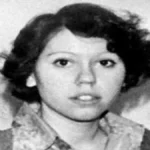

On the morning of June 24, 1974, 14-year-old Margaret Ellen Fox left home and made her way to a bus stop near her family’s house in Burlington, New Jersey.
She wore a blue blouse, a white-and-black checkered jacket, and jeans with a yellow patch on one knee. Margaret also had brown sandals, a gold necklace set with a blue stone, and a matching charm bracelet.
She was missing two front teeth on the upper right side of her mouth and wore eyeglasses with hexagonal gold wire frames.
Margaret was on her way to a babysitting job in Mount Holly, to which her father, David, had granted express permission.
Her younger brother, Joe, walked Margaret to the bus stop near their house and watched her board the 8.40 am bus to Mount Holly, about seven miles from home. She was traveling alone.
Margaret got off the bus around 9 am. She had been instructed to look for a red Volkswagen at the corner of Mill and High Streets.
Her employer was supposed to meet her there before taking her to their home. That was the last time she was seen, according to witness accounts.
Her parents had instructed Margaret to call them the moment she arrived at the house, but the phone remained silent. By noon, anxiety was beginning to build in the Fox household as Margaret was known to be punctual.
Her mother, Mary Fox, dialed the phone number the employer named ‘John Marshall’ had left with the family. It rang repeatedly with no answer.
Someone finally came to the phone in the mid-afternoon. But Mary quickly realized she was not speaking to a homeowner but a bystander who was apparently answering a public payphone outside the A&P grocery store in Lumberton, New Jersey.
Realizing they had been deceived, Mary frantically grabbed the phone book and scanned every listing for a “John Marshall” in the area, but found nothing helpful. Finally, David got into his car and drove up and down the streets of Mount Holly, scouring the parking lots, hoping to catch a glimpse of his daughter or a red Volkswagen.
David returned home at midnight, exhausted and empty-handed. Within the hour, David and Mary reported Margaret missing to the Burlington City Police Department.
Two Girls and a Newspaper Ad

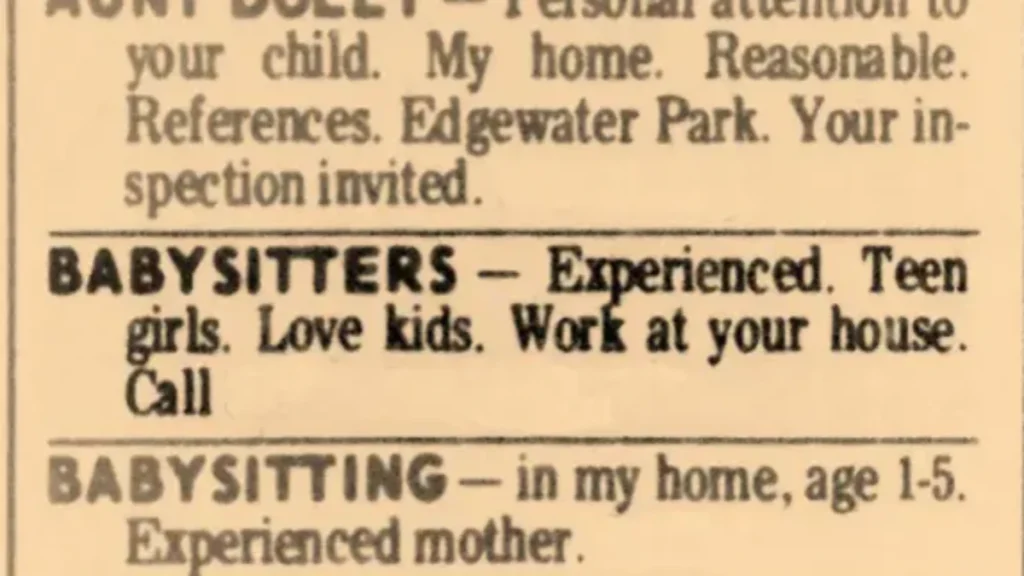
The chain of events that led Mary to the intersection in Mount Holly began with a classified ad. Margaret and her cousin, Lynne Park, placed a notice in the local paper, advertising themselves as babysitters.
Margaret pushed for the idea, though her parents were skeptical about her working for strangers. Her father eventually agreed to let her go ahead with the ad.
A man answered the ad she placed and first called Lynne, saying he needed someone to watch his child at his home in Mount Holly. However, Lynne’s mother would not allow her eleven-year-old daughter to travel out of town for a job, so Lynne passed the man’s number to her cousin.
When he called Margaret, the man introduced himself as John Marshall, saying he needed a sitter for his five-year-old son. The job would be on weekdays from 9.30 am to 1.30 pm, and it paid $40 a week.
David spoke with Marshall on the phone during these arrangements and came away satisfied enough to let his daughter take the job. In part, he was disarmed by the mention that Marshall’s wife would be the one actually to pick Margaret up in Mount Holly.
The two had originally arranged to meet on June 21, but Marshall called to postpone, saying there had been a death in the family, so it was rescheduled to the following Monday, June 24.
The Payphone at the A&P
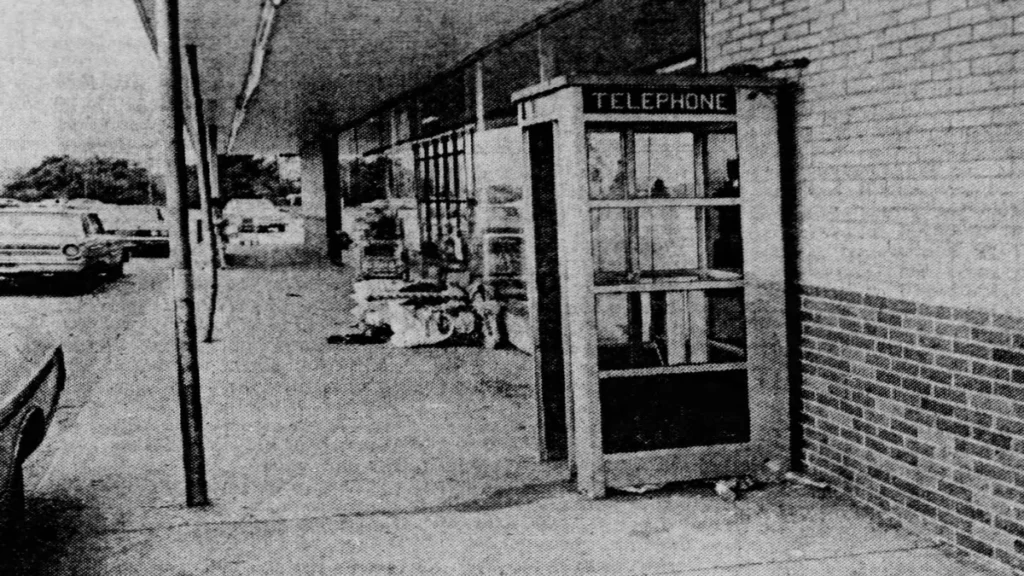
Once investigators traced Marshall’s number to the payphone outside the Lumberton A&P, the case was treated as a probable abduction as opposed to a runaway.
Detectives then interviewed passengers who had ridden the same bus as Margaret that morning. They also looked into all A&P customers and employees that morning and asked whether they had seen anyone using the phone booth that day.
A passenger who rode part of the route told investigators that Margaret had spent the trip talking with a young boy seated nearby and that she let him play with her hair. Other witnesses in Mount Holly reported seeing a girl matching her description at the intersection of Mill and High Streets, standing near a red Volkswagen.
One coincidence complicated the investigation almost immediately, though. An assistant manager at the same A&P store happened to be named John Marshall.
He was interrogated multiple times, given polygraphs, and ultimately cleared after giving a verified alibi. Investigators determined the alias was either a coincidence or deliberately chosen as a misdirect because the caller knew an employee by that name who worked near the phone he was using.
Police also identified a man in a red Volkswagen near the intersection, and he was questioned. After repeated interviews, the investigators concluded that he was not involved.
“Your Daughter’s Life Is the Buttered Topping“
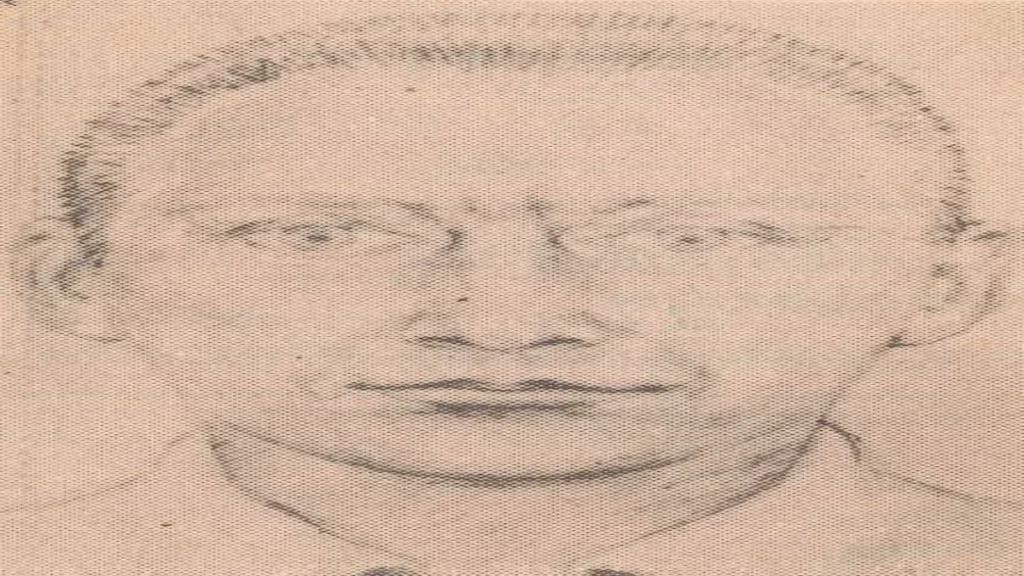
Since the circumstances surrounding the ‘John Marshall’ offer were very suspicious, the Burlington City police department and local authorities decided to place a recording wiretap on the Fox home telephone line.
Four days following the disappearance, the phone rang. Mary Fox answered the phone, and the wiretap captured a chilling interaction with an unidentified man.
He claimed to have Margaret in custody and was demanding a ransom of $10,000 for her safe release. According to the New York Post, the man coolly said, “$10,000 might be a lot of bread, but your daughter’s life is the buttered topping.”
A stunned Mary Fox was heard asking, “Who is this?” but the man hung up. There was no drop-off location or instructions on how to pay. He did not even offer proof of life before hanging up.
Immediately after the call, the police attempted to trace the line. But due to the short duration of the call and the limited technology of the time, investigators were unable to trace the physical location from which he made the ransom demand.
On June 29, 1974, a letter arrived at the Fox household repeating the exact phrasing, “$10,000 is a lot of bread, but your daughter’s life is the buttered topping.”
Unlike the phone call, this letter included actionable instructions telling the parents to place $10,000 in a box wrapped in blue wrapping paper. It also explicitly stated it should match Margaret’s blouse.
According to the Inquirer, the author said, “Margaret is alright. We only tore her blouse and broke her glasses. Follow the instructions.” David and Mary immediately went to the bank, withdrew $10,000, and even wrapped it as requested.
However, the letter did not specify where or when to leave the box, leaving them in limbo. Two days later, the family received another letter. This one repeated the phrasing but altered the grammar to past tense.
Chip Chick reported it read, “Ten thousand dollars was a lot of bread, and your daughter’s life was the buttered topping.” The author claimed the exchange was officially called off because the parents had mismanaged the ransom arrangements.
Despite the grim nature of the situation, David never lost hope, telling the Burlington County Times, “I have a feeling that in my search she will break out and I will be there at the right time and place.”
The Pattern
Local detectives and federal agents seized the letters from the Foxes and processed the paper to isolate any latent fingerprints. They systematically ran the prints against records of local military personnel, federal employees, and offenders booked by the county jail or the prosecutor’s office. No match was found.
The second letter ended with “So Long Again,” where the S, L, and A were highlighted. The FBI cross-referenced this with the SLA, which is a domestic terrorist group that had dominated global headlines months prior by kidnapping heiress Patty Hearst.
Intelligence analysts noted the SLA had no operational presence in New Jersey at the time. So the FBI ultimately concluded that the signature was an intentional misdirection by a local offender, capitalizing on news cycles.
When the ransom demands stopped, detectives shifted their focus onto how Margaret was lured. They looked through the regional classified sections and questioned the local families as well.
Police then discovered a pattern. Several other parents in the Burlington area came forward to report that a male caller had previously tried to entice their daughters with fake ‘out of town’ babysitting jobs.
This confirmed the theory that they were hunting a calculated regional predator. However, the man’s identity was masked by using public payphones.
Margaret’s case is another example of how an ordinary interaction became the start of a disappearance. It resembles the Leonard Dirickson story, where he vanished after leaving his farm with a stranger.
The Confession and Hoax
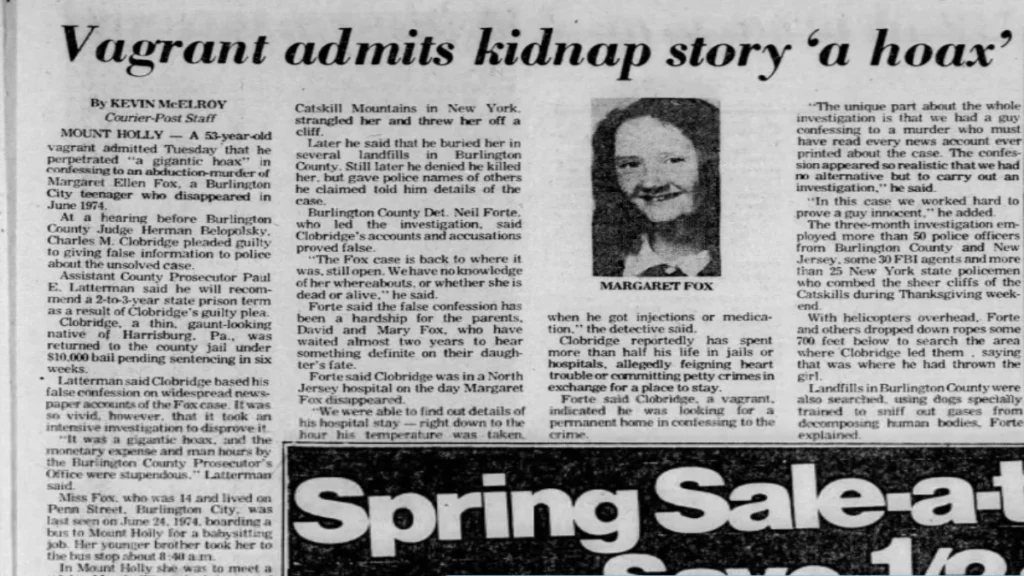
For nearly two years after her disappearance, the Burlington City police and the FBI chased down hundreds of dead-end leads. The trail of physical ransom letters and the telephone booth in Lumberton also went cold.
In January 1976, rumors began circulating in the New Jersey and Pennsylvania media that there was a major break in the case. Patch News reported that Charles Clobridge, a thin, gaunt-looking vagrant from Harrisburg, Pennsylvania, who was under arrest for larceny, claimed he had strangled Margaret and “threw her off a cliff.”
Some 50 law enforcement personnel spent 1975 Thanksgiving investigating this claim. Investigators obtained medical logs which proved Clobridge was physically admitted and staying inside a hospital at the exact time Margaret boarded the bus and vanished.
Faced with the conflicting evidence, Clobridge broke down and admitted he fabricated the entire confession. He falsely confessed to a high-profile child murder in the hopes of getting a life sentence in prison so he could have permanent access to clothing, housing, and food.
The state of Pennsylvania prosecuted Clobridge for his actions. At the hearing, Assistant County Prosecutor Paul Latterman recommended a two- to three-year prison term.
According to the Courier Post, he stated, “It was a gigantic hoax, and the monetary expense and man-hours by the Burlington County Prosecutor’s Office were stupendous.”
The hoax took an immense psychological toll on David and Mary Fox as they were forced to endure the media circus and brace themselves for the recovery of their daughter’s body, only to find themselves back at square one.
Burlington County detective Neil Forte told Patch, “The Fox case is back to where it was, still open. We have no knowledge of her whereabouts, or whether she is dead or alive.”
The Body that was Not Margaret
In 1988, a group of community volunteers was working in a heavily wooded area below Bayside Drive in Atlantic Highlands. They were clearing space for a municipal bicycle trail, and they stumbled upon a human skull.
Police were immediately called to the scene, and a thorough forensic excavation of the site unearthed some decomposed skeletal remains. Alongside the bones, investigators found fragments of clothing, including a bra, knee socks, and a pair of sandals.
State anthropologists determined the victim was a white female between the ages of 15 and 18. She had likely been killed and left in the woods between 1973 and 1975.
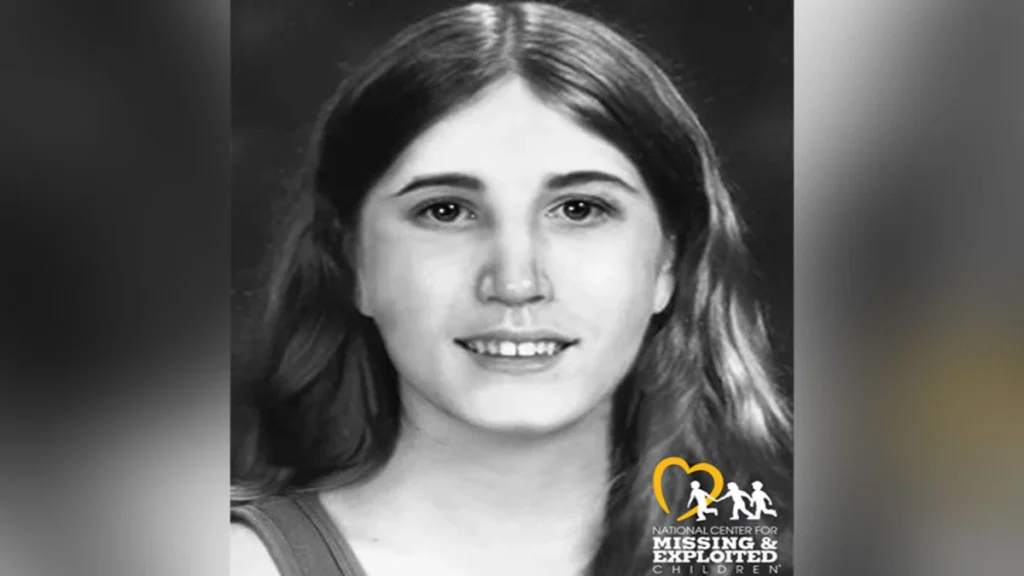
A forensic reconstruction of what the girl looked like in life also showed a striking resemblance to Margaret. Burlington City detectives rushed to match the skull against Margaret’s dental records but discovered that in the 18 years following her abduction, the department had completely misplaced her original dental charts.
With no records and no usable fingerprints from the decomposed remains, the investigation immediately stalled. In 1997, the Monmouth County Prosecutor’s Office sent pieces of the skeletal remains to Labcorp for advanced mitochondrial profiling.
Detectives also secured a reference DNA sample from Margaret’s maternal family line, and the results came back officially ruling her out as a match.
These remains were later identified in 2022 as Nancy Carol Fitzgerald. She was 16-years-old when she disappeared from her home in Bloomfield, New Jersey, in 1972.
Law Enforcement’s Commitment Decades Later
Interest in the case resurfaced in 2017 when retired Willingboro police detective Michael Dalesio partnered with the Burlington City police to take a fresh look at the case.
At the time, he also expressed uncertainty about what happened to Margaret, telling the Philadelphia Inquirer, “Is she alive? I hope so. Maybe she felt she wanted a new life, but how could she fall off the grid like that for so long?”
Two years later, on the 45th anniversary of her disappearance, the FBI Newark Field Office and Burlington City police held a press conference announcing a $25,000 reward for information that would lead to an arrest. They also released the ransom call recording.
The Burlington City police Chief John Fine explained to Patch why the recording had been withheld: “From what I understand through speaking with the original investigators, they didn’t know if the audio was part of a hoax or an opportunist trying to capitalize financially on the disappearance.”
He also added that the case had been passed down through generations of law enforcement: “Many retired officers who worked this case still wonder what happened to Margaret. Unfortunately, many of the original investigators died without knowing the answers they had worked so hard to find. We do it in honor of them too.”
The same Patch piece reported the stance of Justin Notarfrancesco, the FBI agent overseeing the case from the Newark Field Office. He claimed the bureau released the recording in hopes someone would recognize the caller’s voice and that it would generate leads.
“We believe this case, and cases like it, is as important now as it was 50 years ago. It is important that we try to get as much closure for families as we possibly can.”
He added, “The reality with cases like this is they become extremely difficult to solve as time passes. However, the FBI never loses hope that these cases will eventually be solved. All it takes is one small tip from the public to solve the whole thing.”
Unfortunately, Margaret’s parents did not live to see the case develop to this point. Her father, David, spent 1992 agonizing over the bureaucratic roadblock and ultimately passed away the next year from natural causes related to old age.
Mary survived her husband by a decade, passing away in 2003 at the age of 81. She also passed away from old age.
Several of Margaret’s siblings are still alive, though none appeared at the 2019 press conference announcing the reward. Choosing to remain publicly silent, they have stated their preference for letting law enforcement handle public appeals.
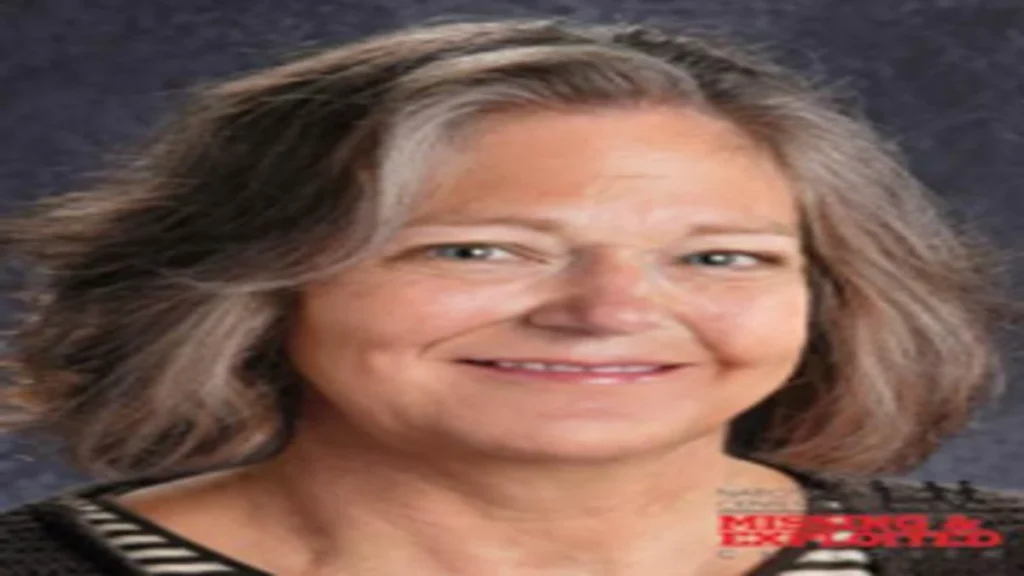
If Margaret were alive today, she would be 66-years-old. The FBI and law enforcement have classified the case as a highly active cold case.
Authorities have also released age-progressed images over the years. Anyone with information is asked to contact the FBI’s Newark field office at 973-792-3000 or the Burlington City Police Department at 609-386-3300.
For more stories on unsolved disappearances, explore our articles on Jodi Huisentruit and Leigh Occhi.