
“The con-artist’s job is to hoodwink the enemy instead of slugging it out with him.” — Ralph Ingersoll.
Had a young German scout stumbled upon Bill Blass or Ellsworth Kelly in the autumn of 1944, he might have found them inflating a Sherman tank (which, to be fair, wasn’t much of a tank anyway).
The “tank”, in fact, was nothing more than the ingenious brainchild of a troop of artists and actors during the Second World War. Layers of painted rubber and canvas had been meticulously shaped to mimic the silhouette of an M4 Sherman tank.
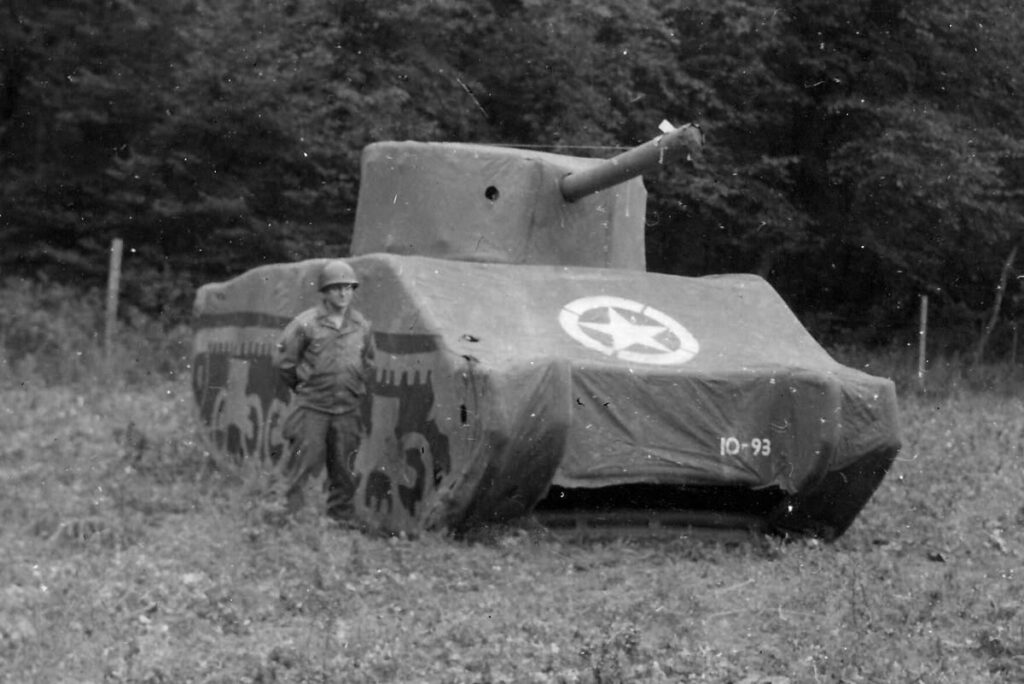
Bill Blass (who would later become one of America’s most celebrated fashion designers) and Ellsworth Kelly (the future pioneer of abstract art) were among the 1,100 men of the 23rd Headquarters Special Troops, better known today as the Ghost Army, a top-secret American tactical deception unit, who were behind these so-called ‘tanks’ and other such artillery.
The Problem With Winning a War
The Allied High Command faced a grim dilemma in late 1943. From the beaches of France to the forests of Poland, much of continental Europe lay under the shadow of the Third Reich, and every inch that the Allies hoped to reclaim would have to be fought for, tooth and nail.
An Allied invasion of Europe meant moving hundreds of thousands of troops, tanks, and supplies across an active front.
The problem, however, was that their troop movement risked being detected by German reconnaissance aircraft and intelligence networks.
A single sighting could reveal Allied intentions, allowing the Wehrmacht to reinforce the very sectors the Allies intended to attack, thus foiling their intentions.
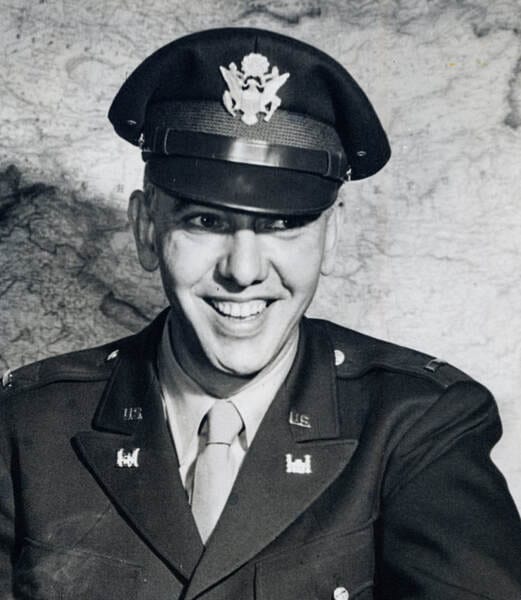
This was the conundrum that lay on the desk of Colonel Harry L. Reeder, Jr., commander of the newly conceived 23rd Headquarters Special Troops, and Ralph Ingersoll, a journalist turned Army planner.
Their solution would prove as audacious as the problem itself.
The slow, lumbering movement of the Allied troops would definitely not escape the hawkish eyes of the Luftwaffe’s reconnaissance squadrons and the Wehrmacht’s intelligence network.
But what if they could create an entirely different (and a lot more visible) army for the Germans to watch?
This was exactly what Reeder and Ingersoll planned to do.
Recruiting the Unlikely Soldier
Executing their plan would require innovation that the US Army had never witnessed before. Wooden artillery and inflatable tanks would have to replace heavy steel and metal machinery.
Further, recruitment here would have to be drastically different from normal US Army recruitment.
The Army actively recruited creative folks such as painters, sculptors, architects, industrial designers, photographers, advertising executives, theatre artists, radio engineers and sound technicians, hoping their civilian professions would aid them in this massive deception that was to be carried out.
The Anatomy of an Illusion
The core of the army was created through four different divisions, each responsible for a different aspect of the elaborate deception.
First, there was the 603rd Engineer Camouflage Battalion, tasked with crafting and deploying inflatable tanks, artillery, aircraft and other believable props.
The 3132nd Signal Service Company Special undertook the generation of convincing fake radio traffic by mimicking the operating styles of real military divisions.
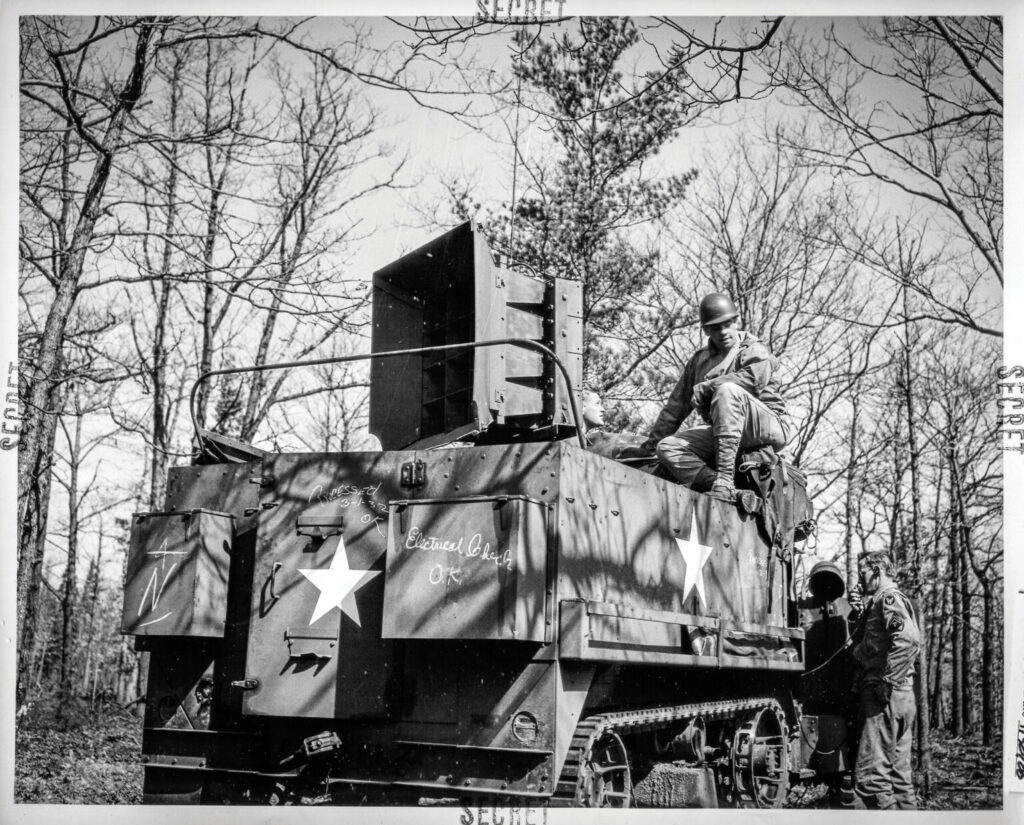
Meanwhile, the 23rd Headquarters Special Troops’ Signal Company operated powerful loudspeaker systems that broadcast carefully recorded sounds of moving convoys, bridge construction and armoured formations, to be deliberately intercepted by the Nazi troops.
Finally, to complete the deception, there was the 406th Engineer Combat Company, whose soldiers posed as members of genuine U.S. divisions, wore counterfeit unit patches, drove vehicles marked with false insignia and casually leaked misleading information wherever enemy spies might overhear it.
The Subtle Art of Deception
Although no single trick was expected to fool the enemy, and the props they had created were quite discernible as fakes upon inspection, the combination of visual, auditory, and human deception did persuade German intelligence into believing that it was observing an actual army.
“The louder we were, the fewer people got killed.”, Seymour Nussenbaum, a Ghost Army veteran, would comment.
Yet, making enough noise to save lives was no routine affair.
Months had to be spent to perfect what was, in effect, a totally new form of warfare. In such a situation, there were no precedents to follow, nor any manuals to refer to.
Every aspect of the deception, from the shape of an inflatable tank to the amount of static to be present in a radio transmission, had to be designed, tested and perfected from scratch.
Moreover, the people who had been recruited had almost no prior experience with warfare either, and had to be trained to ‘act’ their parts.
“Well, it’s a unit– It’s-it’s a decept– It’s a deception, things to fool the enemy. It’s-it’s a– it’s a– It’s an outfit that has been training to fool the enemy.” Jack Massey, a war veteran who had been recruited at around 18 or 19 years of age, would later describe in an interview.
They learnt the histories of the divisions they would impersonate, wore authentic shoulder patches, drove vehicles bearing counterfeit markings, and, most importantly, practised casual conversations designed to be overheard by enemy informants.
Learning to Act a War Out
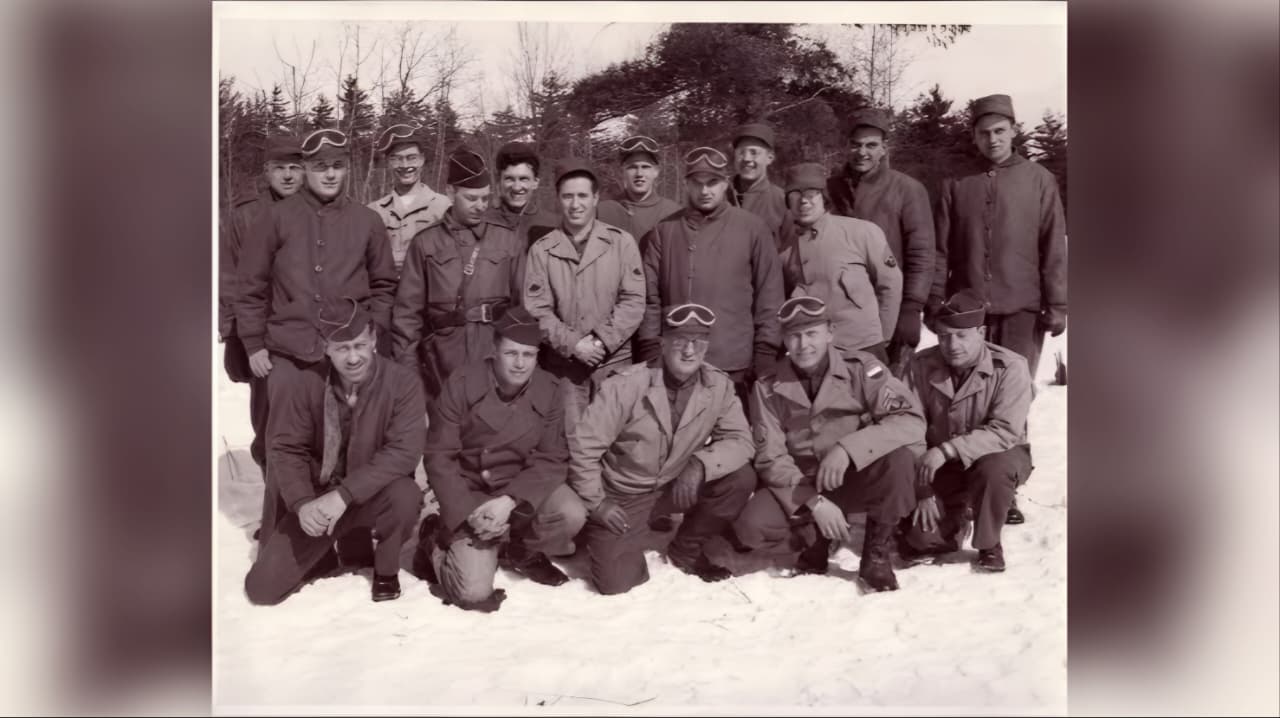
At Camp Forrest, Tennessee, where much of the unit trained before shipping to Europe, a jolly display of interdisciplinary collaboration was put up for show.
For perhaps one of the first times in active warfare, artists worked side by side with engineers, radio operators and combat soldiers in an unlikely collaboration.
To make the deception convincing, speed was of the utmost importance. With the efficiency of the German Blitzkrieg, camouflage specialists learned how to deploy inflatable armour in minutes, thus making the whole act seem genuine.
Radio operators practised reproducing the communication patterns of real divisions, even memorising the distinctive “fists” with which individual operators tapped Morse code.
Sound engineers, on the other hand, experimented with recordings of tank engines, bulldozers, marching infantry and bridge-building equipment, eventually producing audio convincing enough to be heard up to 15 miles (24 km) away under favourable conditions.
By the spring of 1944, the Ghost Army had become a travelling theatre company of sorts, with the Wehrmacht intelligence officers as their audience.
‘Task Force Mason’ Begins
The first major opportunity to put months of preparation to the test for the Ghost Army came only weeks after the Normandy landings. In June 1944, as Allied forces pushed inland through France, this ingenious ‘Army’ was deployed for the first time.
The Ghost Army’s first ‘troops’ reached Normandy in mid-June 1944 as part of ‘Task Force Mason’, a small experimental detachment commanded by Lieutenant Bernard Mason.
The transition was jarring, to say the least. “I can remember the wild difference between last night, when I was in the lovely, quiet, serene countryside, and the grim reality of today”, Sgt. Dowd, one of the deployed soldiers, would later comment.
For an army of men who had almost never seen active combat before, the landscape was ‘unreal’, as Mason himself would later comment.
“There was a cow impaled in a tree that was shorn of all its leaves.. it was so unreal that it is hard to believe” he would say.
Baptism By Fire
The Army’s initial assignment was modest but dangerous. They had to construct dummy artillery positions roughly a mile ahead of genuine American batteries in the hope that German gunners would waste shells on the decoys instead of the real convoy.
The gamble paid off. German artillery and aircraft repeatedly targeted the fake positions (which had intentionally been made easier to spot), while the genuine troops marched ahead relatively unbothered.
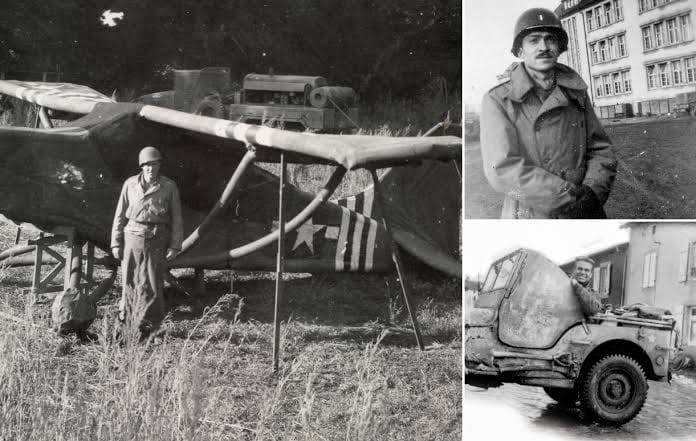
Success here came at a cost, though. The men soon realised that pretending to be an army often meant placing themselves where an actual army was expected to be, but without the defensive mechanisms that the actual army possessed.
“It was kind of scary,” Lieutenant Bernard Mason later admitted.
The Ghost Army had come to France expecting to perform, but the stage in this case was squarely within range of the German artillery.
Operation Brest, and the Army’s First Full-Scale Deception
Task Force Mason had demonstrated that the ‘Ghost Army’s’ inflatable artillery and carefully staged positions could divert enemy fire, but if one were to be honest, it was little more than a modest experiment.
The Army’s first opportunity to employ its entire arsenal of deception would come two months later, during the Allied siege of Brest.
Here, for the first time, inflatable armour, fabricated radio traffic, sound effects and human impersonation in all its glory were orchestrated into a single, meticulously rehearsed performance, called Operation Brest.
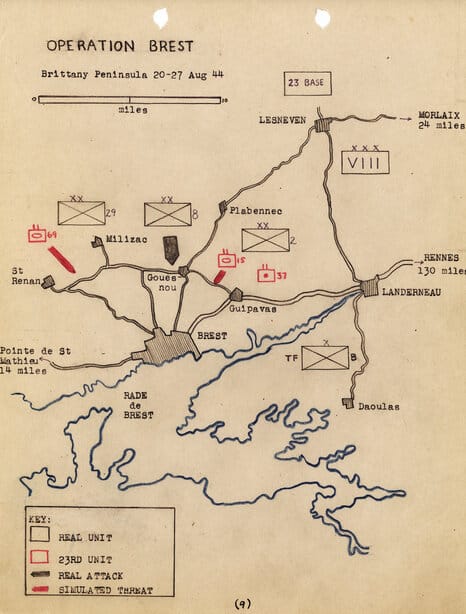
In fact, veteran Corporal Jack Masey described the unit’s first large-scale operation around Brest as “the biggest piece of action I ever saw in World War II.”
To the Germans, it seemed as if entire American troops had materialised overnight, convincing the German General Hermann-Bernhard Ramcke that a far greater force had arrived than was truly present.
With every inflatable tank that was present, matching radio chatter, the sounds of heavy vehicles broadcast from loudspeakers, fresh tyre tracks pressed into the mud, and soldiers wearing the insignia of the divisions they claimed to represent, they trudged along.
Selling the Illusion
Three notional task forces, designated X, Y and Z, were created to impersonate elements of the 6th Armoured Division, even though the real division had already departed the Brest sector.
Real tanks from the 709th Tank Battalion had already driven through the area, leaving authentic tracks in the mud before withdrawing, and loudspeaker half-tracks broadcast the sounds of armour assembling for an assault.
Simultaneously, radio operators flooded the airwaves with convincing traffic that reinforced the illusion of an impending armoured offensive.
American engineers stationed more than a mile away were themselves convinced that a genuine armoured force had arrived, while the Germans were totally baffled.
German forces shifted between 20 and 50 anti-tank guns to counter what they believed was a major armoured thrust on their flank. While the enemy artillery concentrated on the dummy positions, the real American artillery that they were shielding received virtually no counterfire.
Lessons From Brest
General Ramcke refused to surrender, and the siege dogged on for nearly another month.
Although assessments concluded that the Ghost Army had executed its mission “to the smallest detail,” the American attack on 25 August still failed to break the German defences.
Even so, the lessons learnt here would be used later in far more ambitious deceptions at Metz and, ultimately, the Rhine.
Operation Bettembourg
By September 1944, General George S. Patton’s Third Army had reached the heavily fortified city of Metz, one of the strongest defensive positions on Germany’s western frontier.
Patton intended to shift the 6th Armoured Division away from the front for operations elsewhere, but withdrawing such a large formation without alerting German intelligence posed an enormous challenge.
The arduous responsibility for creating the illusion of presence fell, once again, to the Ghost Army, in what would be called Operation Bettembourg, launched in support of Patton’s offensive against Metz.
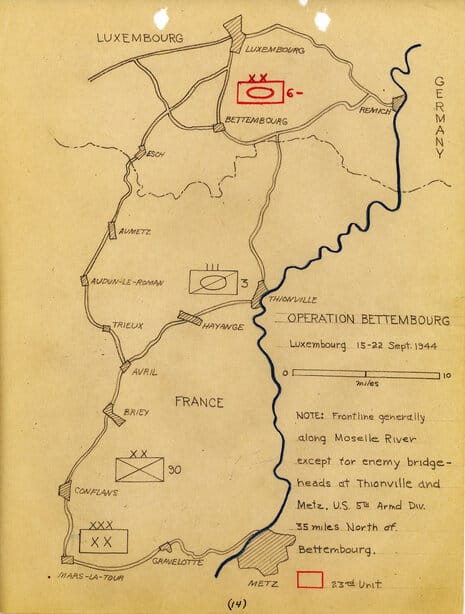
Assuming the identity of the departing 6th Armoured Division, the Ghost Army troops slyly placed inflatable tanks and artillery in place of the actual tanks.
Members of the 23rd Headquarters Special Troops donned the 6th Division’s insignia and deliberately made themselves visible in nearby villages.
The Germans, ingenious as they were, became none the wiser about this switch, and the 6th Armoured Division appeared firmly in place.
“We weren’t behind the front… we were the front.” Jack Massey would later comment.
Four Hundred Men Was All It Took
Risky as it was, the decoy succeeded yet again.
For several crucial days, German reconnaissance failed to detect that the 6th Armoured Division had disappeared from the frontline, and bought General Patton ample time for repositioning the real division with Patton’s Third Army.
Operation Bettembourg marked an important transition in the Ghost Army’s role. The 400-ish men who had been positioned, had cheekily pulled off and act where they pretended to be an armoured division numbering several thousand troops, and the Germans remained blissfully ignorant.
Without firing a shot, the Ghost Army had influenced where German commanders expected to find American troops, and thus, significantly impeded their planning.
The Phantom Crossing
The troop’s success at Metz made them quite a phenomenon among the senior commanders in the Army.
The 23rd Headquarters Special Troops were no longer a passing curiosity, but an important component of battlefield planning.
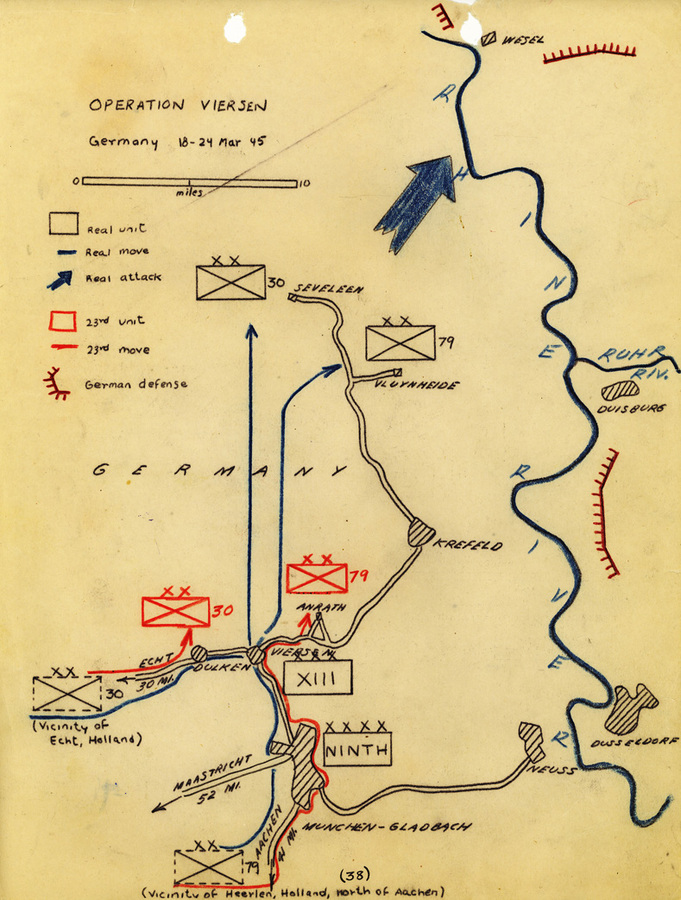
By the spring of 1945 (March, 1945), the Ghost Army would yet again be tasked with an ambitious assignment, Operation Viersen, the deception that would help conceal the Allied crossing of the Rhine.
The Rhine was the last great natural barrier shielding the German heartland, and both sides understood that whichever army crossed it first would dictate the final phase of the war in Western Europe.
German commanders had concentrated thousands of troops, artillery batteries and observation posts along its eastern bank, anticipating that the inevitable Allied crossing would come at one of a handful of predictable locations.
For the Allies in this predicament, the element of surprise was indispensable.
Operation Viersen
During Operation Viersen, the ‘Ghost Army’ was ordered to convince the Germans that two American divisions of roughly 30,000 men were preparing to force a crossing of the Rhine opposite Düsseldorf.
In reality, those divisions were nowhere near the sector. The genuine assault would take place miles away, where General William H. Simpson’s Ninth Army intended to establish its bridgeheads with as little resistance as possible.
The Ghost Army approached the assignment unabashedly, with the confidence of seasoned performers. Inflatable tanks, trucks and artillery once again appeared along the riverbanks, while engineers erected convincing dummy camps, vehicle parks and supply dumps along the bank.
An endless chatter of radio conversation was fabricated by the radio operators, while loudspeaker crews faithfully reproduced the sounds of pontoon bridges being assembled, bulldozers clearing riverbanks and heavy armour moving into position.
“The whole reason for this was to convey the impression… that we’re rehearsing and really about a river crossing,” a veteran would comment upon being interviewed.
“The sounds of tanks moving around… half-tracks… trucks… were brilliantly done.” Jack Massey would say.
Once again, the deception faithfully served its purpose.
The German attention remained fixated upon the phantom army ‘crossing’ the Rhine near Düsdeldorf, allowing General Simpson’s Ninth Army to establish its bridgeheads with far less resistance than might otherwise have been encountered.
In the end, the operation proved so convincing that the Ninth Army’s intelligence staff concluded that, “There is no doubt that Operation VIERSEN materially assisted in deceiving the enemy with regard to the real dispositions and intentions of this Army.”
The Curtain Falls
Within weeks of Operation Viersen, Nazi Germany surrendered. For the men of the Ghost Army, however, there would be no parades celebrating their daring exploits, nor public acknowledgement of the remarkable deceptions they had orchestrated across Europe.
Their mission had been classified throughout the war, and the secrecy remained in force long after peace had returned. Many veterans returned to civilian life unable to discuss their wartime service, even with their own families.
It was only in 1996 that the Ghost Army’s operations were formally declassified, allowing historians to reconstruct the extraordinary story of the 23rd Headquarters Special Troops.
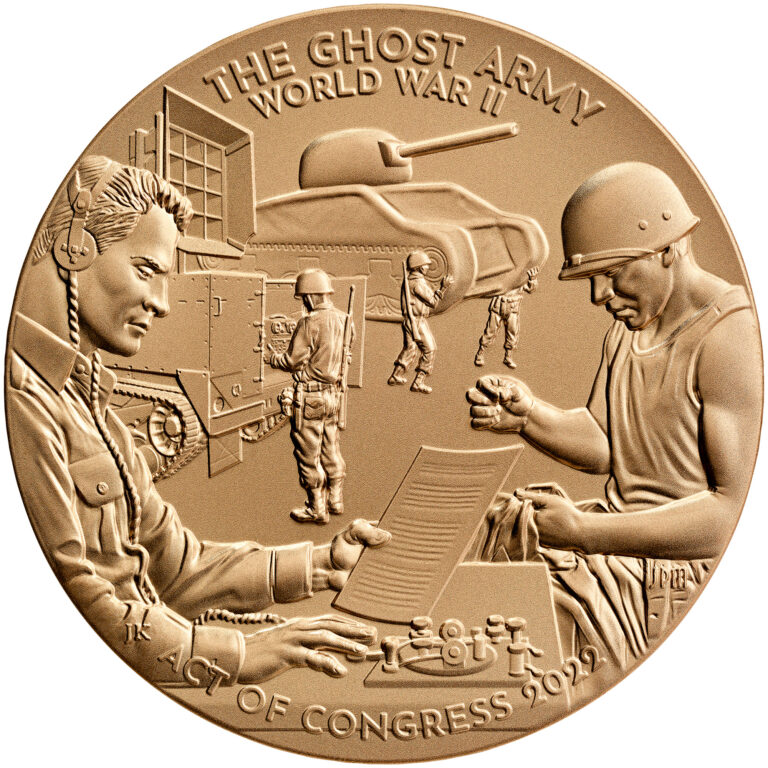
In 2022, the United States Congress awarded the Ghost Army the Congressional Gold Medal, one of the nation’s highest civilian honours, in recognition of the unit’s unique role in helping secure Allied victory.
The Invisible Victors
Bill Blass went on to build one of America’s most influential fashion houses, while Ellsworth Kelly became one of the twentieth century’s foremost abstract artists.
Other veterans of the Ghost Army would also leave an enduring mark on American culture, with Arthur Singer becoming one of the country’s best-known wildlife illustrators, and Art Kane rising to prominence as a celebrated photographer.
Harry Branson, another veteran, contributed to the visual effects industry in Hollywood, each deeply influenced, even in their civilian lives, by their time in the army that was not.
If you like reading about forgotten history, our articles on Poon Lim and The Great Stink of London will surely pique your interest.