

In the 1600s, the rare Semper Augustus tulip became the most coveted flower in Europe. The price of a single bulb climbed to $140,000, the price of a luxurious house in those days. This was Tulip Mania, when flowers became speculative assets, leading to history’s first financial bubble.

A ‘Viral’ Commodity
Before they ever sprouted in Europe, tulips already held the status of prized flowers in the Ottoman royal gardens. But the story of its appreciation among Europeans began when Carolus Clusius, a botanist, planted them in the Hortus Botanicus (botanical gardens) of Leiden University, Netherlands, in 1593.
According to the garden’s official brochure, Clusius obtained the tulips through contacts in Turkey and then created two soil beds in the garden solely dedicated to the flower.
By this time, the Dutch had started to covet the flowers. A few private gardens in the Netherlands already had them. Their value is apparent from a 1610 etching – showing a fence erected to protect them from theft.
Tulips were becoming a popular collector’s item in parts of Europe. But Clusius was reluctant to share his bulbs. He would sell them, but only at a very high price.
He also noticed that some tulips would “break” from one season to another, suddenly blooming in exotic streaks or flames of colour. As per the latest research, the culprit was the Tulip Breaking Virus (TBV).
It caused the petals to develop spectacular feathered/flamed patterns with coloured streaks. One of them was the red-stained variety called Semper Augustus, and the other was Viceroy, a red-stained yellow flower.
An interesting consequence of the Tulip Breaking Virus was that it weakened the bulbs. The prized tulip varieties were also short-lived. This meant that their supply was ever-decreasing. This scarcity kept pushing up the prices of the flowers.
The earliest evidence of the Dutch people catching tulip fever dates to 1614, in paintings of the time. Ambrosius Bosschaert the Elder, a Flemish-born painter, is credited with the earliest paintings of rare tulips. He often painted elaborate flower arrangements, containing the prized tulip varieties.

But tulip trading hadn’t caught on as a speculative activity. That only started happening in the mid-1600s, Dutch opulence rose, and traders sniffed an opportunity in the tulip market.
How Tulips Became Part of the Dutch Golden Age
Until the 1630s, the tulip trade was confined to professional growers and experts – gardeners, botanists, wealthy collectors, horticulturists and bloemists (Dutch word for florists). The market was still an elite niche carved out by the cream of society.
But things changed when the prices started rising. Traders realised the bulbs could be bought & resold for a profit, and soon enough, tulips were being bought not for their beauty but for the possibility of appreciation.
And the Dutch Golden Age added fuel to the fire. Historian Jonathan Denby explains how it happened in his article.
He elaborates that the 1630s were a period of unprecedented prosperity. The East India Company’s profit and the spending power of the merchant classes were at an all-time high. This surplus income was invested in gardens and rare flowers. Tulips fit perfectly into this culture because they were imported, scarce, and visually striking.
Before the 1630s, tulip bulbs were only physically traded among growers in the summer, when they could be safely uprooted. That had developed into an informal spot market for individual commodities where cash and real assets traded hands. But one fine summer, this system had changed.
Growers started selling unharvested bulbs via promissory notes. This helped the growers secure credit and finance future planting rounds, and also limited risk to the lender, who used the borrower’s bulb as collateral.
But there was one caveat to this system: the notes allowed for zero or only a limited opportunity to inspect the goods. There was no guarantee of quality. In fact, one couldn’t even ascertain whether the bulbs were owned by the seller or even existed.
With promised deliveries of the tulip bulbs months away, the interval allowed florists to buy & resell promissory notes. The world’s first futures market was created.
Prior to the informal futures market, a bulb cost around 1000 guilders. When speculation started in the 1630s, the price rose to 3000. Around 1635, at the peak, a bulb could cost 5000 guilders – the price of a luxurious Amsterdam house back then and $250,000 in present-day money.
What followed was a period of hysteria and madness. This was the world’s first asset bubble!

How The First Financial Bubble in History Began
Despite what stories say, the hysteria wasn’t a visible, on-the-face craze. In fact, it happened quietly. The select few elite of society met in taverns. That’s where buyers & sellers interacted, bargained and closed deals. All over a few drinks!
But, according to historian Anne Goldgar’s article, these gatherings also had some structure. The traders in these taverns met as groups called ‘colleges’. There were rules, bidding rituals and also transaction fees called ‘wine money’. Buyers were required to pay 3 guilders for every closed deal.
The deal would come with a fixed settlement date in the future. Typically, neither the buyer nor the seller had the agreed-upon cash, nor did the seller have the bulbs indicated. Neither party intended to deliver on their promise. Only the difference between the contract price & settlement price was expected to be paid.
On the face of it, these transactions seemed quite normal & polished. Quite far from the supposed ‘madness’, but there was indeed a suspension of logic reflected in the rising price of the bulbs.
At the height of tulip mania, a Semper Augustus bulb was recorded as costing 10,000 guilders (equivalent to $1,000,000 in present-day purchasing power). By the winter of 1636, this flower had become one of the most expensive assets across Europe.
While traders revelled in the profits, the literature & art around the tulip trade changed tone – from admiration to mockery.
Fall From Grace
During the peak of Tulip Mania (1636-1637), works of literature & art spoke of the tulip craze in tones of wonder and disapproval. Social opinion back then deemed that first, it was insane to place so much value on a mere tulip bulb, and second, that it was unvirtuous to make money without labour.
The most famous examples of art from this period are paintings by Jan Brueghel the Younger, such as A Satire of Tulip Mania, in which speculators appear as monkeys. One can see monkeys negotiating, weighing bulbs, fighting, crying in the stocks, getting dragged to their graves & more.

The message was that tulip traders had stooped below human dignity and had become creatures driven by vanity & greed. While the madness drove up demand for tulips, it also ramped up production of myths & satire.
There are stories of houses, estates & businesses being mortgaged for participating in the trade. In his book, Extraordinary Popular Delusions And The Madness Of Crowds, historian Charles Mackay narrates a fun anecdote about a sailor who mistook the valuable tulip bulb of a merchant for an onion and grabbed it to eat.
The merchant and his family hunted down the sailor to find him “eating a breakfast whose cost might have regaled a whole ship’s crew for a twelvemonth (a year)”. The sailor was supposedly jailed for eating the bulb.
By circa 1637, Tulip speculation had begun to take on an air of absurdity. One thing led to another, and in one fine trading session, the bubble burst.
The Tulip Mania Crash of 1637
By late January of 1637, a subtle shift had happened. Some florists had begun liquidating holdings instead of reinvesting. This was an early warning sign and the beginning of the end. The problem became visible in an auction in Haarlem, a city in the Netherlands.
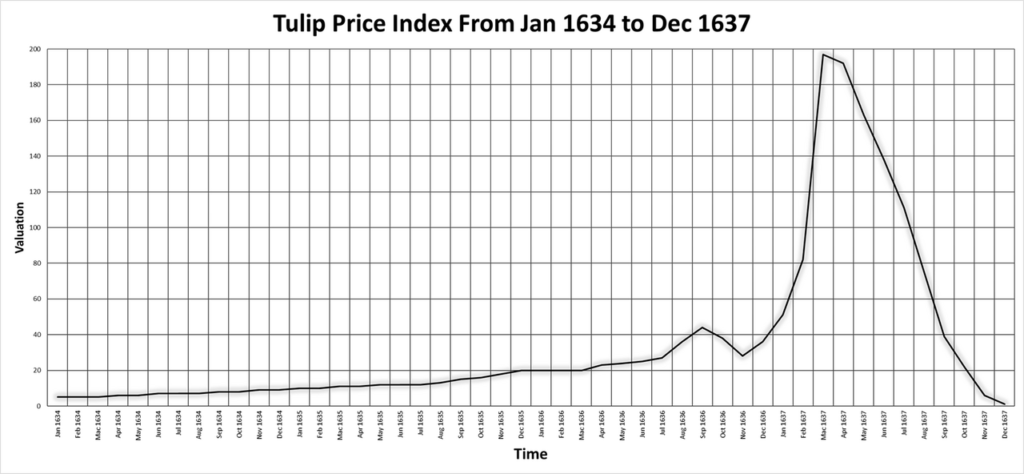
One fine day in February, an auction in Haarlem began as usual. Buyers & sellers were present, and the bidding started as usual. But the first offer of bulbs didn’t receive any bids. The price was lowered, but there was no response, so the sellers cut it again.
An article in the Encyclopedia Britannica notes that around this time, faith in ever-rising prices was shaken. Traders who had bought bulbs and needed to sell panicked, but there were no buyers left.
But unlike other market crashes, the key issue wasn’t loss of capital. The central problem was contract enforceability. Traders refused to honour high-priced agreements, and the pricing structure collapsed overnight.
But this didn’t affect the Dutch economy overall. Contrary to folklore, there was no big depression. The crash affected only the small circle of tulip traders who participated in the market.
Historian Anne Goldgar says in her History Today essay, “The people who stood to lose the most money in the tulip market were wealthy enough that losing 1,000 guilders wasn’t going to cause them great problems.”
The biggest impact of the tulip crash was culture shock. The trade & credit relationships created up to that point were completely destroyed, and trust was lost. Defaults were dragged to court, but even the courts labelled them as ‘gambling debts’ and refused to enforce them.
Instead, the courts advised traders to settle the contracts on an individual & local basis. Most disputes were ultimately settled for a nominal payment of about 3.5% to 10% of the original contract value.
The World after Tulip Mania
In the early 1600s, financial authorities weren’t so quick to respond to such crises. There were no sweeping reforms made after the incident, but it did instil a lasting distrust of speculative trading.
The Tulip Mania crash became a case study in futures trading. Many called it the first financial bubble in history, and the whole phase became a cautionary tale. The moral? Invest in value, not hype.
Despite the lessons learnt, people never stopped looking for ways to exploit financial systems for profit. Centuries later, a retired couple in Michigan did something remarkably similar with a lottery loophole. Read about it here.