
The purpose of the project was to gather knowledge, experience, and data points to help prepare for an actual mission to Mars. It was to determine the main physiological and psychological effects on astronauts of being in that enclosed environment for an extended period.
The need for this study stemmed from observable effects on expedition crews on the International Space Station following long space missions.
When contemplating missions beyond Low Earth Orbit, such as to the Moon and Mars, it became apparent that the crew’s daily life could be affected by the environment. The need for autonomy, the effects of isolation, and interactions with other crew members became significant factors.
It was determined that a better understanding of these aspects was essential for developing criteria for an exploration mission.
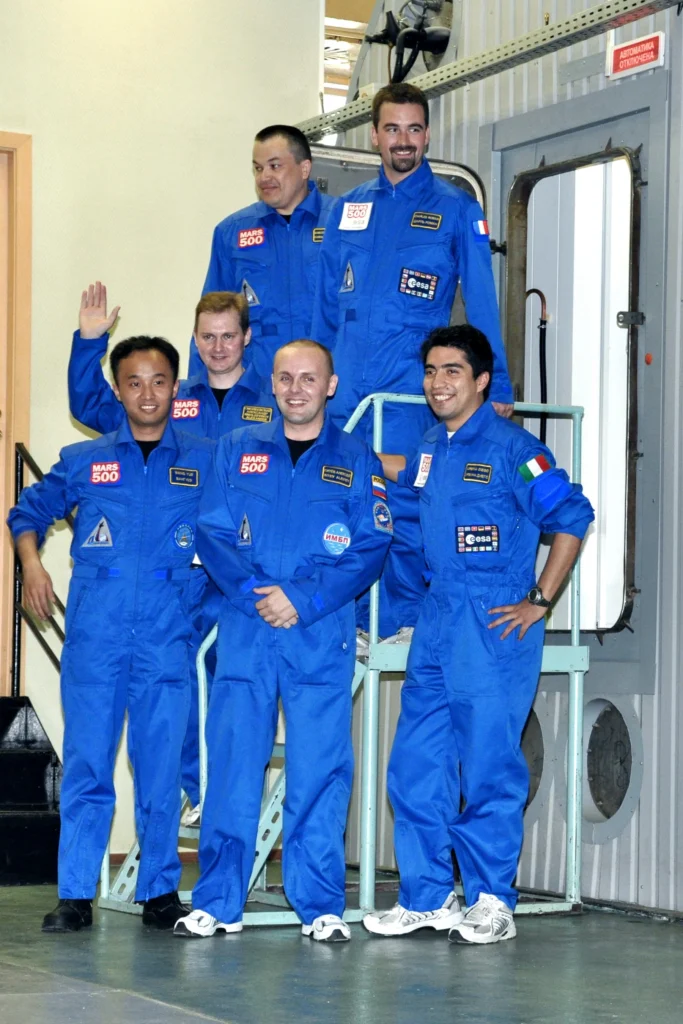
On the morning of June 3, 2010, six men walked into the structure and sealed the hatch behind them. They were not going to see the sky again for 520 days. The makeshift spacecraft was about the size of a modest apartment.
Engineering the Structure
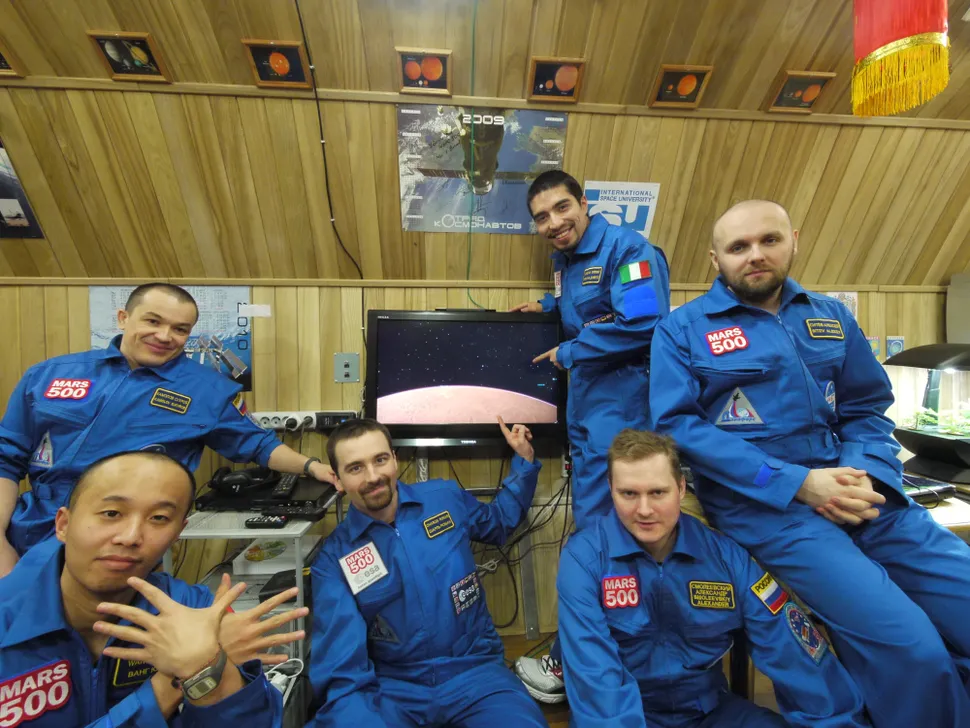
The ESA received funding and other resources from China for the project and opted to run the simulation from the ground. They set up a mock spacecraft with interconnected metal modules. This totalled 550 cubic meters of usable space.
It included a medical module, living quarters, and a Mars lander for simulated surface operations. There was also a greenhouse that served as the team’s farm, producing small amounts of food. A storage compartment with food supplies was available to cater for the entire journey.
The team of six recruited for the mission underwent a thorough selection process. Engineer Alexey Sitey was chosen as team leader and commander. Two other Russian compatriots were also chosen. Flight engineer Alexandr Smoleevskiy and Sukhrob Kamolov as the team doctor.
Engineer Romain Charles from France and Italian-Colombian engineer Diego Urbina represented the European contingent. The final crew member was Wang Yue, a researcher provided by the China National Space Administration.
From the onset, the lack of female candidates for the mission was apparent. According to Yury Karash, a Russian space policy expert, the crew’s gender composition was deliberately chosen to allow the participants to focus on their professional duties rather than inadvertently competing for the attention of any female crew members.
The addition of gender dynamics might have been an unwelcome complication to studying the physiological and psychological effects of long space missions
These men would follow a specific mission profile. That is 250 days of the transit to Mars. The schedule indicated 30 days in Martian orbit. At that time, the team would also practice a surface landing. The final phase of the journey was 240 days for the return leg.
Christer Fuglesang, from the ESA directorate for human spaceflight, stated, “You cannot simulate everything. That is obvious. The scare factor cannot be simulated. It’s true, we don’t have this aspect; they may not come back.”
The diet was supposed to be ordinary. Nothing varies from what the astronauts ate on the International Space Station. It included bread or cereals for breakfast, and fish or pasta for the main dish.
The crew was also given all of the food at the beginning for storage. This was to force them to ration resources appropriately.
The difference was that, unlike real-life astronauts, these participants would not have to deal with zero gravity.
Communication with the outside world would be done via text and video messaging. An artificial time delay was also introduced to match the typical time delays expected in radio signals across space.
At the height of the simulation, the messages would take 25 minutes to reach a party, one way. That meant no immediate response to any request, even in an emergency.
ALSO READ: Project West Ford Was a Wild Cold War Plan in 1963 to Wrap Earth in Copper Needles
Feeling the Effects of Isolation
For the first few weeks and months, the reports from inside the modules were normal. The crew exercised on treadmills and stationary bikes religiously. They also conducted experiments to gauge the effects on their body, and ate carefully rationed meals.
Romain Charles learned a bit of Russian, while Wang Yue improved on his English. Diego wrote a blog to document the experience.
However, the scientists who were analysing the participants noted a slow but steady degradation in their rhythm of life.
Dr Mathias Basner from the University of Pennsylvania analysed the data and realised that the crew’s sleep patterns deteriorated over those 520 days. The men tended to sleep more, but their sleep was actually drifting out of alignment with the set day and night cycle in the ‘space station’.
It was as if their bodies lost their grip on time because they were denied natural sunlight and social or environmental cues that typically cement their circadian rhythms. These factors could not be replicated within the structure because their bodies were designed to take cues from the real thing.
One of the crew members who exhibited the strongest reactions spent the last months of the mission in a constant state of drowsiness. He slept at irregular times and moved through the structure in a form of metabolic slow motion. The participant was not sick in the conventional sense, but he was ‘drifting’.
There was stillness to think about, too. Physical activity levels were assessed by sensors worn on the participants’ wrists. Due to the confined space, physical activity gradually declined over time. The crew moved less and less. They sat for longer periods and exercised with diminishing enthusiasm.
This alarmed the researchers more than anything else because a lack of physical motivation or activity on a Mars mission would significantly increase bone density loss. It could also cause cardiovascular decline and muscle atrophy in problematic ways.
This was something more serious to the scientists than laziness. When every day looked like the next, and there was no destination to walk toward, or errands to run, the body just stopped asking why it needed to bother.
They discovered that motivation was not internal but also determined by the environment. If the environment is removed, motivation begins to decline.
ALSO READ: Beatriz Flamini Spent 500 Days Alone in a Cave and Came Out Wanting a Beer and a Shower
The Mars Landing
On the 12th of February, three crew members conducted a simulated surface landing on Mars. Alexandr Smoleevsiy, Wang Yue, and Diego Urbina donned the Orian spacesuits and moved through an airlock into a crafted chamber. It had reddish sand and ambient martian light to make it look like the real thing.
The crew members collected samples and planted flags. During this time, they did three Mars walks from February 14th to the 22nd.
While they were on the Martian surface, the remaining group closed the hatch between the simulation module and the rest of the facility. It was only opened when the Mars surface simulation was complete.
Mission control back in Moscow was also only observant. By the parameters of this experiment, they would be largely unreachable.
Crew members described this part as feeling real in a way that the rest of the simulation did not.
The Results of the Science
When the hatch was eventually reopened on the 4th of November 2011, the six men emerged from their cocoon and were debriefed immediately. They were analysed for years, with the research published across several peer-reviewed journals. It painted a picture of how the human mind coped with prolonged confinement.
The biggest aspect was on sedentary behaviour and its effects on sleep. Most of the crew appeared to experience issues with their sleep quality. They also had deficits in alertness, which indicated their circadian rhythms were not synchronised.
Other findings were a bit more nuanced. There were no psychotic breaks, as was the fear of some researchers. Nor did they begin to turn on each other. There was no unravelling or violence in their behaviour. By most psychiatric conventions, the six men came out mentally intact.
What the experiment showed, though, was a set of systematic vulnerabilities. It was a quiet erosion of the human body. It became apparent that bodies need natural light and movement. The human body also needs unpredictability caused by social environments.
A behavioural study of the case found that the members’ progressive sedentariness was evident, as they slept longer. There were also lower workload ratings, indicating the need for a coping strategy to address consistent monotony. The communication delays also continued to the boredom.
Researchers also noted interesting elements within the interpersonal data. Despite the pressure of living 520 days within an enclosed space, the crew reported very low levels of interpersonal conflict. This was irregular, considering neither of them knew each other before.
The screening and crew selection process based on personalities had seemingly worked. Though the scientists also noted that no conflict was not the same as thriving off of each other’s presence.
For the most part, the crew had withdrawn, each individual to themselves. Over the period, the interactions became more formal and transactional. The spontaneous chatter that was there in the early months gave way to energy-conserving.
It was as if they just wanted to survive and get through the mission, which meant minimising negative incidents.
After the Mission
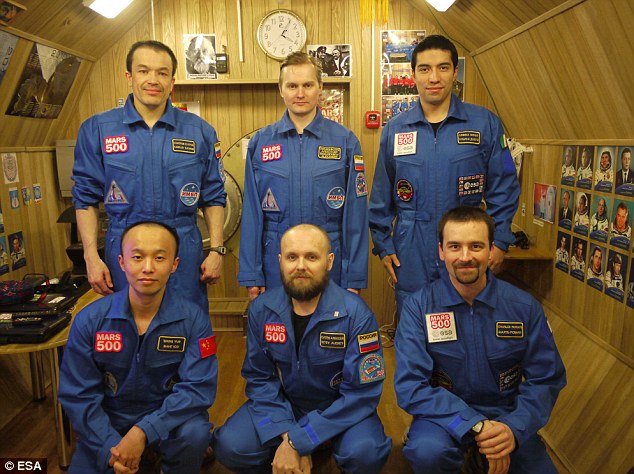
The six men were heavily monitored after their mission. Diego Urbina, who came from the facility, said, “On the Mars500 mission, we have accomplished on Earth the longest space voyage ever so that humankind can one day greet a new dawn on a distant but reachable planet.”
Most of the experiments they did while in isolation were repeated to compare their results. Diego and Romain Charles remained in Moscow for a month. Three months after the mission, they were subjected to other tests in Germany.
Diego later settled in Brussels and remained engaged within the space exploration community as an engineer. During the Covid-19 pandemic, he offered advice on isolation, reiterating the importance of establishing routines and maintaining a regular sleep rhythm.
Following the mission, Romain Charles spent six months at the ESA technical centre conducting post-mission medical and psychological tests. He also became a public voice on how to cope with extended periods of confinement during the pandemic.
The mission commander, Alexey Sitev, returned to the biomedical community. In Russia, following the post-mission tests, he kept a low profile but has been present in Russian space and biomedical research programs.
Also from Russia, Alexandr Smoleevskiy returned to biomedical research. Previously, he was studying human tolerance to adverse environments, so the mission provided valuable data for his laboratory’s physiological investigations.
Sukhrob Kamolov was the first crew member to go through the hatch on the day everyone exited. He also returned to Russian biomedical research. Like the other two Russians, he also kept a low profile after the experiment concluded.
Wang Yue had a more notable post-experiment experience. He went back to the Astronaut Centre in Beijing, where he was working as a trainer on adapting to various environments.
Though he felt out of place after the mission, leading to a problematic readjustment. Wang stated, “Inside the spaceship, I missed everything to do with the outside world, but as soon as the mission finished, I couldn’t help but try to escape from normal life.”