


In the winter of 1963–64, Linda Macdonald was introduced to her parents. She did not recognize them. The previous September, she had been discharged from Montreal’s Allan Memorial Institute, where she had spent months in the care of psychiatrist Donald Ewen Cameron.
Writing about the aftermath years later, Macdonald described the return of her five children. They, too, were unfamiliar. Her eldest could read and write; she could do neither. For five years, she recalled, she carried a dictionary as she struggled to understand words.
“I had no sense of responsibility because I didn’t know what a mother was,” she told The Province in 1991.
At twenty-five, Macdonald had entered the institute exhausted, overworked and sometimes depressed, according to her account. There she underwent repeated electroconvulsive treatments and prolonged drug-induced sleep.
Her family had entrusted her to McGill University’s professor of psychiatry and the founding director of its Allan Memorial Institute.
Born in Scotland and trained at Glasgow, Cameron had joined McGill in 1943. The Allan opened the following year in Ravenscrag, the former mansion of shipping magnate Sir Hugh Allan on Mount Royal. Cameron established research laboratories and psychiatric training; in 1952, he became president of the American Psychiatric Association.
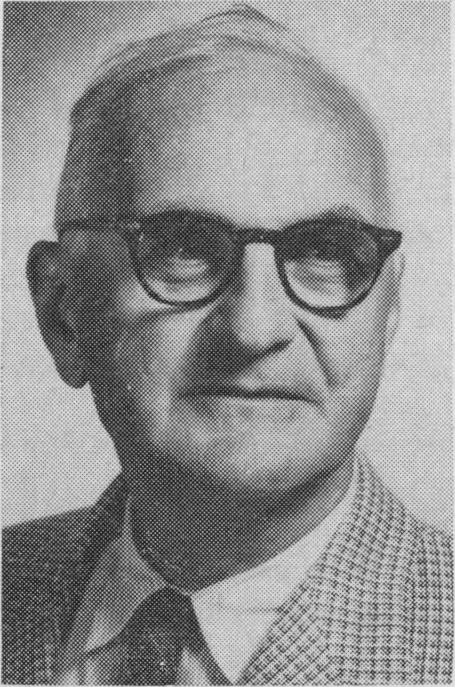
By 1953, he was studying how repeated verbal messages affected his patients. He called the method psychic driving. Patients heard recorded statements over and over. Repetition, he argued, could penetrate psychological defenses and keep prompting responses after a session ended.
He presented the work at the association’s 1955 meeting in Atlantic City. In January 1956, the American Journal of Psychiatry published his conclusions: “The responses tend ultimately to be therapeutic.” The report chiefly concerned repeated playback of patients’ own words; the value of its many variations, he acknowledged, remained uncertain.
Depatterning was a different procedure, using intensive electroconvulsive treatment with prolonged drug-induced sleep. It deliberately produced confusion and memory disturbance. Psychic driving could be used alongside depatterning, but repeated messages and induced disorientation served different purposes in Cameron’s research.
Val Orlikow had been referred to Cameron for depression following childbirth. In late 1956 and early 1957, she was receiving LSD. She later recalled a tray holding a syringe and a card bearing her name; she read the drug’s chemical name.
A friend who was a psychiatric nurse consulted a psychiatrist and warned her against taking it. Orlikow accepted the injection, trusting Cameron’s reputation. Recalling her treatment in a 1984 CBC interview, she described a distorted room and the sensation that her bones were melting. Asked to write down her thoughts, she could not concentrate.
She believed she had received LSD 14 times. Cameron, she recalled, responded to her objections by putting an arm on her shoulder and persuading her to continue. Although frightened whenever she saw him, she told the interviewer, “But I adored him.”
On one occasion she hid in her washroom as he approached, then refused: “I’m not taking any more injections.” After further discussion, she said, he left.
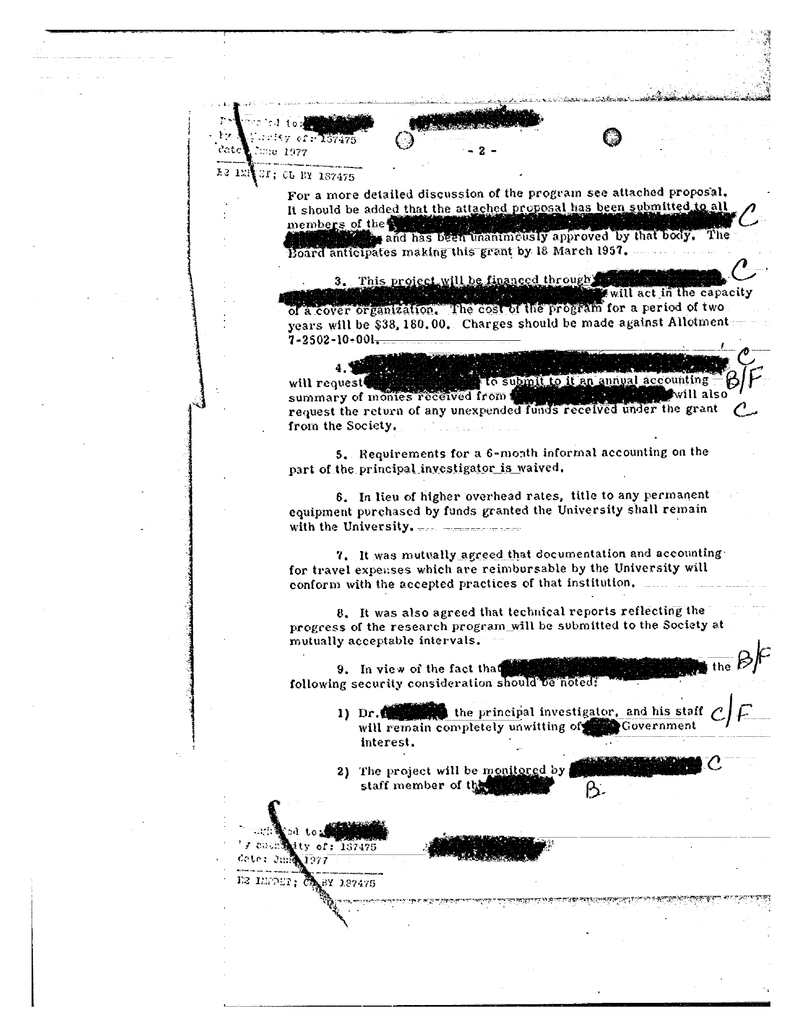
Orlikow’s treatment had begun before the CIA grant. Cameron’s published work had attracted John Gittinger, a CIA employee, who invited him to apply for funding from the Society for the Investigation of Human Ecology. The society channeled CIA money into research while concealing its source.
The agency had launched MKULTRA in 1953 to investigate ways of altering human behavior for covert operations. It sought to counter perceived Soviet and Chinese advances in interrogation and develop techniques for its own use. In March 1957, it approved Cameron’s grant as Subproject 68.
Cameron’s application described a procedure he claimed to have already developed: intensive electroshocks, followed by recorded messages for 16 hours a day over six or seven days. During the repetitions, patients would be held in partial sensory isolation. Seven to ten days of continuous sleep were to follow.
In his most successful case, he reported, behavioral changes had lasted two months. He wanted to investigate chemical methods that would cause less damage to perception and thinking than existing procedures. Among the experiments he proposed were studies using LSD.
An internal security memorandum specified that the investigator and his staff “will remain completely unwitting” of government interest. Agency personnel were to avoid direct contact except in extreme circumstances. The instructions establish an intention to conceal the sponsor; whether Cameron ever learned the source of the money remains uncertain.
At the Allan, Cameron and S. K. Pande argued that breaking up established patterns of pathological behavior would permit new ones to form. Recovery, they believed, required reorganization. The 26 patients in their 1958 account were aged 17–54 and diagnosed with paranoid schizophrenia.
Their regimen used chlorpromazine and three barbiturates to produce 20–22 hours of sleep daily. Patients were awakened three times for meals and toileting; nurses repositioned them every two hours. The prescribed electroshock schedule extended beyond discharge: weekly for the first month, then monthly for two years.
The CIA funded Cameron’s project from 1957 to 1960, but he continued the research afterward. A grant history later reproduced in court records lists Canadian federal support from 1961 to 1964 for research into personality change through repeated verbal messages.
Cameron measured depatterning through the patient’s loss of orientation in time and space. In the intensive phase described in their 1962 account, he and his colleagues prescribed two Page–Russell sessions daily, each delivering six electrical impulses in rapid succession. Some patients could forget their marital status or lose a second language.
In advanced forms, they wrote, “he may be unable to walk without support, to feed himself, and he may show double incontinence”—loss of bladder and bowel control. Yet these losses were uneven: an incontinent patient might retain an advanced vocabulary. The authors abandoned the idea of orderly regression to childhood.
Earlier in their work, the team had mistaken anxiety and restlessness during recovery for relapse, intensifying the shocks and returning patients to the deepest stage of depatterning. They later described these episodes as anxiety associated with recovery and changed their treatment.
Families were to be warned about a considerable gap in memory and asked to stay away during treatment, according to Cameron’s written instructions.
Macdonald arrived in March 1963. She wrote that Cameron told her husband she faced lifelong institutionalization without deep-sleep treatment. She found no signed consent form in her file. Her family could visit once that summer.
Two weeks before her September discharge, she was incontinent. She reported receiving no rehabilitation or counselling afterward and attempting suicide twice within two years.
Cameron retired from the Allan in 1964 and returned to Albany, taking research posts at its medical school and Veterans’ Administration hospital.
A. E. Schwartzman and P. E. Termansen identified 79 patients admitted between 1956 and 1963 who had reached the third stage of depatterning. In a follow-up published in April 1967, they reported obtaining current-status information for 47.
Of 27 who completed a questionnaire, 60 percent reported persistent memory gaps covering six months to ten years before treatment. Yet formal test results for 28 patients, compared with pretreatment scores, yielded little evidence of general intellectual or memory impairment attributable to intensive shock.
The investigators suggested that the methods might measure different aspects of memory; continuing distress over earlier memory loss was another possible explanation. Their comparison with another published study found no clear clinical advantage over other treatments. Physical complications and anxiety about memory difficulties, they concluded, argued against intensive electroshock as standard treatment.
On September 8, 1967, Cameron died at Lake Placid, New York. He was 65. His obituary in the British Medical Journal praised his organizing abilities and called him “a clinician till the end.”
Early in 1979, Val Orlikow’s husband, David, a Canadian member of Parliament, approached American lawyers. The couple had learned of the CIA connection through a New York Times story, according to their lawyers’ account. The agency’s surviving records were incomplete.
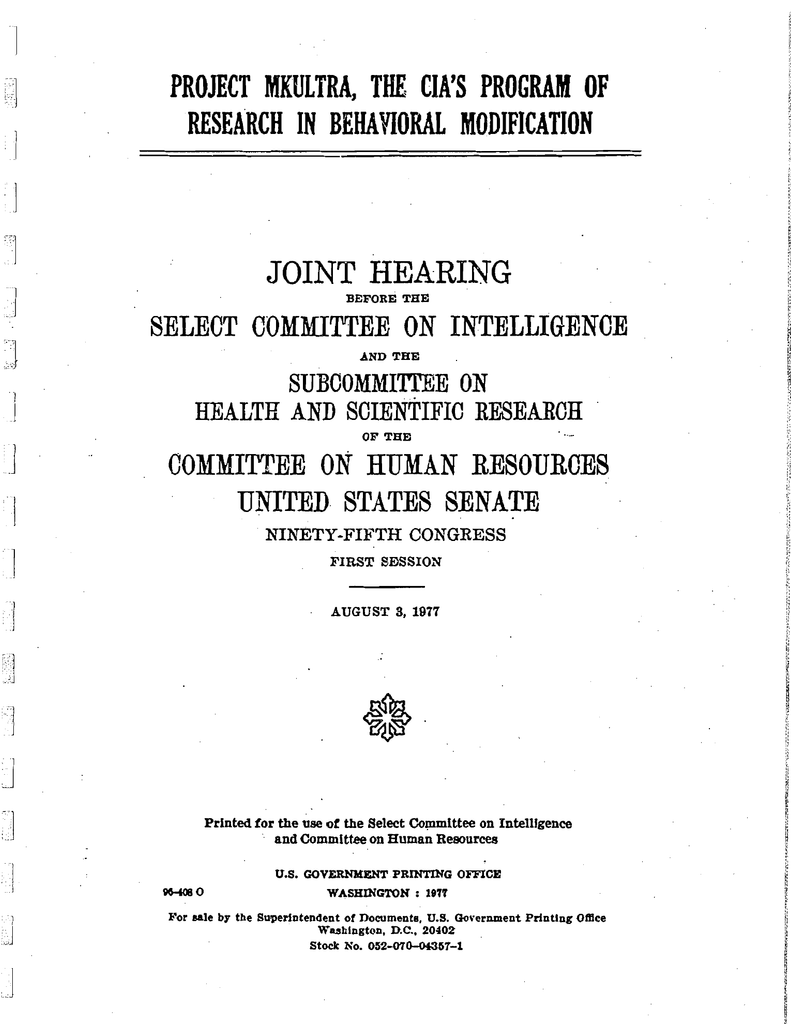
Six years earlier, in January 1973, CIA officials had destroyed MKULTRA files under orders authorized by director Richard Helms. Investigations made the program public in 1975. In 1977, an employee responding to Freedom of Information Act requests located seven boxes of records.
CIA director Stansfield Turner told senators that the largely financial papers had escaped destruction because they were filed separately among budget records. They included occasional research proposals but generally lacked progress reports.
Author John Marks opened his research files to the Orlikows’ lawyers; researcher Jay Peterzell helped develop the evidence. On December 11, 1980, the lawyers filed suit against the United States on behalf of Orlikow and other former patients, alleging negligence in CIA funding and supervision.
Until she learned of CIA funding and litigation in 1984, Macdonald wrote, she had believed Cameron had saved her.
Florence Langleben died before the American suit was resolved; her husband, Moe, took her place as a plaintiff in April 1986. The government maintained that Cameron’s methods fell within acceptable psychiatric practice.
In January 1988, the judge noted that various forms of treatment consent had been given, although the plaintiffs had not known of the alleged experimental nature of Cameron’s techniques. He allowed the remaining claims to proceed toward trial, dismissing Mary Morrow’s as filed too late.
When the parties reached a tentative US$750,000 settlement that October, Orlikow told United Press International she was pleased. “I would have liked to have a day in court,” she added. On October 11, the Justice Department approved the agreement, expressly denying that it constituted an admission of liability or guilt.
By 1991, Macdonald was working as director of a Canadian Mental Health Association clubhouse in White Rock and pursuing compensation from Ottawa. In November 1992, Canada announced payments of C$100,000 for eligible former patients, on compassionate and humanitarian grounds, while declining to admit legal responsibility.
“It took too long,” Macdonald told a reporter. Eligibility was limited. A later court judgment records that recipients had to be alive when paid and sign releases covering Canada and the Royal Victoria Hospital. Family members and some former patients whose treatment fell outside the program’s scope were excluded.
The assistance program closed in January 1994. In a 2005 parliamentary account, the government reported approving 77 of 332 applications and paying C$7.7 million.

A later Canadian class action encompassed claims from former patients and their families. The United States was shielded by state immunity; in May 2024, Canada’s Supreme Court declined to hear an appeal. On July 31, 2025, a Quebec judge authorized the action against the Royal Victoria Hospital, McGill University and the Canadian government, allowing it to proceed without establishing liability.
In a response dated January 30, 2026, the hospital stated that it intended to contest the claim. Among the questions the court had set for the case was whether patients had given informed consent to the experiments.
Welcoming the Canadian announcement in 1992, Macdonald had described the compensation as a symbolic apology. She also told the reporter that “no amount of money can compensate me for the loss of memory of the first 26 years of my life.”