

In the 1950s, women lived in a man’s world. And the sport of billiards wasn’t any different. In this male-dominated activity, women weren’t taken seriously… until Masako Katsura arrived on the scene! She changed the world of billiards forever.
An Earthquake in Tokyo!
Masako Katsura’s birthplace was Tokyo. When she was born in 1913, the city was modernising quickly. It was poised to become a cosmopolitan metropolis. Many Western leisure concepts were being imported, including sports.
The girl was born on this backdrop of a vibrant city, but the billiards champion in her really came to life 13 years later when her mother pushed her towards the sport.
“I was weak when I was young, and I was tired all the time,” Masako told The Sacramento Bee in 1952. “So my mother wanted me to play billiards to give me exercise and make me stronger.”
A 14-year-old Masako started working as an attendant in her brother-in-law’s billiard room, where she also spent more time practising the sport after hours. She owes much of her initial prowess to her time there.
“I practise before the parlour opens every day for two hours. Every day I practise, soon I will play with many men. Men want to beat me. I play men six to seven hours a day. Men no like, they do not beat me.”
Masako said in a Jimmy Cannon interview published in Robert Byrne’s Advanced Technique in Pool and Billiards book, “If I hit no good, my brother-in-law, after billiard parlour closed, say this shot no good. This shot bad, I make good.”
When the girl turned 15, the ground shook. The Great Kantō Earthquake devastated the city, and it seemed like Masako personified this unstoppable force… as she went on to win the Women’s Championship Straight-Rail Tournament of Japan.
_(cropped).jpg)
While the rest of the city was rebuilding itself from the disaster, she drowned herself in the sport and emerged a champion. After winning the tournament, she, along with a sister of hers, started touring Japan, China and Taiwan.
Billiards didn’t just begin as a casual hobby for Masako, though. Her two sisters also played the sport competitively. So it seems she grew up in the right environment for making it big in the sport.
Until 1937, Masako was a gifted player, but she was far from a serious world-level athlete. All that changed when she met Kinrey Matsuyama.
The Star Pupil Of A Legend
Kinrey Matsuyama is an old legend in the sport. A Time magazine article from 1952 dubbed him the Japanese Willie Hoppie – the legendary American billiards champion. When he spotted Masako, she was already well-known.
Matsuyama was impressed by her skills. He recognised that Masako wasn’t just a talented young player, but someone with serious discipline and instinct that could be polished for the world stage.
He started training her in three-cushion billiards, which is much more intricate than the basic straight-rail games Masako was used to. One needs to have patience, cue-ball control, positional calculation, and the ability to think several shots ahead.

In the 1930s, Matsuyama was training all of the big Japanese names in billiards. Masako is considered one of his star pupils. But the good old days of the child prodigy didn’t last long.
Dark clouds of World War II were already looming over the horizon. When the war began, Masako’s career came to a halt. All she did was perform one-woman shows for the Japanese Army to keep their spirits high.
Unfortunately, the Japanese were defeated. American troops occupied the country as the famed Tokyo Trial was going on. According to a Time Magazine article, Masako spent this time entertaining the American troops with trick shots.
Coincidentally, the same article includes a quote from the time when the US was learning about Masako. Three-cushion champion Welker Cochran asked Matsuyama about her.
He famously said, “Sometimes I beat her; sometimes she beats me.” This speaks volumes about how skilled Masako was. But her real claim to fame came when she reached the shores of the ‘free world’.
Making Waves In America
Masako’s path to the US began when she bumped into Air Force Master Sergeant Vernon Greenleaf, who was stationed in Japan. After two years of courting, they married. In late 1951, the sergeant was transferred home.
The ‘little Japanese war bride’, as Masako was once called by Kansas’ Salina Journal, accompanied her husband to the States. Cochran, who had already heard about Masako, was psyched about her arrival.
He told the San Francisco Examiner, “The game has needed a woman player with skill enough to compete against the greatest of men players. And I’m convinced now that it’s finally got just that.”
Soon after her arrival, Cochran became her manager/promoter. Masako would go on to compete in tournaments and exhibition matches. The Daily Calumet of 2nd May 1952 calls her Japan’s first lady of billiards – possibly her first time being called that.
Her competitors also had nothing but praise. Jay Bozeman said she was “one of the finest players I’ve faced in a world tournament.”
Willie Hoppe said, “In the East, they told me she was good, but I never expected to see anything like this. The girl is marvellous.”
During this time, she continued entertaining the US Air Force men. Here’s a video of her shot on Valentine’s Day, 1952, in Sacramento, California, demonstrating her skills in front of the officers.
A Woman In A Man’s World
The American billiards scene was taken aback by this little Japanese girl who was ‘cue-tall (5 ft.) and light as chalk (96 Ibs.)’, as described in the Times Magazine article Lady With A Cue.
Billiards in Japan was a unisex sport, but in America, it was entirely male-dominated. When Masako first came to the US, she was surprised as to why more women didn’t take up billiards.
It involved full-body movement, and it was the ideal sport for ladies. “I have only met one woman billiard player while I have been here,” she said once. She was, in a way, trailblazing the way for women in billiards.
In March 1952, she took a giant leap for womankind. She competed for a world title in the World Three-Cushion Championship held in San Francisco. In the tournament, she competed with legends of the sport.
She lost a close match to Irving Crane (A six-time World Straight-Pool Championship winner), defeated Herb Hart (A regional Three-Cushion champion) and beat Joe Procita. She also played the legendary Willie Hoppie.
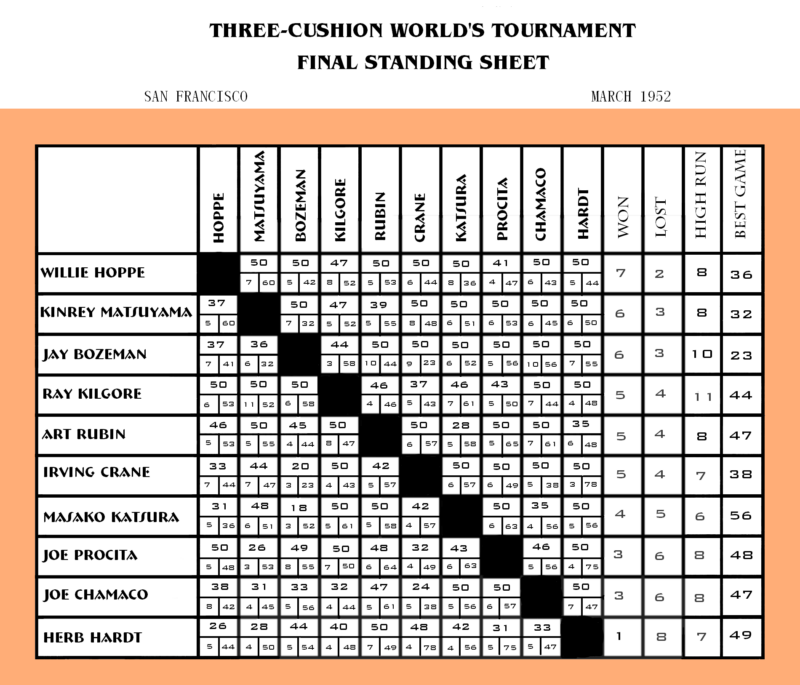
A huge crowd gathered to watch her play. Life magazine remarked, “San Franciscans who did not know a cue from a cucumber crowded in to see her”. Masako finished seventh, but in people’s eyes, she was a winner.
After the tournament, she did a US tour. Her only hope was that it would help women see that billiards wasn’t just for men. The tour started with an engagement at the Garden City Parlour in San Jose.
And then she planned stops at Kansas City, Chicago, Detroit, Cleveland, Buffalo, Boston, Philadelphia, Dallas, San Diego, Los Angeles, and Long Beach.
Her petite frame, in contrast to her ability to outplay male athletes, challenged gender norms and prompted the whole country to rethink its assumptions about what women could achieve.
In the next few World Title attempts, Masako drove this point home! In the world championships of 1953 and 1954, she ranked fifth and fourth, respectively. The latter was the best ranking of her entire career.
She came, she saw, and she proved a point. Billiards was no longer a man’s game. By the time she finished with her last world championship, she had become somewhat of a celebrity.
Fame, Fandom and Finishing Strong
In 1958 alone, she did 30 exhibitions. As per a KQED article, Cochran, her manager, said, “She will spend four hours practising, then play another four in her exhibitions and think nothing about it.”

Her aura was media-worthy. Danny McGoorty, a famous player, said, “Masako was cute! She was thirty-nine years old, but she looked twenty-nine. She hopped around that table on her high heels, giving the fans a little smile, and everybody loved her.”
The ‘first lady of billiards’ also appeared on popular TV shows such as CBS’s What’s My Line and ABC’s You Asked For It. It was clear she was a household name by then.
But in 1961, Masako got an opportunity to play for the world title. This was going to be one of her last appearances.
Harold Worst, the reigning champion since 1954, had challenged her to defend his title. This was common practice among senior athletes for staying relevant and in the public eye.
The prize money was $2000. The champion defeated Masako in six out of seven matches. His three-cushion score was 350 as opposed to her 276. But this wasn’t her last appearance.
In 1976, she was spotted at Palace Billiards in San Francisco. In Byrne’s Treasury of Trick Shots in Pool and Billiards, it’s mentioned that she borrowed a cue from someone and scored 100 points in straight rail with ease.
Byrne also mentioned that after this score, “[Masako] smiled and bowed to the applauding crowd, stepping away from the spotlight, and disappeared forever from the American billiard stage”
Bringing It Home: The Legacy
In June 1967, Masako’s husband died. Around two decades later, in 1990, she flew back to Japan to spend the rest of her days with her sister Noriko. The first lady of billiards died in 1995.
While she passed from this world quietly, her legacy still speaks loudly. Her contributions to women in sports and feminism were honoured on International Women’s Day 2021 with a Google Doodle.
Masako was later inducted into the Women’s Professional Billiards Association Hall of Fame. Her posthumous legacy was even honoured in Japan at the event titled Katsura Memorial: The First Ladies Three Cushion Grand Prix.
Masako Katsura didn’t only serve as a symbol of women’s prowess. She was also a technically super-skilled athlete with great global-level skill. This combination of attitude with aptitude paved the way for women in the sport.
But she wasn’t the trailblazer in a man’s field. One such woman was Sarah Winchester, who built an astonishing maze of a house that confounds the best architects to date. Find out why the mystery still remains unsolved.