

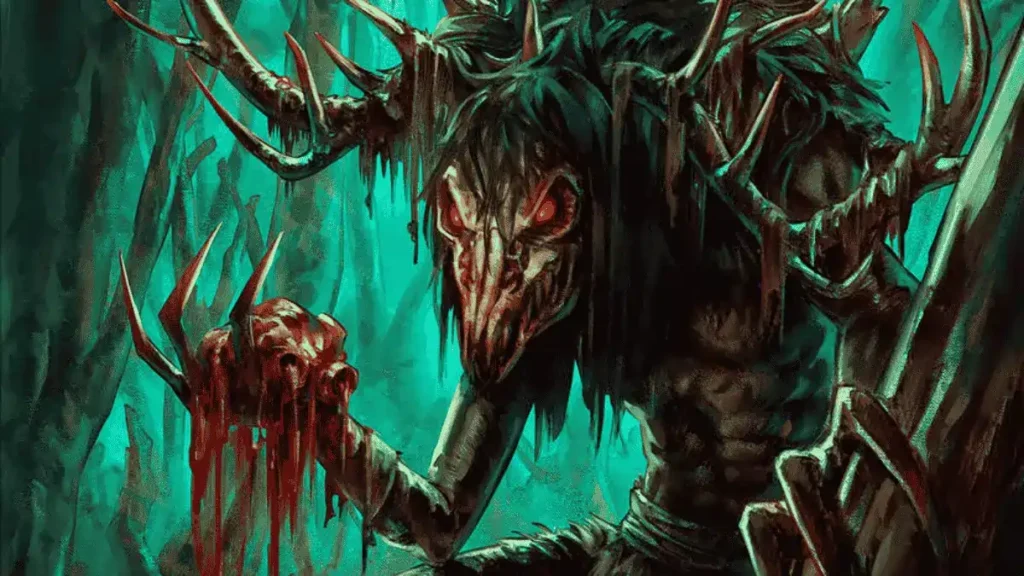
In the harsh, frozen forests of North America, a legend has been whispered for centuries. They say it has an undying hunger for human flesh. People are afraid to say its name aloud, but those who do call it Wendigo.
The Wendigo Origin Story
In the forests of North America, winters are long and dark. There’s very little daylight, up to 8 hours. And the temperature drops to frigid lows (around -30°C to -40°C at night). In such conditions, food becomes extremely scarce.

The legend is that during one such brutal winter famine, a man gave in to intense hunger. He feasted on human flesh. This immoral act transformed the man into a sinister entity – a monster with an insatiable hunger for humans.
That monster was a Wendigo. The myth comes from several Algonquian-speaking Indigenous peoples living in northern forests and cold regions of North America.
In these places, winter wasn’t just a season. It was a survival crisis. Long winters could mean scarce food and failed hunts. The threat of starvation was constant. This environment made cannibalism the ultimate taboo.
The Wendigo embodied that taboo. It personified the terrifying hunger that made people act inhumanely. The legend persisted through whispers. It was passed down orally from one generation to the next.
In the 17th century, the first written account appeared.
As per the Canadian Encyclopedia, Paul Le Jeune, a Jesuit missionary, was the first European to mention the Wendigo. During his stay with the Algonquin people, he sent his superiors a report stating:
“This devilish woman…added that [the wendigo] had eaten some Attikamegoukin – these are the tribes that live north of the River that is called Three Rivers – and that he would eat a great many more of them…”
This report predates the Salem witch trials by 60 years, showing how even 17th-century Europeans were plagued with fears of supernatural entities. Reports of the legend continued well into the 20th century.
Over the years, minor details of the legend changed, but the fear remained the same. And when stories changed hands, the spirit’s form also varied.
What Does a Wendigo Look Like?
Popular descriptions differ from tale to tale, and while there’s no single fixed Wendigo appearance, there are some common features across most stories.
- A giant, human-like figure.
- An emaciated body.
- Sunken eyes.
- Grey or decaying skin.
- Sharp teeth.
- A smell of death.
- A heart of ice.
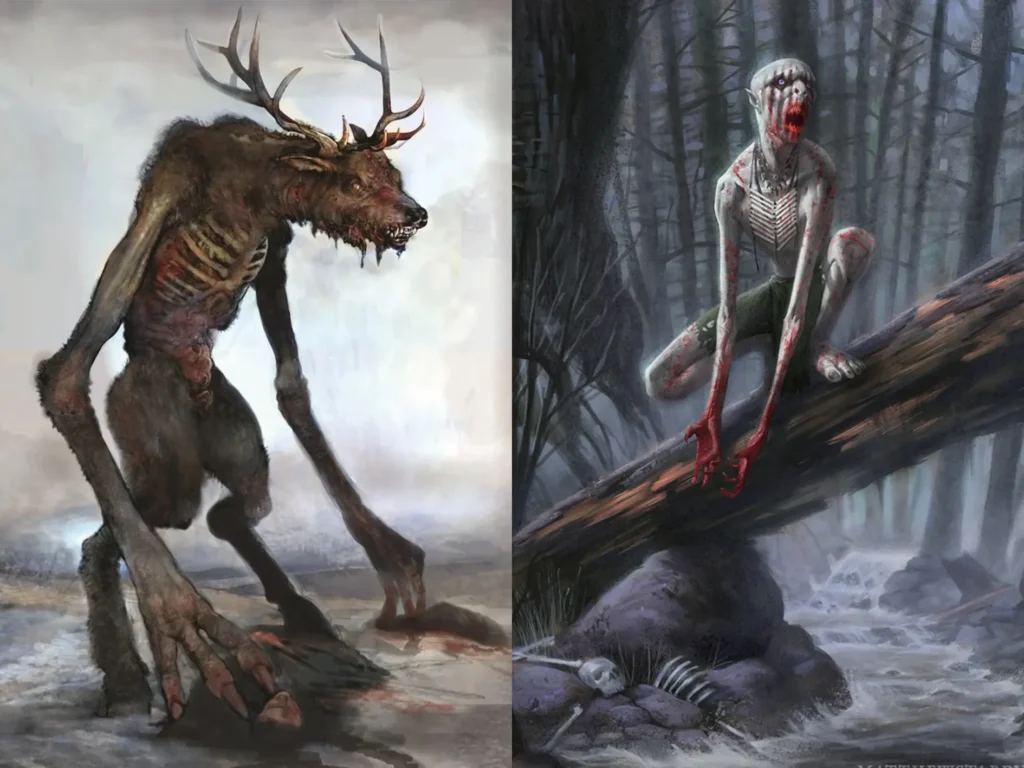
Throughout history, a wendigo has been described as a distorted, starving, human-like cannibal being. But pop culture has transformed the spirit into a deer-like forest demon. The popular deer skull, antlers/stag-headed monster image is mostly a modern horror invention.
And most wendigo concept art in circulation currently follows this version – a tall, skeletal creature with the skull of a deer or elk, often with large branching antlers.
The skull is usually stripped of flesh, exposing the bone underneath. Its eye sockets are hollow, and the mouth is lined with sharp teeth. This unnatural blend of human & animal traits makes it instantly terrifying.
Some traditions say that every time a Wendigo eats, it grows larger. With its size, its hunger also increases. This is one of the most frightening parts of the myth: consumption does not satisfy it. It only leads to more hunger.
The monster isn’t just rooted in old legends, though. There’s a long line of tales, sightings and historical reports mentioning the spirit. Some credible, some fantastical, but all of them equally terrifying.
Chilling Legends
One of the more vivid folk tales appears in George E. Laidlaw’s 1915 collection, Ojibwa Myths and Tales, which includes stories connected to the Rama First Nation area in Ontario.
In one story, a large Wendigo captured an indigenous boy. But it didn’t eat him immediately – the boy was too thin. Instead, the Wendigo kept him alive. It wanted the boy to get fat enough to eat.
The boy was forced to travel with the creature and gather food. One day, while searching for food, he reached a village. The boy warned the people there. “A wendigo is nearby”.
The people went back and cut off the Wendigo’s legs. When they came to check if the monster was dead, they found him alive, drinking the marrow juice from its own half-cut bones.
Then the Indians killed it – this time they cut it into multiple pieces… just to be safe.
Bezhigobinesikwe Elaine Fleming, an Ojibwe storyteller, also recounts a tale where a Wendigo terrorised villages during a harsh winter. The creature was enormous, thin, impossibly strong and driven by an insatiable appetite for human flesh.

People lived in constant fear as the monster hunted them in the forests.
First, the community tried stopping the spirit on its own. In some versions of the story, a brave man challenged the creature to a race, hoping to outsmart it. The plan failed, and the Wendigo continued to endanger people.
Then another Ojibwe man had a dream that he could defeat the spirit. The man eventually raced the Wendigo and then slew it. But the significance of the monster doesn’t end with its death.
These folk stories are much more than just a campfire story. They symbolise the dangers of uncontrolled hunger, greed, and moral collapse. In Algonquian traditions, the creature represents a person losing their humanity after committing cannibalism during hard times.
The tales were used as warnings – cautionary tales against hoarding resources and abandoning community responsibility. When survival depends on co-operation, that’s where morality is tested the most.
Like the cannibal spirit’s hunger, its presence in today’s world is undying.
Is the Wendigo real?
The internet is filled with sightings of the monster. And most of them describe the kind of appearance. This begs the question – Is the Wendigo more than just a myth?
Some Reddit users lean towards ‘yes’.
A 33-year-old woman posted about being inches away from the monster.
She was fast asleep in one of her friend’s campers when there was a voice outside her door asking, “Anybody in there? Hmmmm…” and the sound of CLAWS dragged down the side of the camper.
The woman knew none of her friends would ask that question – they knew she was sleeping in the camper. And at that exact time, the whole forest around her had gone strangely quiet.
Her dog, too, was shaking in fear. At first, she assumed it was a skin-walker, but then she remembered that mimicking your loved ones is what a Wendigo does.
Another user described the monster as an eight-foot-tall emaciated being with glowing eyes, bony limbs and sharp teeth. He was in a cabin near the Canadian border when the incident happened.
“Let me in,” the monster said, opening its mouth wider than any human being could. The user locked the door, grabbed a nearby rifle and waited until it left.
When his uncle returned from a supply run, the user told him everything. But there was one unsettling detail – there were no tracks in the snow. The uncle looked visibly shaken.
The user left the next morning, but before he did, his uncle told him something.
“If you ever hear it again,” he said, “don’t look. And whatever you do, never let it in.”
Most Wendigo sightings have happened in or near forests. But urban areas have had their share too. A teenager from East Washington saw this monster, too. As per his post, his girlfriend’s mom was driving him back when it happened.
Suddenly, a large figure darted in front of the car. The boy described the monster as a tall slender figure 8-10 feet tall, with very long slender arms and legs, with a hunched back and oblong head.
There are many more sightings littered all over paranormal websites, podcasts & more. Science brushes off these events as misidentification, hallucinations & cultural paranoia, but there’s an interesting psychological angle to the myth.
The Myth, The Monster & The Psychosis
Anthropologists & psychiatrists use the term ‘Wendigo Psychosis’ to describe cases where individuals believed they were turning into the monster. Most of these cases have been from Algonquian-speaking Indigenous communities.
One popular example is the Swift Runner (1879). A man from the Cree community called Swift Runner butchered and ate his wife & kids. When the police investigated his camp, they found skulls & bones strewn.

The man claimed the Wendigo spirit had possessed him to consume his family. But there’s another popular tale, which is the other side of the coin.
It involves Jack Fiddler, an Oji-Cree chief and medicine man known for his powers in defeating people who turn into Wendigos. He had killed 14 such people in his lifetime. But his spree ended in 1907.
Wahsakapeequay, the daughter-in-law of Jack’s brother Joseph, had been killed by the two brothers. She was believed to be turning into a Wendigo. When the police heard about this, the brothers were arrested.
The Oji-Cree community didn’t see it as a murder, though. It was a “communally sanctioned defensive act”. But the magistrate didn’t see it that way. “What the law forbids no pagan belief can justify,” the judge reportedly said.
This case depicts the stark contrast between indigenous beliefs and Western sensibilities. It’s also an example of how violently tribal beliefs were overwritten by Canadian colonial law.
The myth of the Wendigo revealed so many layers of society – the primal, the social & the psychological. It is, perhaps, due to this richness that writers and filmmakers have adapted this monster so widely in pop culture.
Reel-Life Monster
The earliest non-indigenous adaptation is Algernon Blackwood’s 1910 novella The Wendigo. It’s the West’s first introduction to the creature. Stephen King’s Pet Sematary (1983) is also where the myth crystallises into a monster haunting the land.
_front_cover,_first_edition.jpg)
But it isn’t only the books where the creature flourishes. Hollywood is filled with Wendigo movie appearances.
For example, the deer-like look debuted only recently in the movie Antlers (2021). This film strongly popularised the antlered, skeletal version of the monster. The Wendigo has many other series to its credit – Supernatural, Hannibal & many more.
Surprisingly, the monster has also appeared in video games. Until Dawn (2015) and Fallout 76, to name a few.
An Undying Legend
The Wendigo endures in folklore to this day. Is it because of the frightening aura of the monster? No. The monster lives on because of a deep-seated human fear.
It was never just a monster hidden in the forests. It’s a warning. A reminder of what happens when hunger, greed, or desperation push people to act in inhuman ways.
Pop culture has reshaped the Wendigo into a familiar horror – tall, skeletal, and often crowned with antlers. But does that change its origin? Somewhere beneath that Hollywood magic, the uncanny essence of the tale lives on.
The legend is about transformation. The claws or fangs don’t terrify as much as the loss of humanity does. This is why the story survives – because of the uncomfortable insight into human behaviour.
It’s unsettling to think that the line between human and monster might be thinner than we believe.
Centuries after the Wendigo, strange waves of collective fear keep appearing frequently. One strange incident is the bizarre outbreak of creepy clown sightings in 2016, where reports of sinister clowns appearing in woods and neighbourhoods spread across the United States.