
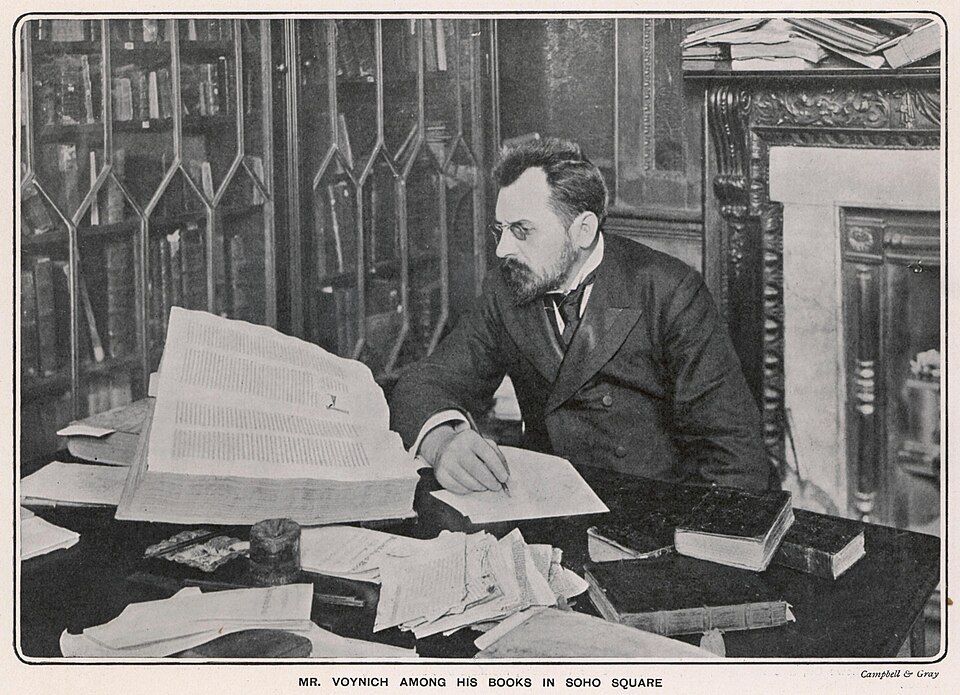
Polish antique book collector Wilfrid Voynich was convinced that he had hit the jackpot when he discovered a highly unusual manuscript in Italy in 1912. Written in a strange script and profusely illustrated with images of plants, the cosmos, the zodiac, nude female figures cavorting in bathing scenes, and other such fascinating depictions, it was truly an object of intrigue. Being an avid bibliophile and antiquarian, Voynich understood the importance of the manuscript. “The text has to be unravelled, and the history of the manuscript has to be traced,” he noted.
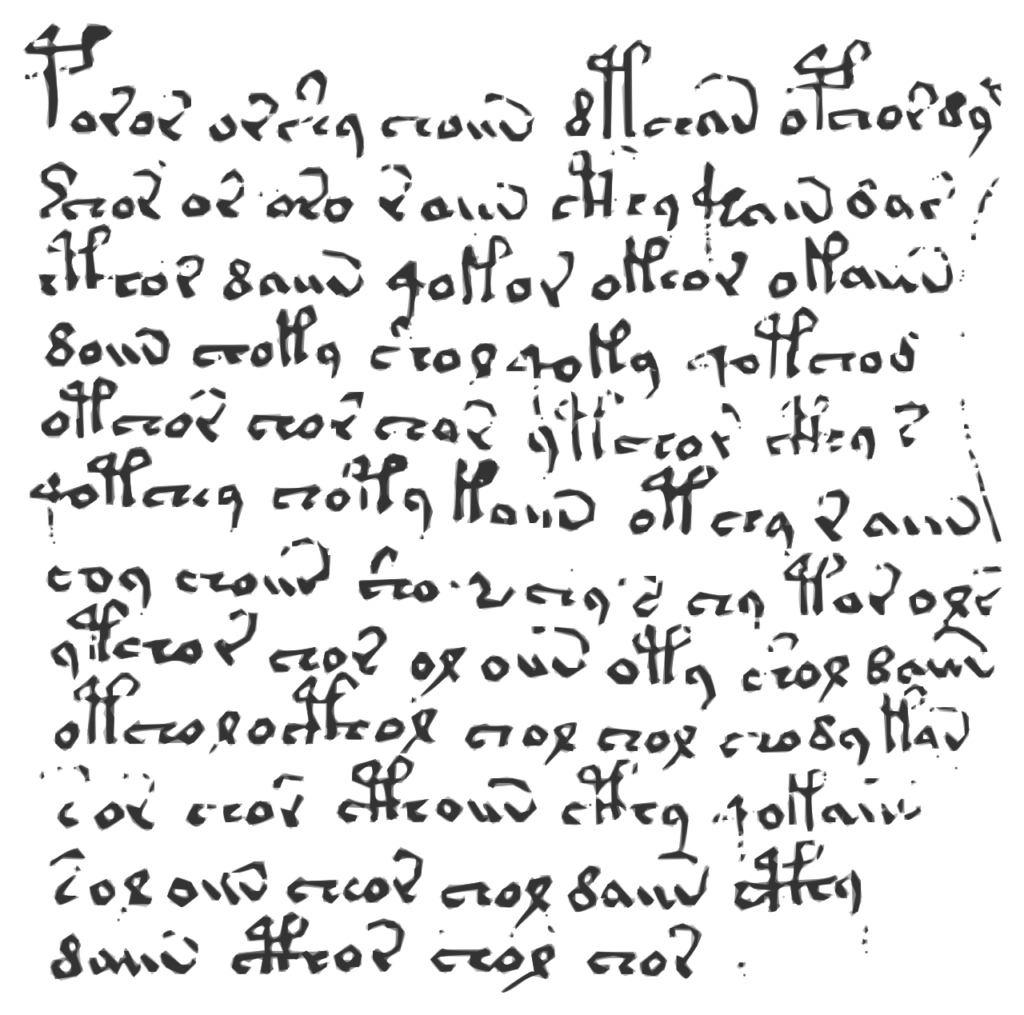
Named after the person who brought the manuscript’s intrigue to light, the Voynich manuscript is a codex written on vellum pages and measures 9¼ inches (23.5 cm) by 4½ inches (11.2 cm). The codex contains about 240 pages and has an empty cover without any indication of the title or author. The text consists of “words” written in an unknown “alphabet” and arranged in short paragraphs. Many researchers say the work seems to be a scientific treatise from the Middle Ages, possibly created in Italy.
At least the manuscript’s time frame was confirmed when the Voynich manuscript was carbon-dated to 1404-1438 in 2009. The contents of the book, however, are a complete and indecipherable mystery, baffling researchers for over a century, without any concrete conclusion.
How the Manuscript came to light in 1912
The modern history of the Voynich Manuscript begins in a Jesuit villa outside Rome, during a period when Catholic institutions in Italy were still dealing with the prolonged aftershock of 19th-century secularisation, confiscation of church property, and changing educational finances. The Jesuits were discreetly selling manuscripts to relieve financial strain at the Collegio Mondragone / Jesuit holdings in Rome.
Villa Mondragone, one such Jesuit college in Frascati, Italy, near Rome, had offered a part of their collection for sale, and Wilfrid Voynich (having earned a name for being able to spot neglected treasures by then), was exactly the sort of buyer they needed.
After escaping from a Russian penal colony in Siberia, he had made a career out of acquiring rare books and manuscripts from religious institutions and old libraries, many of which, in the shifting financial and political climate of post-unification Europe, were parting with pieces of their collections.
A book nobody could read
Voynich was not the sort of man to stumble upon an unreadable manuscript and simply shelve it as a passing curiosity. Almost immediately after his acquisition, he seems to have understood the enigma of the historical oddity in his hands. Its text was unlike any script he recognised, yet it did not look random.
What truly intensified Voynich’s excitement, however, was not merely the manuscript itself, but a letter found tucked inside it.
The letter, dated 1665 or 1666, was penned by the Prague physician and scholar Johannes Marcus Marci to the Jesuit polymath Athanasius Kircher, one of the most celebrated intellectuals in Europe at the time. Marci explained that he was sending the mysterious manuscript to Kircher, hoping that the Jesuit scholar, who had previously claimed success in deciphering Egyptian and Coptic texts, might succeed where others had failed.
More tantalisingly still, Marci added a remarkable rumour, that according to his late friend Raphael Mnishovsky (a renowned Bohemian cryptographer of the time), the manuscript had once belonged to Holy Roman Emperor Rudolf II, who had supposedly purchased it for 600 ducats, an enormous sum. Further, Marci noted, some believed the author might have been none other than the 13th-century English friar and polymath Roger Bacon.
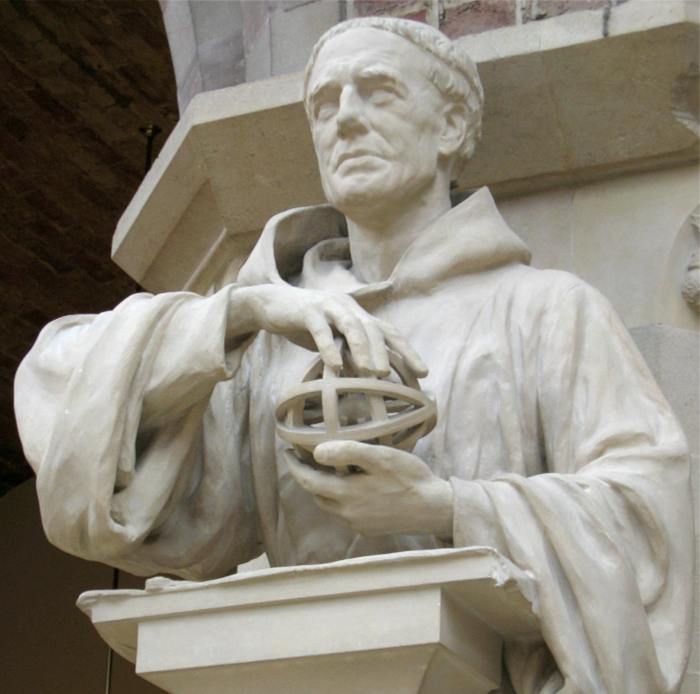
Voynich’s excitement knew no bounds.
His enthusiasm was not entirely irrational either. The manuscript did possess the outward features of a serious academic treatise. Its pages were organised into what appeared to be neatly classified thematic sections. To a dealer accustomed to medieval and early modern books (oxymoronic, yes), the text in the manuscript felt like an impermeable encryption.
In doing so, like many after him, Voynich made the same fateful assumption that simply because the manuscript looked meaningful, it must be.
What’s Actually in the Voynich Manuscript?
Before anyone could even hope to decipher the Voynich Manuscript, they first had to contend with a simpler, but more fundamental question: what exactly did it seem to contain?
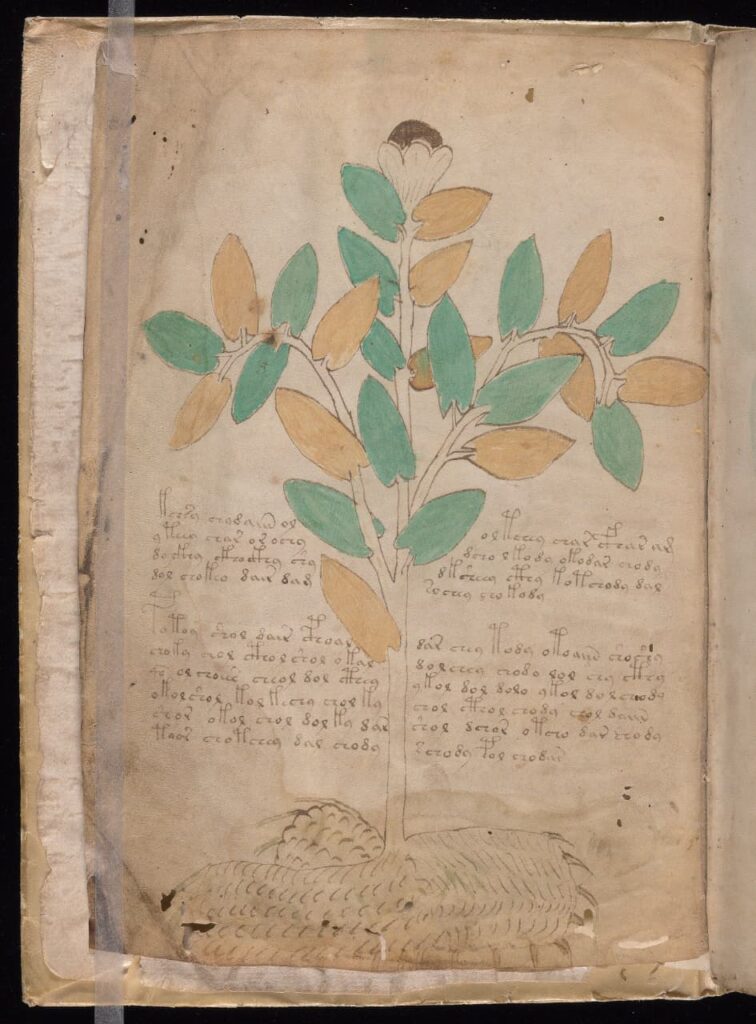
The codex, upon first glance, does not seem to be a simple amalgamation of pictorial depictions or symbols. The pages appear highly structured, and scholars have often divided the manuscript into several broad categories.
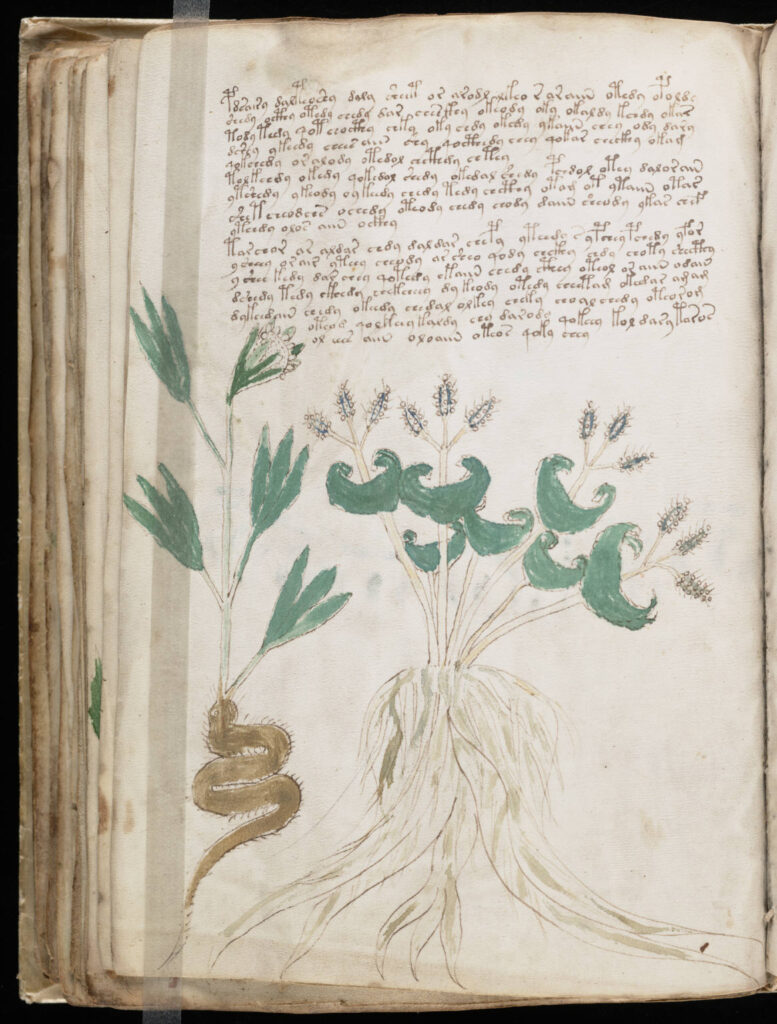
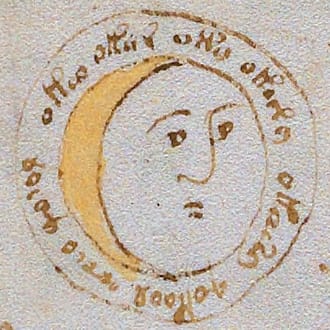
The first section contains a large botanical section filled with strange plants; then a portion containing astronomical and astrological diagrams; a series of enigmatic bathing scenes featuring nude female figures immersed in a green liquid or connected by tube like forms; a pharmaceutical section with jars, roots, and isolated plant fragments; and finally, pages of short text that resemble recipes, instructions, or catalogued entries.
The first Great ‘Solution’
The first among the great line of stalwarts who have tried to prove their mettle against the manuscript was William Romaine Newbold, a philosopher at the University of Pennsylvania.
In the 1920s, he claimed to have cracked the manuscript’s code, and, in doing so, seemed to vindicate Voynich’s fondest suspicion that the author was Roger Bacon.
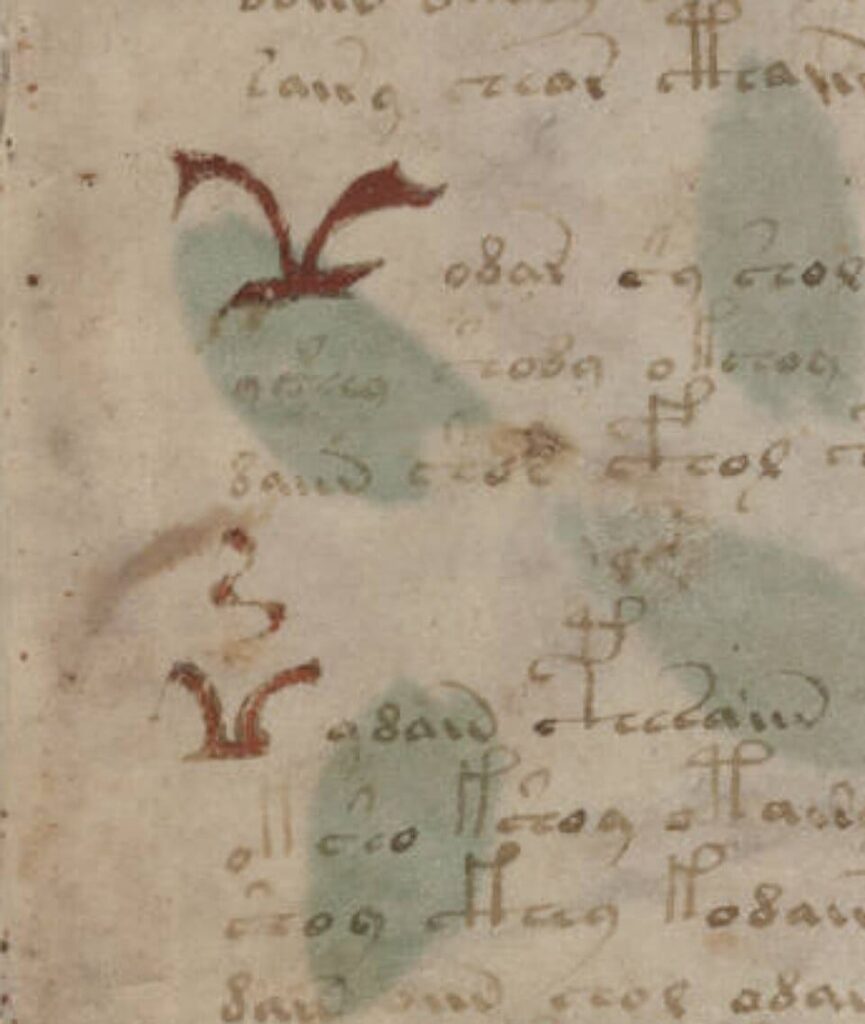
Newbold’s theory was, in a word, baroque. He argued that the textual writing on the page was not the actual message itself. Instead, he claimed that each character was made up of microscopic markings or “shorthand” symbols that were so small that they could only be seen under a microscope.
These markings were supposedly a second layer of writing based on Greek shorthand that could be rearranged to spell meaningful words in Latin. According to him, the text was not only encrypted, but encoded beneath the actual text itself (an arduous task, even by ingenious standards).
If this was hard to believe, what this microscopic cypher allegedly revealed would most certainly make a medievalist fall out of his chair.
Newbold claimed that the manuscript had indeed been written by Roger Bacon, who had purportedly observed certain concepts that seemed to be impossible for a 13th-century scientist.
One of the most sensational claims Newbold dared to make was that Bacon had observed the Andromeda Galaxy through a telescope (supposedly hundreds of years before it was even invented).
Apparently, he had further observed microscopic structures that would have required an optical instrument long before
modern microscopy. In short, his discovery aimed to portray Voynich’s manuscript as a breakthrough document that had supposedly proven that a medieval monk had somehow managed to advance hundreds of years into the future.
Voynich, naturally, was elated. Newbold’s work appeared to validate the Baconian theory he believed in. The document began to be treated as a coded scientific masterpiece from the Middle Ages, hidden in plain sight for centuries. Newbold’s findings were eventually published posthumously in 1928 as The Cypher of Roger Bacon, further validating the aura of scholarly legitimacy around his outlandish claims.
The Icarian Fall of Newbold
Criticism, which quickly demolished this theory, emerged quickly. John Matthews Manly, a distinguished scholar and cryptanalyst, initially treated Newbold’s work seriously but gradually concluded that the entire method was fatally flawed, and he then proceeded to prove it.
In a detailed 1931 demolition, termed “Roger Bacon and Voynich Manuscript”, Manley demonstrated that the “microscopic shorthand” that Newbold had claimed to have discovered was not hidden letters at all, but merely cracks in the ink, i.e. tiny fissures that naturally form as old ink dries and ages on vellum.
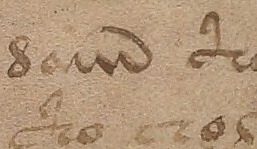
Worse still, even if one were to accept the premise of these microscopic symbols, Newbold’s method of decryption allowed far too much freedom. Individual marks could be interpreted in multiple ways, letters could be rearranged almost at will, and Latin words could be coaxed out of results, which one would otherwise be forced to claim as utter gibberish.
It was, as later critics noted, the kind of system that could “decode” almost anything into whatever one already wanted to find.
Further attempts after Newbold’s disastrous failure
Newbold’s collapse should’ve humbled the field, but it had an almost polarly opposite effect. It established a pattern of glittery, dramatic theories which would inevitably die under scrutiny, only for the next would-be conqueror to step forward with renewed confidence.
After Wilfrid Voynich died in 1930, the manuscript was passed to his widow, Ethel Voynich, the novelist best known for The Gadfly. Professional cryptanalysts started swarming in hordes to take a shot at drawing the metaphorical Excalibur.
The most important among them were William F. Friedman and Elizabeth Friedman, the husband-and-wife codebreaking duo who would later become legendary for their work in American cryptography. Introduced to the manuscript shortly after Newbold’s collapse, they toiled for decades at it, but with absolutely no success. It was almost a professional insult.
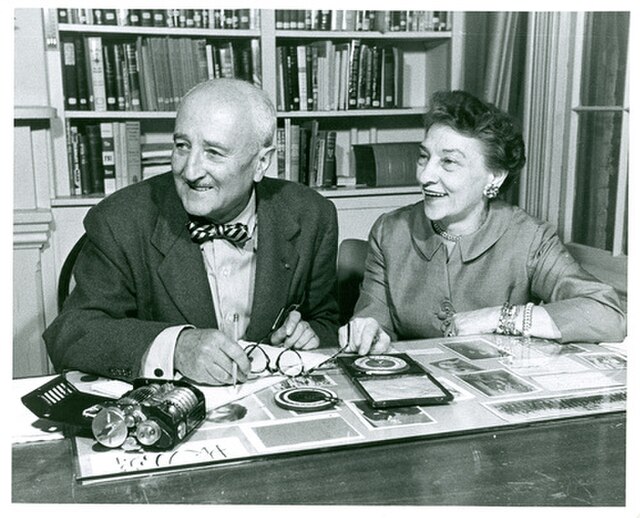
By 1944, the Friedmans had formed a formal Voynich Manuscript Study Group, enlisting the aid of fellow cryptanalysts and colleagues to study the text, but without success.
After Ethel Voynich’s death in 1960, the Voynich Manuscript came under the care of her close associate Anne Nill, who sold the Voynich to rare book dealer Hans P. Kraus in 1961 for $24,500. By 1969, unable to market the Voynich, Kraus donated it to the Beinecke Rare Book & Manuscript Library at Yale University. It remains there to this day as MS 408.
The Voynich Manuscript was digitally scanned by the Beinecke Library in 2020. It was posted online in its entirety, a significant step toward making the Voynich more accessible. This essentially handed one of the most notorious unsolved mysteries over to the entire internet.
In fact, one can access the document quite easily today.
Is the Voynich Manuscript Really That Strange?
Among a certain group of academicians, there is a respectable argument that much of its strangeness has been exaggerated by hindsight.
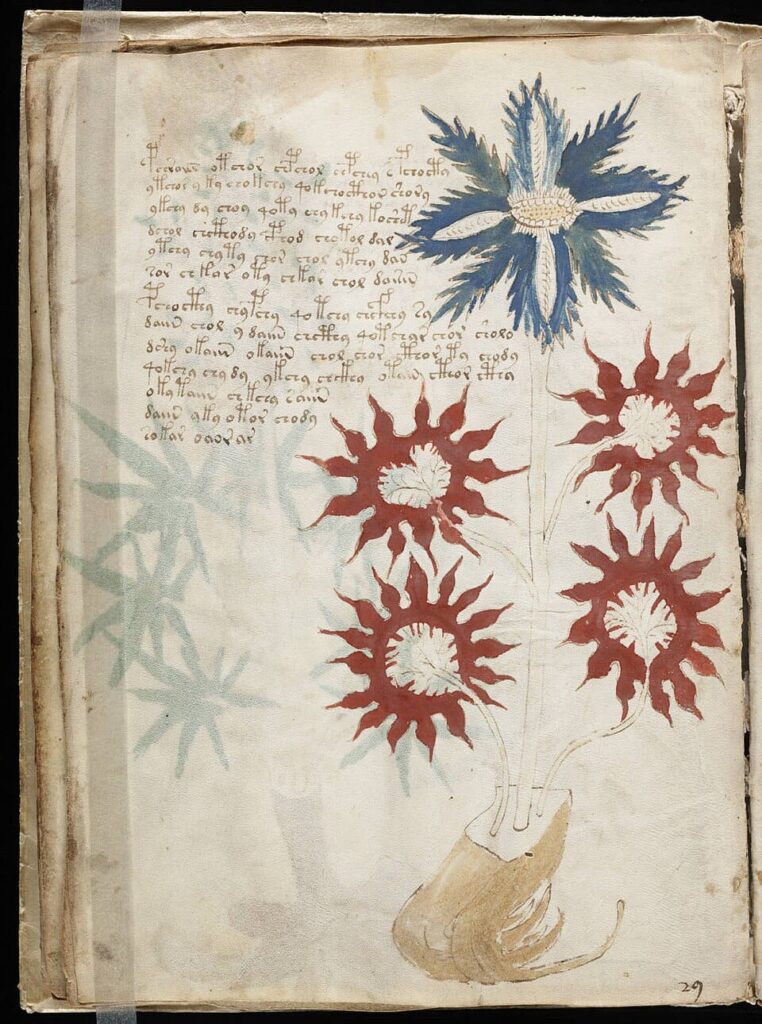
Many of the so-called “non-existent” plants, for instance, may not be impossible at all. Several researchers and commentators have noted that they resemble distorted botanical drawings similar to what one might expect from a medieval herbal manuscript copied and recopied by scribes of varying artistic competence.
A plant drawn from a pressed specimen can already look strange in a first-generation illustration; if it is redrawn over generations, it may soon start to look like something entirely alien.
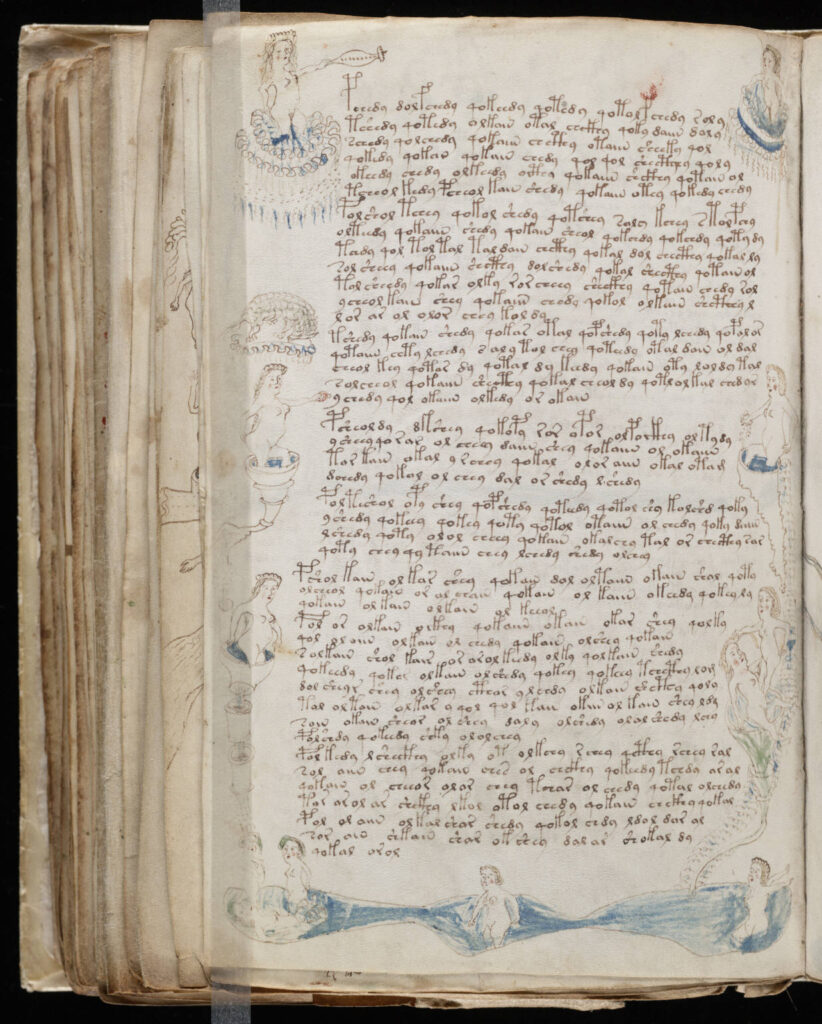
The same may be true of the manuscript’s famous bathing women. Though they are often presented in popular retellings as evidence of occult rituals, an alchemical fantasy, or some incomprehensible symbolic language, they may simply resemble cruder versions of a recognisable genre, drawn by incompetent hands.
Medieval and Middle Ages Europe produced a number of balneological texts (works concerned with baths, mineral springs, and therapeutic waters) that frequently depicted nude or semi-nude figures immersed in pools. Taking that into consideration, the Voynich women may not be so much bizarre as merely unfamiliar to the modern eye.
Some scholars and observers have further suggested that the manuscript’s illustrations were altered by a later hand, perhaps by someone attempting to “restore” the fading pigments with heavy applications of green and brown paint.
If proved to be true, it would go some way towards explaining why the colour of the water in the bathing areas seems so utterly implausible, and why some of the botanicals seem rather imprecise in terms of their original lineart.
The Hoax theory and Arguments Against it
The hoax theory suggests that the Voynich Manuscript may not actually encode a real language or a meaningful cypher at all, given the fact that many stalwarts of modern times have failed to solve it. Instead, it argues that the manuscript was created solely as a hoax.
The most famous version of this theory was proposed by the computer scientist Gordon Rugg in 2004. He suggested that a hoaxer could have created a manuscript that appeared to be the Voynich Manuscript, using a table of syllables and a perforated template similar to a Cardan grille.
Another scholar, Andreas Schinner, suggested that some of the statistical properties of the Voynich Manuscript could be consistent with sophisticated gibberish. Some even went as far as to say that it was a “madman’s ramble”, on social media platforms.
Arguments against this claim state that proponents fail to account for the high cost of creating or purchasing a book in the 15th century. It would be entirely cost-prohibitive for almost everyone. Further, only religious scholars, monks, certain successful merchants, and some of the aristocracy/higher gentry were literate.
It only stands to reason that this restrictive access might have buried contextual clues needed to solve the mystery.
Modern theories surrounding the Manuscript
Over the years, the Voynich Manuscript has attracted no shortage of ‘would-be’ solutions, but among them, three broad modern interpretations have gained the most relevance.
One of the most publicised among these is a 2019 paper by Gerard Cheshire stating that the manuscript was written in a lost “proto Romance” language and functioned as a kind of therapeutic reference manual, possibly compiled by Dominican nuns for Maria of Castile, Queen of Aragon. Cheshire claimed the text dealt with herbal remedies, therapeutic bathing, astrology, female health, reproduction, and child care.
Though the claims Cheshire had presented were grounded, they drew quick backlash from the linguistic and Voynich communities for the approach Cheshire had taken. Even the University of Bristol, from which the research had been published, distanced itself from the announcement as soon as the media storm had died down.
A second, more interpretive theory, holds that the manuscript may preserve a female-authored body of knowledge, perhaps produced by a woman (or women) of means in late medieval Italy, especially one concerned with medicine, bathing, fertility, and women’s health. This idea has appealed to some readers because the manuscript’s imagery repeatedly returns to female figures in bathing pools, zodiacal diagrams, and anatomical or therapeutic-looking motifs that may be connected to gynaecology, fertility, or reproductive care.
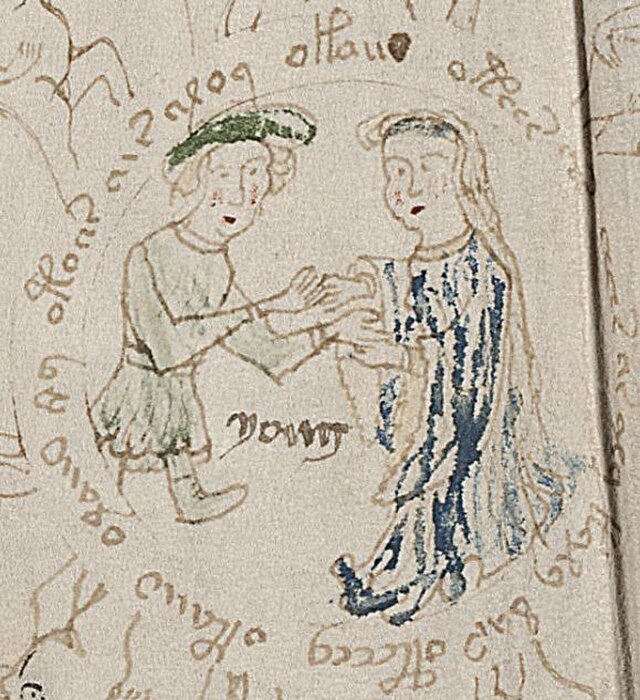
A third and closely related theory suggests that the Voynich Manuscript may not be a grand esoteric code at all, but a disappointingly ordinary practical medical or balneological handbook, perhaps used by a healer, midwife, or medically literate household, written in a specialised shorthand or perhaps even an ‘invented’ script that only they knew.
Finally, a minority theory suggests that Voynich himself fabricated the manuscript to create a lucrative mystery, but this rests entirely on the assumption that he would have had to stumble upon a large number of era-appropriate vellum sheets and ink from medieval times to do so. It is easily refuted by documentary evidence showing the manuscript existed long before Voynich ever handled it.
Words Don’t Come Easy
For now, however, the Voynich remains what it has always been. It’s not proof of lost civilisations, alien visitors, or impossible medieval technology, but simply a stubborn historical object that refuses to yield to endless attempts to decipher it.
Whether it is a cypher, a shorthand, a private script, or an elaborate joke played for a century too long, the manuscript’s greatest power lies in the fact that it still compels intelligent people to believe they might be the one to finally make it speak, and then proceeds to humble them with equal grace.