
The success of John Wick (2014) spurred a franchise of action-packed movies and spinoffs, culminating in a sprawling underworld cinematic universe spanning almost a decade. But during its production, the film was almost cancelled, until Eva Longoria swooped in at the last minute and saved it. Here’s how it went down.

A ‘killer’ concept
In 2013, Derek Kolstad was fresh in Hollywood, having sold only two scripts. One never got produced. The other, The Package, starring Dolph Lundgren & Stone Cold (Steve Austin), reportedly earned only $ 1,469. So when he wrote a script about a retired assassin seeking vengeance, its profitability was doubtful.
Originally, the script had one big difference. “The lead was a seventy-five-year-old man, twenty-five years after being retired. It was the fun of watching Clint Eastwood kick ass,” the franchise producer, Basil Iwanyk, confessed in a book. The older lead made the script a tricky sell in the initial days.
But Iwanyk believed the script was “subversive and really fun” and had a “very clear emotional through line and a great premise for an action movie.” When Kolstad started selling the script, it received 4-5 offers, including Iwanyk’s, the lowest-paying.
According to Kolstad’s agent, getting the movie produced was more important than getting the biggest paycheck. So he suggested Kolstad accept Iwanyk’s offer.
Enter Keanu Reeves
One fine day, Iwanyk’s office got a request. Jimmy Darmody, an agent at CAA, asked him, “Do you have any action movies for Keanu Reeves?” Iwanyk saw the opportunity & pitched the script to the actor. Reeves loved the script – it appealed to him.
“It has this emotional connection with John Wick, who’s grieving, who’s lost the love of his life and has this mythical dark past. And I loved the quest that he goes on to reclaim his life. And the world he moves through to do it,” Reeves said in the book.
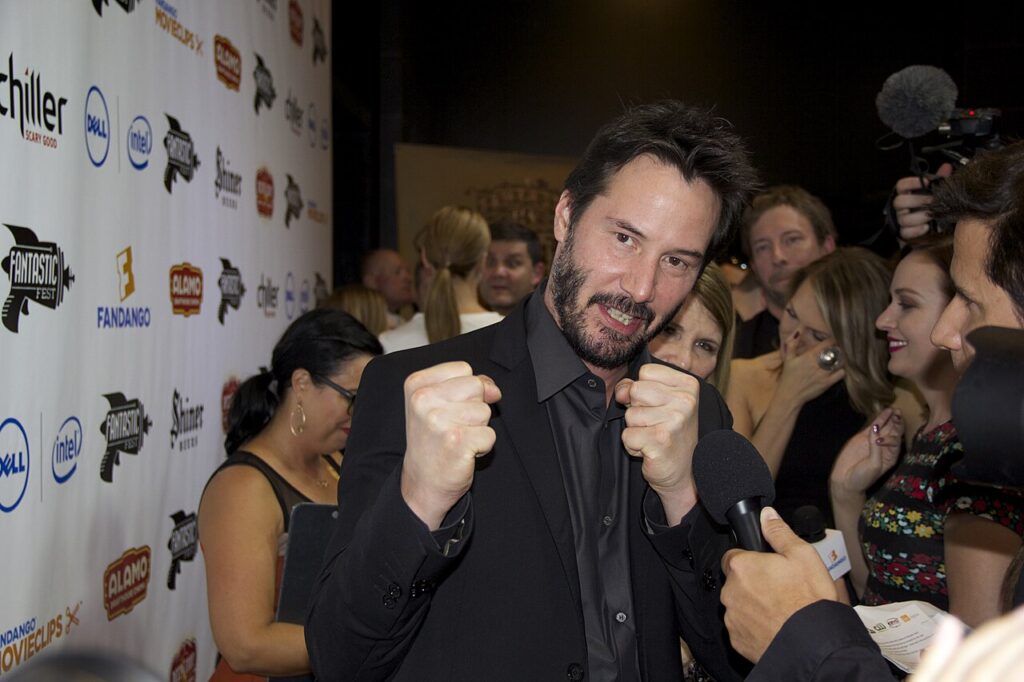
Considering Keanu Reeves’ age (and possibly his eternally youthful appearance), it was decided that the lead character would not be a 75-year-old man. After reading the script, the actor curtly declared, “Okay, Derek, I’m going to play him 35.”
Apart from making key character decisions, Reeves was also responsible for bringing on some key people to the crew – the directors.
A job for stuntmen
Chad Stahelski, the director, had worked with Reeves on the iconic stunts in The Matrix (1999). The actor felt Stahelski’s style matched the tone of the material. So the actor reached out to him & suggested he choreograph the action sequences or better yet, direct the action.
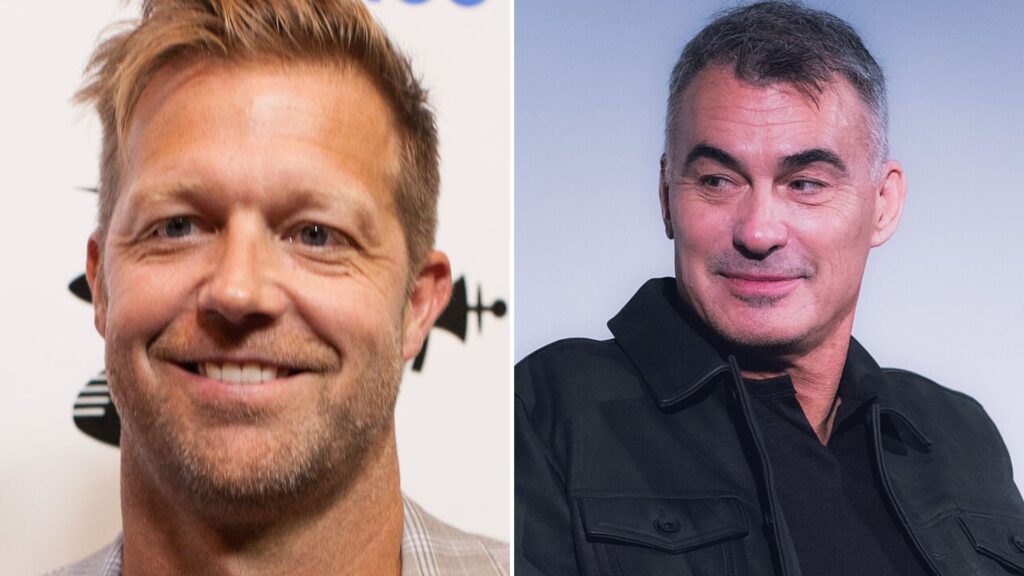
But Stahelski had something different in mind. He and David Leitch, his long-term professional partner, lobbied to co-direct the film and pitched their own stylised version of the movie. Unlike the grounded, Cold War vibe and the revenge-thriller treatment, they had a mythic approach in mind.
The core idea was John Wick descending into this mythic underworld, resembling the nine circles of hell in Dante’s Inferno. Stahelski & Leitch turned the movie’s feel into a graphic-novel-like myth, making John Wick less an assassin and more a feared urban legend.
In a report, John Wick described how he viewed the transformed character. “John thought he was stronger than he is, when really he’d been drawing that strength from his wife, Helen.”
“He thought he was in control, but the switch flips, and there’s no turning back. I always thought of it as being a kind of Old Testament revenge story. When someone takes the things he cherishes, violence erupts, and John can’t temper it.”
With this intense vision locked, the project began production. The rest of the ensemble was cast, and the shoot began. But there were some signs that things wouldn’t go smoothly. Just like John Wick’s victims, the movie was possibly doomed because of the dead dog.
The dead dog and the ill omen
While everything was green-lit, financiers & people from the production team didn’t feel good about the death of John Wick’s dog.
“We were told, ‘It’s bad luck.’ ‘It’s bad juju.’ ‘It’s Old Yeller, you can’t do this!’ ‘No one will want to see this on screen; you’re going to alienate the audience,'” co-director David Leitch told Business Insider.
“For the next couple of weeks, it was suggested that we shoot an alternative ending revealing that the puppy actually isn’t dead,” added co-director Chad Stahelski. But Keanu Reeves stood by the directors. Without the puppy’s death, John Wick would lose a strong, intense motivation for revenge.
To avoid repelling the audience while preserving the emotional intensity, the directors devised a solution. They decided to show the death off-camera, with a blood trail suggesting the puppy tried to crawl back to John Wick. Stahelski & Leitch’s creative instincts paid off.
The scene not only preserved but also heightened its emotional weight. But perhaps the bad omen had already taken effect. Right before principal photography, a major setback nearly killed the project.
When production almost died
The movie was being financed independently, not by big studios. As per Chad Stahelski’s interview on Business Insider, one of the investors failed to raise $6 million gap financing in time. This gap financing was crucial to obtaining the completion bond.
In practical terms, a completion bond is the mechanism that lets independent projects move from “we have commitments” to “we can actually make the movie”. Lenders will almost always require the bond before funds are released.
For an indie film, the gap financing is crucial because it covers the shortfall between a film’s budget & its secured funding. Losing this amount could have resulted in 4 possibilities, none of which would have been less than catastrophic for the project.
Possibility 1 – Production would have been delayed. Stahelski admitted in an article that they were less than 24 hours away from filming. The film would have needed to be rescheduled, restructured or worse yet, abandoned.
Possibility 2 – The film would have lost its bond, and the rest of the lenders & financing would have been lost. The team would have needed to seek out financing and approvals all over again.
Possibility 3 – If, by some miracle, the film had survived the delays & loss of funding, there would have been significant creative downgrades to the vision. John Wick would not have been the experience we know it to be.
Possibility 4 – A financing failure could have crushed vendor confidence & crew morale, assassinating the spirit of the project.
When all was lost, and John Wick was at risk of oblivion, a last-minute fund infusion saved the project.
Eva Longoria to the rescue
In her own words, Eva Longoria was no investment genius. A last-minute financing contact had reached out to her, “You got money, you should put your money here.” She confessed she had no idea how film financing worked, but she loved investing in people.
“I mean, [directors Chad Stahelski and David Leitch] did their work. They put in their 10,000 hours as stunt guys and second unit directors; they had seen all the bad movies and knew how to make a good one.” Longoria described the reason for her funding in an article.
“They were undeniably passionate, and I knew they were going to make an undeniable product.”
Her conviction about the team & people involved led her to finance the $6 million dollars in record time, single-handedly saving the film. It was a gamble, but one that paid off handsomely!
The gift that keeps on giving
Eva Longoria’s last-minute funding helped John Wick be released on time (2014). The film made over $86 million worldwide. Currently, more than a decade later, Longoria is still receiving checks from this investment.
Her return is reported to be $12 million & counting, a whopping 200% ROI, making her a happy investor with only one single regret – ‘not being attached to all of the films.’

A decade after the release, Keanu Reeves ran into Eva Longoria at an art event. “I’d love to take you to dinner; we should celebrate 10 years.” Reeves offered, as per her interview. They happily toasted to John Wick’s success.
The movie has spawned a $1 billion franchise, with many spinoffs – including the recently released Ballerina (2025), starring Ana De Armas – she plays a ballerina taking on an army of killers to avenge the death of her father.
The main storyline is also getting expansions, with John Wick Chapter 5 and an animated prequel in the works. A Caine spinoff has also been planned. Despite the possible death of John Wick in Chapter 4, it seems that he lives on, and the franchise has more in store for its fans!