

Blurb: A revolting stink, a river full of ungodly things and a looming health catastrophe. This is the story of the Great Stink of London, a crisis that reshaped English society forever.
The summer of 1858 in England was a long, hot and oddly stinky one. It was the era of hourglass corsets, afternoon high-teas, stark class inequality and a stench so strong that it caused anyone who smelled it to throw up in a jiffy.
“It was the best of times, it was the worst of times.”
The Great Stink of London, 1858, was a two-month-long period when the city’s primary waterway and lifeline, the River Thames, turned into a bubbling vat of filth and a breeding ground for disease.
What caused the Great Stink of London in 1858
The 19th century saw London’s urban population rise from under 1 million to a whopping 3 million, leading to more wastewater being discharged into the existing, outdated sewage systems.
This, combined with the introduction of flushing toilets, led to more water and effluents being discharged directly into the Thames. Discharge from factories, slaughterhouses and other industrial operations added further stressors on the already failing system.
The Metropolitan Sewers Act of 1848 allowed for sewage to be taken from homes in London and dumped into the waterway, under the presumption that it would all be washed out into the sea. The same waterway that was being used, nearly half a billion litres a day, for washing and even drinking.
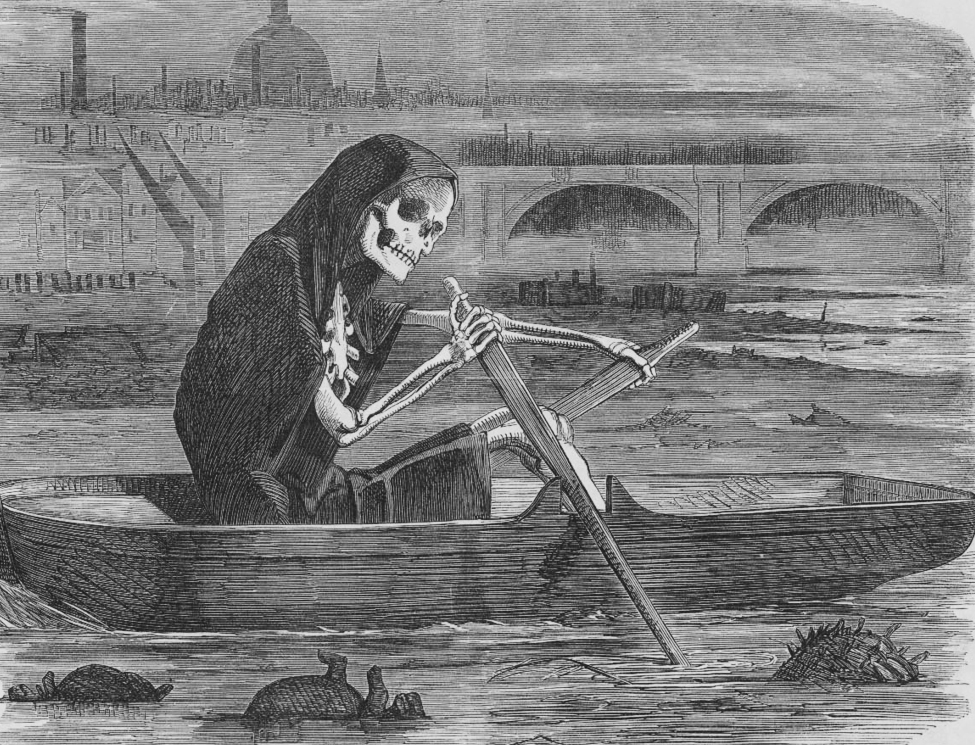
From carcasses of cows, dogs, cats, rats and horses to bodies of murder victims and executed pirates, the river had seen it all. Besides this, the river received waste from homes, businesses, hospitals, schools, prisons, tanneries, factories and slaughterhouses.
The aftermath of this toxic cesspool was unsurprisingly a massive public health crisis. Only half of London’s infants lived till the age of five. Diseases such as Cholera, Typhus, and Typhoid, among others, became widespread.
Charles Dickens, in his novel Little Dorrit, described the Thames as “a deadly sewer … in the place of a fine, fresh river”. He also described even a short whiff of the “most head-and-stomach-distending nature” in a letter to his friend.
When heat, sewage and the Thames created a perfect disaster
As the hot summers rolled in, a heat wave hit the city in June of 1858, and soon temperatures reached 30 degrees and stayed there for weeks. This, accompanied by a dry spell, made the Thames river stand still.
As the sun blazed on, untreated sewage was brought back to the surface and onto the riverbanks. The gut-wrenching smell was so overpowering that whoever came in its way started vomiting violently.
Some left the city to escape the revolting smell, while others stayed locked indoors or tried to get around town with scented handkerchiefs. In an attempt to block the stench, curtains and blinds were soaked in lime chloride, according to the London Museum.
Long before The Great Stink happened, Londoners were still grappling with the issue. Three years before the Stink, renowned scientist Michael Faraday wrote a letter to The Times of London to call attention to the situation. He described a small experiment he had conducted to test the river’s opacity.
On a sunny day, Faraday dropped bits of torn white paper cards into the river so they would sink below the surface. He did this at every interval along the bank. The results remained the same each time; the paper bits became invisible even before they had sunken below the surface.
Faraday observed that near the bridges, human waste rolled up in clouds so dense that they were visible at the surface. He noted that the smell was common to the whole river.
“The smell was very bad, and common to the whole of the water; it was the same as that which now comes up from the gully-holes in the streets; the whole river was, for the time, a real sewer,” declared Faraday.
The government responded by dousing the curtains of the Houses of Parliament with chloride of lime and by pouring chalk lime, chloride of lime, and carbolic acid directly into the river.
Even the monarchy couldn’t escape the Stink. While cruising across the river at Deptford, Queen Victoria was so overcome by the stench that she tried to mask the smell by stuffing a bouquet of flowers. She could only last a handful of minutes before ordering the boat to be turned around.

Doctors of the Victorian Era believed in the “miasma theory,” which implied diseases were caused by bad smells. So instead of tackling the source of the smell, the medical community focused on covering it up.
For the poor townsfolk of London, the Thames was the primary source of drinking water and livelihood. Attempts to cover up the smell by releasing lime chloride into the water stream had the opposite of the desired effect, as it essentially poisoned the river.
English writer and clergyman Sydney Smith humorously summed up the situation as “He who drinks a tumbler of London water has literally in his stomach more animated beings than there are men, women and children on the face of the globe,” according to an article by The Guardian.
Why Parliament acted only when the smell reached Westminster
By June, the crisis had reached fever point, the ripples of which could be felt in the House of Commons. As a matter of fact, the Parliament had just moved to the newly completed Palace of the West Minister.
The stench from the neighbouring Thames was so nauseating that it obstructed official administrative work. The smell got so bad that the lawmakers floated the idea of shifting to either Oxford, Edinburgh, or Dublin.
The British daily The Times reported that the intense heat drove lawmakers from the section of the building overlooking the river. Those inclined to investigate the matter ventured into the library, but were instantly driven away, with each man stifling their noses with a handkerchief.
This proved to be a catalyst for change. Spurred on by nausea, the Parliament passed a bill in only eighteen days to fund the construction of a brand-new sewer system that would undo centuries of damage to the Thames.
The Times noted mockingly that the MPs had not heeded earlier warnings by Faraday and only jumped into action due to their proximity to the smell, “proximity to the source of the stench concentrated their attention on its causes in a way that many years of argument and campaigning had failed to do,” the newspaper observed.
How Joseph Bazalgette’s sewers changed London forever
The Parliament enlisted the help of the English civil engineer Joseph Bazalgette to design and build a new sewer system. Spoiler alert: Bazalgette’s vision and genius basically saved the city.
The newly formed Metropolitan Board of Works, headed by Bazalgette, was tasked to raise the modern-day equivalent of $300 million for the construction and implementation of the ambitious sanitation system.
Bazalgette proposed a network of main sewers that ran parallel to the river rather than into it. Thus diverting rainwater and waste downstream, towards the east of the city, before being emptied into the river, from where it would flow easily out into the sea.

The network consisted of 1,300 miles of brick-lined sewers that fed into 82 miles of intercepting ones. The plan also included the construction of water treatment stations, pumping stations, embankments and the development of alternative sources of fresh water.
The Abbey Mills pumping station at Stratford, the Western pumping station at Pimlico, Deptford Pumping Station, Crossness Pumping Station, and the Southern Outfall Sewer collected sewage from low-lying areas and discharged it into the outfalls.

Some of these stations were architecturally magnificent and reminded one of ornate, imposing cathedrals. The striking structures stood as a testament to Bazalgette’s revolutionary undertaking.
The Victorian engineer also designed the city’s iconic Albert, Victoria, and Chelsea embankments, which housed the sewers in Central London. Drawing from his experience of land drainage and reclamation while working as a railway engineer, the embankments were designed to carry tunnels, including the underground railway network.

They also cleaned up the mud banks along the river’s edge, improved traffic flow on the roads, and freed up space for additional construction land. Largely considered to be Bazalgette’s most notable work, he himself considered the embankments tremendously hard work. “It was certainly a very troublesome job,” Bazalgette reflected.
The brilliance of Bazalgette’s scheme also hinged on his foresight in doubling the pipes’ diameter, according to the Institution of Civil Engineers. Bazalgette based his calculations on areas with high population density and then doubled his findings.
The infrastructure was designed to withstand a population boom of up to 50%, from 3 million to 4.5 million. “We’re only going to do this once, and there’s always the unforeseen,” noted Bazalgette. His timely intervention prevented the city’s sewers from overflowing in the 1960s and is still functional to this day.
In the end, London’s unlikely hero saved the city from drowning in its own waste.