


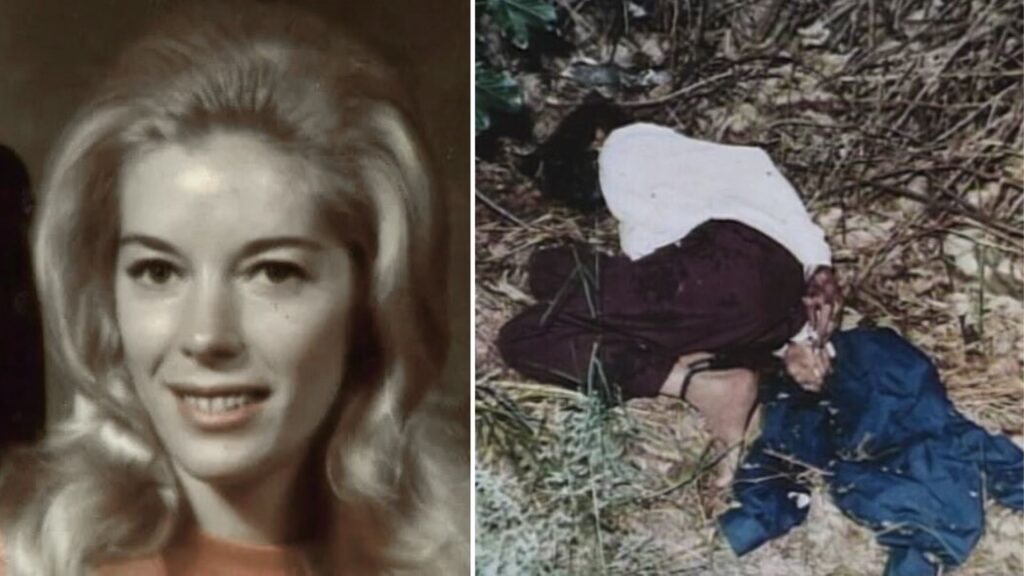
Two weeks after Cindy James disappeared, a municipal worker cutting through a quiet Richmond property walked past an old fuel tank and saw a line of orange spray paint running across the ground. At the end of it, in the weeds behind an abandoned house, he found a body tied up like a warning.
This second part of our investigation continues to rely on The Gazette’s 1989 serialization of Neal Hall’s The Deaths of Cindy James, along with public archives and inquest records. Direct witness quotations from that period are used as originally reported.
In the days after her car was found at Blundell Centre, Richmond RCMP moved quickly on paper and very slowly in certainty. Officers went door to door near the mall. A helicopter circled overhead, taking photographs of roofs, lots, and roads. A Coast Guard hovercraft worked the shoreline. Patrols swept the dikes and bridges in case Cindy had walked or been dumped there.
They checked the airport to rule out the possibility she had fled on a flight without telling anyone. Cab companies reported no relevant fares from the mall. Bus drivers who used the Blundell route did not remember a woman like Cindy that night. Inside Richmond, one of the most watched women in the city’s recent history seemed to have slipped out of frame without leaving a clean mark.
The death of Cindy James and the search that followed
Back at the detachment, Constable Jerry Anderson and an Ident officer examined the Chevrolet that Agnes and Tom Woodcock had refused to touch. Before disturbing anything they documented every surface. The heater sat on the defrost setting. The transmission was in park. Her hospital parking pass lay on the dashboard, exactly where a nurse coming off shift might drop it.
Inside the ashtray, they counted six Cameo cigarette butts, the brand Cindy smoked. Her Herb Alpert cassette was in the stereo, mid nostalgia. Groceries were neatly stacked on the passenger seat and floor. On the back seat, two Sears bags held a croquet set and wrapping paper for Adrian’s birthday. Receipts showed those had been bought around 12:30 p.m. the previous day.
Her purse contained a couple of coins and the usual clutter. Beneath it, on the front seat and floor, sat full brown bags from Safeway. Later checks against store records failed to find a matching transaction for that combination of items on May 25. The gap irritated investigators. Someone had bought those groceries. The paper trail refused to line up.
When they opened the glove compartment, they found maps, papers, and an old notepad scrawled with “KDV 784 Small, silver (gray).” It looked like a license plate and vehicle description. The note lay buried deep, apparently written long before. Records turned up no car that fit. Next to it sat a small hand held alarm unit, the “panic button” Kaban had given Cindy.
That device should have been with her. She had used it in October 1988, when police found her partially undressed, bound, and unconscious in her car with a nylon stocking at her throat. She usually carried it when stepping out of her vehicle at night. Seeing it abandoned in the glove box suggested that on the night she vanished Cindy James felt safe, or very tired, or very distracted.
Investigators removed the back seat and checked the trunk. Empty. No signs of a struggle inside the vehicle. Only that small smear of blood on the driver’s door and her bank card and deposit slip on the ground beneath, showing she had used the cash machine at 7:58 p.m. They pulled every record of customers who used the terminal within minutes of her.
One woman, Tracey McLean, remembered a blonde driver who nearly hit her car, then parked in the middle of the lot, away from other vehicles. Another, bank manager Barry Leroy, recalled a blonde walking diagonally across the lot in dark slacks and a jacket. Both thought the woman might have been Cindy, but neither could swear. Under hypnosis, Leroy only added the detail of a boot style shoe. Nothing that pointed to an abductor.
Around the same time, Cindy’s tenant Richard Johnston told Anderson that a man had phoned his office pretending to be Cindy’s father and asking about her life insurance policy. The secretary had started to share information, then stopped and insisted he come in person. When questioned, Cindy’s father denied making the call. It settled into the file as one more loose thread.
Then came the paint. On the fuel tank beside an abandoned house on Blundell Road, someone sprayed the words “Some bitch died here.” An orange line ran from the tank across the ground to a human shaped outline. This was before Cindy’s body was formally recovered there. To some, it looked like taunting graffiti. To others, like evidence that her death had been staged as a sick joke.
To understand why that message cut so deep, you have to remember the story her father had already taken to the media. Otto Hack stood in front of cameras after she went missing and recited, almost in a soldier’s cadence, the history of his daughter’s suffering. Stabbed and strangled in a garage in 1983. Bound and left unconscious. Terrorized with dead cats, anonymous calls, shredded notes. Attacked, he said, five times. Never one arrest.
Public sympathy flooded in. So did tips that led nowhere. Cindy’s case became a civic puzzle. Some residents saw a clear pattern of escalating violence against a woman who had asked for help and been met with skepticism. Others, including certain officers, quietly believed they were trapped inside a story she was scripting. The argument grew louder each week she remained missing.
Four days after Cindy vanished, Otto offered what he saw as a practical solution. As a former military man, he told Anderson he could rally up to 500 soldiers from the Canadian Armed Forces base at Chilliwack for a coordinated ground search of abandoned lots and buildings. His suggestion was declined. Police dog handlers, he was told, had searched those areas already. Too many boots would only trample what evidence might exist.
That decision returned like a ghost two weeks later. On June 8, 1989, paving worker Gordon Starchuck walked the narrow strip behind the Blundell Road house, near one of Richmond’s busy arteries. Among the undergrowth, barely twenty metres from a sidewalk used daily, he found Cindy James.
Her body lay on its side, partially hidden by brush. Her hands and feet were hogtied behind her back with coarse rope. A black nylon stocking encircled her neck. One leg stretched into the blackberry tangle. Her coat lay nearby. The orange graffiti on the fuel tank read as if someone had been waiting for this moment or wanting people to think they had.
The closeness to traffic raised its own questions. How had a body lain there for days without anyone noticing. Forensic entomology suggested she had been dead at the site since as early as June 2. That still meant multiple days in late spring without a reported smell strong enough to draw curiosity. Skeptics and believers would argue over that timeline for years.
At autopsy, pathologists documented a pinprick mark on the inside of her right elbow. Toxicology found massive amounts of morphine, diazepam, and flurazepam. The morphine level alone was ten times a lethal dose. Stomach contents showed she had swallowed large quantities of sedatives. The method of morphine administration could not be pinned down. If injected, she would have lost consciousness in minutes.
Here lay the central riddle. Cindy was bound in a way that looked elaborate and tight. During the later inquest, knot specialist Robert Chisnall would demonstrate that she could have tied herself in a similar configuration in about three minutes before collapsing. It was physically possible. Whether it was psychologically plausible remained another question, one the jury was asked to consider without definitive guidance.
Private investigator Ozzie Kaban flew back from a trip when he heard that her body had been found. At the morgue, studying her remains, he noticed lividity staining her left side. Because police photographs showed her discovered on her right, he took this as a sign that her body had rested elsewhere, in a different position, before being placed in the weeds.
He also wondered why there was so little obvious animal disturbance. Why the skin appeared parched in places in spite of shade. Why scent, flies, passersby had not exposed her earlier. None of these points proved murder. They did feed the conviction of those who already believed Cindy James had been killed elsewhere and arranged like a grotesque exhibit.
On June 12, which would have been her forty fifth birthday, her family gathered instead at the Richmond Funeral Home. Police installed a hidden camera to film everyone who arrived, capturing faces and license plates for possible suspects. One absence stood out. Her ex husband, Roy Makepeace, did not attend the service.
Pastor Ralph Mayan told mourners, “No one can imagine the pain and heartache James must have experienced in those years that culminated in her murder.” He spoke of hatred and violence in the world as if her story was its distilled example. Friend Wally Christensen called her life “snuffed out” without reason and warned that the “greatest horror” was that whoever did it walked free.
“To us she was love and beauty personified,” her father Otto said, the line echoing in print the next day. For the family, there was nothing ambiguous. Cindy James was murdered. Any other interpretation felt like an insult layered over grief.
Although RCMP publicly stated they were investigating a homicide, the working theory among several officers was drifting toward a different script. Off record, some suggested Cindy had orchestrated incident after incident and had possibly taken her own life in a way that matched the drama she had lived in. When that suspicion reached headlines, her family’s fury hardened.
Two Vancouver columnists captured the shock of that turn. Nicole Parton wrote of staring at Cindy’s photograph and wondering if the bruises came from another hand or her own. Patricia Graham wrote of disgust and anger that a woman could die because she was deemed too difficult to protect or believe. Their pieces reflected a city split between sympathy and suspicion.
In the spring of 1990, British Columbia convened a coroner’s inquest. Five jurors listened to more than eighty witnesses over forty working days. It was the longest and most expensive inquest the province had run. They watched video of her decomposed body at the scene. They heard the eerie answering machine messages Makepeace had received: “Cindy, dead meat soon,” and the talk of “more smack, more downers.”
Psychiatrists took the stand. Some believed Cindy James lived with hysteria or borderline personality disorder, rooted, they suggested, in a childhood of harsh discipline and possible abuse, though nothing in her testimony directly confirmed that. Others described her as intelligent, fearful, under siege from something they hesitated to label. Makepeace used his appearance to accuse her family and police, inflaming tensions in every direction.
Jurors were told about medications found at her home after her death, drugs quietly flushed by relatives who did not want her painted as unstable. They saw evidence that could support the theory that she had access to means. They listened as Chisnall showed how she might have bound herself. They weighed Kaban’s concerns about lividity and location against forensic conclusions on insect activity that supported the body lying where it was found.
Who killed Cindy James
They were, in the end, presented with three narratives. One said Cindy James was murdered by a persistent stalker who terrorized her for years, outwitted police, and staged her final scene. One said she constructed a sprawling false victimization story that ended in a complicated suicide. The third suggested that reality might be tangled enough to blur those edges.
On May 25, 1990, exactly one year after her disappearance, the inquest delivered its verdict. The jury could not agree on homicide, suicide, or accident. They concluded only that Cindy James died as a result of an “unknown event” following a multiple drug overdose. No one was charged. The file closed without closing the argument.
Her case stayed alive in the public imagination. Television programs profiled the story. Two books, including Neal Hall’s The Deaths of Cindy James and Ian Mulgrew’s Who Killed Cindy James?, mapped the evidence in competing tones. A later podcast revisited the contradictions. Each return to the case replays the same fragments, hoping they will line up differently.
More than three decades later, Cindy James exists where she spent most of her final years, caught between versions of herself. To some she remains a woman failed by institutions that hesitated to believe a victim of sustained violence. To others she stands as a study in how fragile identity and perception can be when fear and illness are involved.
What does not move is the image Agnes first saw in that parking lot. Groceries untouched in the front seat, a birthday gift waiting on the back seat, a nurse who promised to be home by dark. Whether she met a killer that night or surrendered to a terror that had consumed her, Cindy James walked into Canadian history carrying a story no one has been able to finish.
If Cindy James’s death stayed with you, read about Mary Stewart Cerruti, whose remains were found sealed inside the walls of her own house, and Joshua Maddux, discovered in a chimney years after he vanished. Both stories ended, yet their questions never really did.