
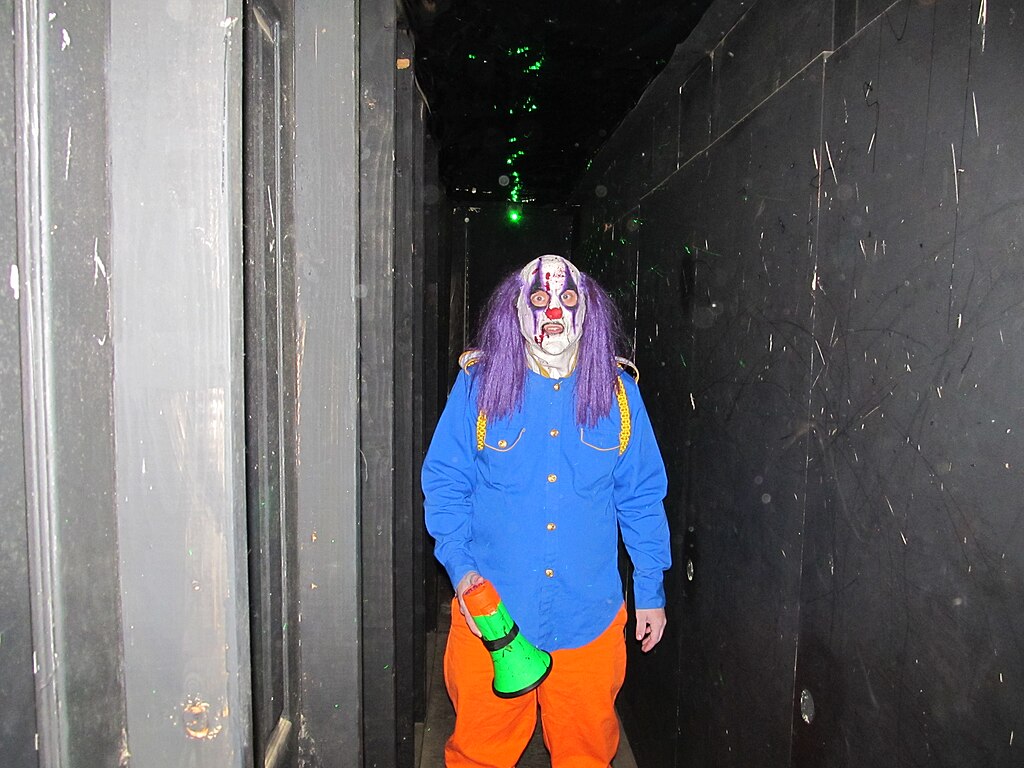
Imagine walking back home at night through a deadly quiet neighbourhood. Only the sound of your hurried breaths is audible. Suddenly, a strange-looking clown-shaped figure appears out of the edge of the deep, dark woods, making his way towards you. His face is plastered with chalky-white paint and a singular, menacing, wide smile frozen in place.
This is what the children of the Fleetwood Manor Apartment complex in Greenville, South Carolina, saw in late August of 2016. An alarming number of children reported being approached by a group of clowns hanging behind basketball courts who tried to lure them into the woods. That is where the clowns lived near a house by a pond, according to the terrified children.
First sightings in the U.S. and how the killer clown attacks in the 2016 panic began
Another group of children also reported a similar incident to the police, except the clowns tried to lure them into the woods with the promise of money. Following this, an officer went into the wooded area behind the apartment complex to investigate the killer clown attacks of 2016. Although he did find a small house at the end of a trail, there were no signs of clowns or clown paraphernalia at the house. Residents also heard chains and banging sounds coming from the woods.
Soon, residents began seeing clowns in their backyards, playgrounds, and other places. Gilberto Franco, the public information officer for the Greenville Police Department, said police, together with the sheriff’s office, scanned surveillance footage from across various complexes to see if anything pops up.
“It’s too early to confirm if this is just a hoax or if it’s someone with ill intent. This is a little strange because this has to do with clowns. But it’s just like any other suspicious person’s call. We take it seriously. We want to make sure everyone is safe, especially the kids,” observed Franco.
While investigators tried to ascertain if the sightings of killer clown attacks in 2016 were coming from children’s imagination or if something more sinister was afoot, things took a dark turn when panicked residents started taking the law into their own hands by firing shots in the direction of the wooded area.
One parent at the complex informed the authorities that her son had witnessed clowns in the woods whispering and making strange, inhuman noises, as per an incident report from the Greenville County Sheriff’s Office. Upon investigating, the mother saw several clowns in the woods flashing green laser lights, but fled away when approached. While another lady said she saw a “large-figured clown with a blinking nose” standing under a streetlight. Upon noticing her, the clown waved at her. She even waved back.
Sounding straight out of a Stephen King novel, sightings of creepy clowns lurking in the woods, on dark roads, in cars, and, in some instances, even brandishing knives soon ignited a nationwide panic. Before long, police across all six states were being bombarded with claims that creepy clowns were lurking in the shadows to frighten, steal and chase people down.
Sightings were reported in at least six other states: Alabama, Georgia, Maryland, New Jersey, North Carolina, and Pennsylvania. Even as authorities scrambled to verify the reports, they multiplied.
The unusual sightings resulted in at least twelve arrests across the country and one death, as per reports. In a tragic incident, high school sophomore Christian Torres was stabbed to death by a person in a clown mask in Pennsylvania. As per the Reading Eagle, things got heated after a person showed up in a clown mask. Police turned up on the scene to find a large crowd gathered on the street and the 16-year-old lying on the front porch of a home.
Creepy clown sightings in 2016 went global, reaching Australia, New Zealand, and the U.K.
The sightings soon spurred similar “copycat” acts in Australia, New Zealand, and the UK, prompting police to issue stern warnings.
Across the pond, the first named victim of the clown craze was 17-year-old student Megan Bell, who had a lifelong fear of clowns. Bell was chased down by a person dressed in a clown costume head-to-toe as she walked along Queensway in Newcastle. “I was walking home and saw a figure walking towards me; it was dark, so I didn’t think about it. When the person got closer, I noticed he was in a clown costume from head to toe and wearing a mask. Being terrified of clowns, I turned around and ran for what I thought was my life. I was screaming and shouting for help, but no one was around. I was chased for about 20-30 seconds,” said Bell.
Over the days that followed, the police recorded half a dozen similar clown incidents. A teenage clown was also arrested in possession of a “bladed article”.
Soon, creepy clowns started popping up everywhere in Wales, Manchester, Sheffield and Liverpool. Then almost everywhere.
In a similar incident that raised public concern, two individuals dressed as clowns approached two schoolgirls in broad daylight and asked whether they wished to attend a birthday party. The incident prompted Clacton County High School to ban students from leaving the school premises at lunchtime.
Chief Inspector Darren Deex of Essex Police said it seemed the individuals dressed as clowns only intended to scare the public, and to date, there had been no reports of physical threats or violence being caused.
“These incidents follow on from a ‘craze’ originating in the US whereby people dressed as clowns have been photographed or filmed carrying out various acts with the intention of scaring or causing fear,” said Deex.
“There has been huge public interest in these photographs and videos, particularly on social media networking sites, which more often than not do not represent accurate reporting. This inaccurate reporting is further fuelling the craze and creating a perception of fear in the community,” he further noted.
It’s unclear whether the killer-clown craze was a marketing campaign, a cruel prank, or a horror-movie publicity stunt. However, clown sightings were soon reported in several Australian cities on social media, including one disturbing incident in Brisbane in which a woman was chased by a clown wielding a knife.
In response, the Australian police issued strong warnings to individuals dressing as clowns, cautioning that such behaviour could amount to a criminal offence or put them at risk of harm from frightened citizens. “The clown purge appears to be a copycat of incidents being seen in the US. Any intimidating or threatening, as well as anti-social behaviours, will not be tolerated and will be investigated,” the police in the Australian state of Victoria said in a statement.
Following this, videos and pictures of clowns scaring residents in various cities in New Zealand also appeared on social networking sites. In the city of Hamilton in New Zealand, a 22-year-old woman was assaulted by two men dressed as clowns. “This was a very frightening experience for the young woman,” New Zealand police said in a statement.
Why clowns became the stuff of nightmares
In a tale as old as time, clowns have always terrified both children and adults. After Stephen King introduced the world to Pennywise, the nightmare-inducing clown of the horror novel turned movie “IT.” But what’s so scary about vibrantly-coloured wigs, ill-fitted clothes and exaggerated expressions?
Experts argue that the unease around clowns lies in their carefully constructed appearance and performative behaviour. Heavy makeup, oversized eyes, lips and exaggerated expressions obscure facial cues, masking genuine emotions, making them difficult to read. “A clown’s features are deliberately distorted, which makes them unfamiliar and unsettling,” says consultant clinical psychologist John McGovern. He adds that clowns are designed to surprise rather than reassure, relying on slapstick, unpredictability and exaggerated emotion; qualities that can easily shift from playful to disturbing.
Fear of clowns or Coulrophobia often develops at a young age. This is, in fact, a natural reaction. Clowns are often big and loud, with exaggerated face paint that can seem “weird, distorted and grotesque” to children.
Professor of psychology David G. Myers characterised the sightings as “mass hysteria” driven by a feedback loop in which people’s fear fed on one another.
However, associate professor Jason D. Seacat of Western New England University proposed another perspective on the clown hysteria: suggesting the sightings fulfilled a social need to feel part of a high-profile viral moment. “A need for people to feel connected to a news event that had garnered national headlines,” said Seacat.
With many sightings proven difficult to verify, Seacat noted that false reports involved little risk of being exposed, while offering the reward of attention, conditions that may have encouraged fake reports. “Since the event appears to be difficult to verify, the claim that one has had such an encounter is easier to make and relatively free from the risk of being called out as a fraud,” he observed. “So, low risk of being called out for lying and the benefit of positive attention for reporting such a claim may motivate some people to lie.”
“The fascination with clowns is really the fact that they’re not real,” says Scott Bonn, a criminologist and professor of sociology at Drew University in New Jersey. “We don’t know what’s beneath that makeup. It could be anyone or anything. They’re actually very frightening.”
Clown purges, arrests, and bans as the 2016 clown sightings map filled up
With the clown scare at its peak. Hundreds of Pennsylvania State University students set out on a mass clown hunt. At least 500 students swarmed the surrounding streets after rumours began swirling that a clown was at large near the campus. Videos on social media showed students running through the streets together, chanting, “We are Penn State!”
Shops in New Zealand withdrew clown costumes from their shelves. While in the United States, schools in California, New Jersey, and Ohio enforced a blanket ban on clown costumes and masks. US retailer Target pulled clown masks from its website and stores following the clown sightings. As authorities sought to curb public anxiety, theme park employees were also directed to remove any horror-themed costumes or makeup before leaving the premises.
In a strange twist to the already bizarre clown sightings, McDonald’s announced that its yellow jumpsuit-clad iconic mascot, Ronald McDonald, would be stepping back from public appearances. The American fast-food giant said it was being “thoughtful” about Ronald McDonald’s involvement in community events, citing the “current climate around clown sightings” following a wave of unsettling reports across the globe.
Author Stephen King, whose 1986 novel “It” tells of a Maine town terrorised by a supernatural clown, also weighed in on the situation. “Hey, guys, time to cool the clown hysteria, most of them are good, cheer up the kiddies, make people laugh,” he said in a post.
The issue even made its presence felt in the White House, where press secretary Josh Earnest, when asked about the president’s opinion on the clown chaos, said: “I don’t know that the president has been briefed on this particular situation. Obviously, this is a situation that law enforcement is taking quite seriously,” noted Earnest in an interview.
Impact on the clown community and the #ClownLivesMatter movement
The string of killer clown attacks in 2016 ultimately claimed an unusual victim: the professional clown community. World Clown Association president Randy Christensen said the trend of people dressing up as creepy clowns in public to terrify others was turning a “good, clean, wholesome art form and distorting it. “This is not clowning,” he said.
“I fear for my life,” rued Jordan Jones, who works part-time as Snuggles the Clown in a haunted house. The 22-year-old says he’s afraid of what he sees on the news, especially reports of clown hunting at Penn State.
“At the end of the day, people look at me like I’m a clown trying to hurt them,” he says. “I feel that people are out clown hunting because they think it’s cool now. I’m scared that someone might take a swing.” Although well-known in his neighbourhood as Snuggles the Clown, Jones is concerned about backlash from people outside his community. “I really think people mistake me when I put my stuff on,” Jones says. “They forget that it’s a person under that mask.”
Jones, who’s spread joy as a professional clown for more than a decade, launched the ‘Clown Lives Matter’ movement on his Facebook page in an effort to spotlight the growing backlash faced by working clowns. Speaking about the impact, he described the situation as deeply personal. “I’ve invested years of my life into this,” he said. “It’s stopped being a joke.”
He criticised teenagers for treating the incident as entertainment, calling it “cruel” and “disturbing,” and pushed back against the public perception of clowns as threats. “We’re not the people hiding in the woods,” he added. “I’m not the enemy.”